
The injection moulding industry has evolved significantly over the past decade, driven by increasing demands for precision, efficiency, and cost-effective manufacturing. As industries such as automotive, medical devices, consumer electronics, and packaging continue to require high-quality plastic components, manufacturers face growing pressure to maintain consistent quality while maximizing production output. Even small variations in temperature, pressure, cooling time, or material flow can affect product quality and lead to costly defects, waste, and production delays.
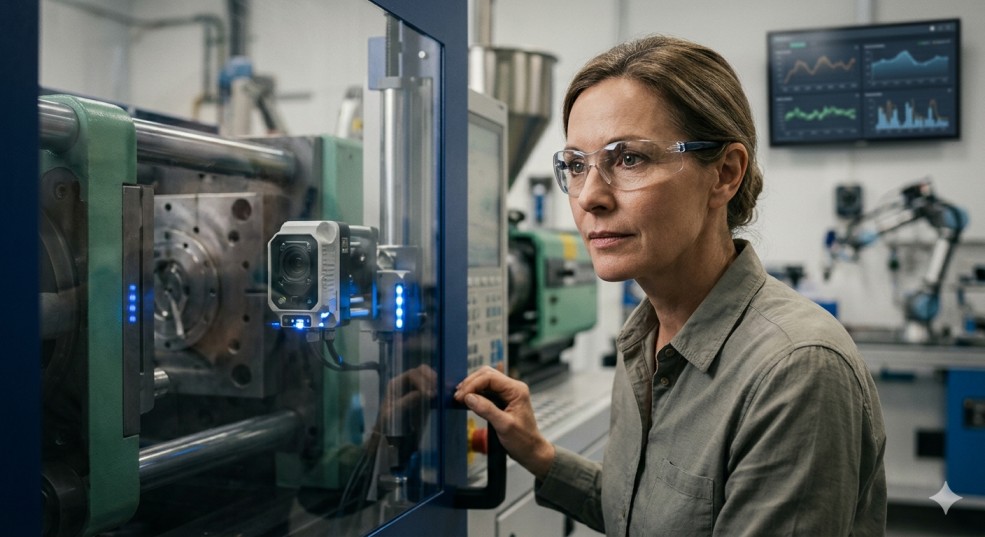
To address these challenges, manufacturers are increasingly adopting intelligent technologies that can analyze production data, optimize machine performance, and improve decision-making in real time. Advanced solutions such as a vision mould protection system play a crucial role in preventing mould damage, detecting foreign objects, and ensuring proper part ejection before the mould closes.
How AI Improves Quality Control in Injection Moulding
Maintaining consistent quality remains one of the most challenging aspects of injection moulding. A slight fluctuation in process parameters can lead to defects such as flash, sink marks, short shots, warpage, or dimensional inaccuracies. Traditional quality control methods often rely on periodic inspections and operator expertise, which can sometimes detect issues only after defective parts have already been produced. This reactive approach increases material waste and production costs.
Modern data-driven systems improve quality by continuously monitoring critical production variables throughout every cycle. Sensors collect information related to injection pressure, melt temperature, cooling time, clamp force, and material behavior. Advanced analytical tools then evaluate this data and compare it with predefined quality standards. When unusual patterns emerge, operators receive immediate alerts, allowing them to make adjustments before defects occur.
Real-Time Monitoring and Automated Inspection
One of the most significant advancements in injection moulding quality control is the ability to inspect products in real time. Vision systems equipped with intelligent image-processing capabilities can examine every component leaving the production line. These systems identify surface defects, dimensional deviations, and cosmetic imperfections far more consistently than manual inspections.
For example, an automotive supplier producing dashboard components may manufacture thousands of parts daily. A manual inspection process could miss subtle defects during high-volume production. Automated inspection systems analyze every part with the same level of accuracy, ensuring that only components meeting quality requirements proceed to assembly. This approach not only improves customer satisfaction but also reduces warranty claims and costly recalls.
In addition, real-time monitoring helps manufacturers optimize process parameters continuously. Instead of relying on fixed machine settings, production systems can adapt to changing conditions, resulting in more stable operations and higher-quality output.
Benefits, Applications, and Productivity Improvements
Improving quality is only part of the equation. Manufacturers must also increase productivity to remain competitive in today’s fast-moving market. Higher productivity means producing more components within the same timeframe while maintaining quality standards and controlling costs.
One of the most valuable advantages of intelligent manufacturing systems is predictive maintenance. Traditionally, maintenance schedules were based on fixed intervals or performed after equipment failures occurred. Both approaches have limitations. Scheduled maintenance may replace components that still have useful life remaining, while reactive maintenance often results in costly downtime.
By analyzing machine performance data, predictive maintenance systems identify early warning signs of wear and potential failures. Maintenance teams can then vertical plastic injection molding machines address issues before they disrupt production. As a result, manufacturers experience fewer unexpected breakdowns, better equipment reliability, and improved production efficiency.
Practical Examples and Best Practices
Manufacturers across multiple industries already benefit from these technologies. In the medical device sector, precision is critical because even minor defects can compromise product performance. Real-time monitoring ensures that moulded components consistently meet strict regulatory and quality requirements. In consumer electronics manufacturing, companies use intelligent process optimization to maintain dimensional accuracy for intricate plastic parts used in smartphones, laptops, and wearable devices.
Several best practices help manufacturers maximize results:
- Monitor critical process parameters continuously.
- Use automated inspection systems for consistent quality control.
- Implement predictive maintenance to reduce downtime.
- Analyze historical production data to identify improvement opportunities.
- Train operators to interpret performance insights effectively.
Organizations that combine technology with skilled personnel often achieve the greatest improvements in quality and productivity.
Challenges, Industry Trends, and Future Outlook
Despite the significant benefits, implementing advanced manufacturing technologies presents certain challenges. Initial investment costs can be substantial, particularly for small and medium-sized manufacturers. Integrating new systems with existing equipment may require infrastructure upgrades and technical expertise. Furthermore, production data must be accurate and reliable because poor-quality data can reduce the effectiveness of analytical tools.
However, industry trends indicate that adoption will continue to accelerate. Manufacturers increasingly recognize that the long-term benefits outweigh the initial investment. As technology becomes more accessible and affordable, even smaller facilities can take advantage of intelligent monitoring, predictive maintenance, and automated quality control.
The future of injection moulding is closely connected to smart manufacturing and Industry 4.0 initiatives. Connected machines, cloud-based analytics, and digital twin technology are creating more responsive production environments. These innovations enable manufacturers to simulate production scenarios, optimize workflows, and make data-driven decisions faster than ever before.
Sustainability is another major trend shaping the industry. Manufacturers face growing pressure to reduce material waste and energy consumption. Intelligent process optimization helps achieve these goals by minimizing scrap rates, improving machine efficiency, and reducing unnecessary resource usage. As environmental regulations become stricter, these capabilities will become increasingly valuable.
Conclusion
AI improves injection moulding quality and productivity by enabling manufacturers to make faster, more informed decisions throughout the production process. Through real-time monitoring, automated inspection, predictive maintenance, and intelligent process optimization, manufacturers can reduce defects, minimize downtime, and improve operational efficiency. These technologies help Paheej Machinery businesses maintain consistent product quality while lowering production costs and increasing output. Although implementation may require investment and planning, the long-term benefits often deliver significant returns. As smart manufacturing continues to evolve, companies that embrace data-driven production strategies will be better positioned to meet customer expectations, enhance profitability, and remain competitive in an increasingly demanding global marketplace.
Frequently Asked Questions (FAQs)
How does AI improve injection moulding quality?
It improves quality by monitoring production parameters in real time, detecting abnormalities early, and helping manufacturers maintain consistent process control.
Can AI reduce machine downtime?
Yes. Predictive maintenance systems identify potential equipment issues before failures occur, reducing unexpected downtime and improving reliability.
What industries benefit most from intelligent injection moulding technologies?
Automotive, medical devices, consumer electronics, packaging, and industrial manufacturing sectors benefit significantly from improved quality and productivity.
Does AI help reduce material waste?
Yes. By minimizing defects and optimizing production parameters, manufacturers can significantly reduce scrap rates and material consumption.
What is the future of AI in injection moulding?
Future developments include smart factories, connected machines, digital twins, and advanced analytics that further improve efficiency, quality, and sustainability.