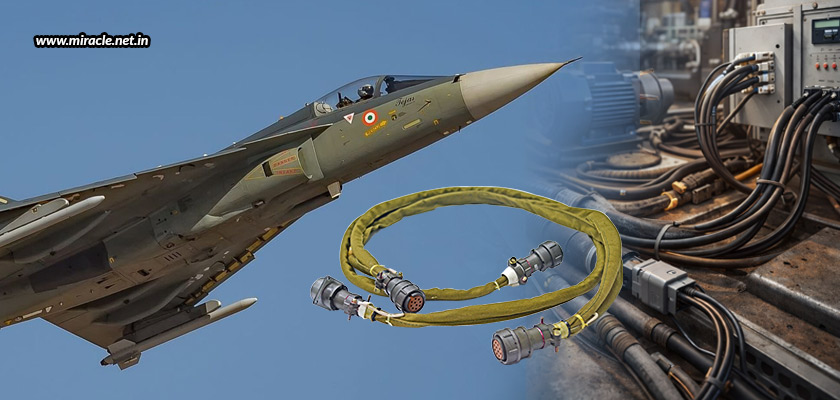

Aerospace cable harnesses are critical components that form the electrical and control backbone of modern aircraft systems. They connect avionics, sensors, power units, and control systems into a single organized network that ensures safe and reliable performance. These harnesses must operate in extreme conditions such as vibration, pressure changes, and wide temperature variations. Cable harnesses are also used in other industries, where requirements may differ based on environment and application needs. However, aerospace systems demand the highest level of precision, strict quality control, and rigorous testing. This ensures maximum safety, efficiency, and reliability throughout the aircraft’s operational life cycle overall.
Key characteristics of aerospace cable harnesses
Aerospace cable harnesses are significantly different from the harnesses used in other industries. While these harnesses, like any other, are a combination of wires, connectors, terminals, shields, and protective coverings, they have special features that help them operate reliable under extreme temperature and pressure variations, especially while landing and take-off, or when flying from one environmental region to another. They are also designed to handle the extreme vibration and mechanical fatigue that comes with the aircraft’s operation, while maintain performance under electromagnetic interference. Despite all these features, aerospace cable harnesses also ensure lightweight construction for reduced aircraft weight and better fuel efficiency. Unlike other industries, aerospace systems leave zero room for error, making quality assurance and testing far more rigorous.
Aerospace vs. marine cable harnesses
Marine environments are in their own way very stressful and demanding, but they are very different from what aerospace applications demand. Marine environments are highly humid, exposing the cable systems to continuous water and moisture exposure, along with chemical degradation and saltwater corrosion. On the other hand, aerospace environments involve varying altitudes, varying temperatures, low pressures, high vibration, dynamic stress, and intense electromagnetic conditions. So, where marine systems need to fight moisture and corrosion, aerospace systems have to fight multi-dimensional and varying stress factors simultaneously.
- Marine harnesses thus need to focus heavily on corrosion-resistant materials like tinned copper, along with waterproof insulation. On the other hand, aerospace harnesses need high-strength but lightweight materials like PTFE and ETFE, with advanced shielding.
- Marine systems have larger spaces and open structural spaces, making the routing easy and assembling less complex. But, aerospace systems require highly compact and densely routed harnesses to fit within the limited aircraft space, while catering to a multitude of requirements.
- Marine systems prioritize durability and corrosion-resistance, while aerospace systems require a unique combination of utmost safety and lightweightedness. Moreover, marine systems need to comply with industry-based standards, while aerospace harnesses need to abide with global aviation regulations.
Aerospace vs. automotive cable harnesses
Even though aircrafts are a part of the automotive segments, transferring people and cargo from one city/country to another, there are major differences between the two systems. Automotive cable harnesses need to power engine systems, lighting, sensors, ECUs, and infotainment systems. But, aerospace harnesses need to control even more complex systems like flight control, navigation, communication, avionics, and safety. Even though both systems need navigation and safety, aerospace systems are more safety-critical, with automotive systems being more comfort and performance driven.
- Automotive systems face moderate temperature variations, road judders, and exposure to dust and moisture. Aerospace systems need to handle extreme altitude pressure changes, high vibration during flight and take-off, wide temperature fluctuations, and continuous EMI exposure.
- Automotive systems may or may not need to be optimized for weight, but in the case of aerospace systems, every gram impacts fuel efficiency and performance, making lightweight insulation and compact routing systems critical.
- Automotive systems are mass produced with match sampling inspections and standard functional testing. On the other hand, aerospace harnesses need to be highly precise, which requires 100% individual inspection, environmental simulation testing, and strict compliance documentation.
Aerospace vs. railway wire harnesses
Railway systems operate in environments that expose the systems to continuous vibration, dust, moisture, and long operational hours. Cable harnesses for the industry are designed to ensure reliable power and signal transmission across traction systems, control panels, lighting, communication units, and safety systems. They are designed for durability, mechanical strength, and long service life, with relatively more space and easier maintenance compared to aerospace systems. In contrast, aerospace cable harnesses must withstand extreme altitude changes, pressure variations, high vibration, and temperature fluctuations. They demand ultra-lightweight design, maximum precision, strict testing, and zero-failure reliability under highly regulated global safety standards.
- Railway cable harnesses are built for long service life and must withstand constant vibration, shock loads, and varying weather conditions, while aerospace harnesses must handle extreme altitude, pressure changes, and far more complex multi-directional stress factors.
- Railway systems often use robust insulation and protective coverings to ensure durability and easy maintenance, whereas aerospace systems require ultra-lightweight materials and advanced shielding for performance and fuel efficiency.
- Railway cable harnesses follow strict national and international rail safety standards, and are designed for ease of repair and replacement, while aerospace harnesses demand far stricter global certification, multi-stage qualification testing, and zero-failure tolerance.
Unique challenges and engineering solutions for aerospace cable harnesses
Across all comparisons, aerospace clearly emerges as the most demanding environment. The key challenges include:
- Extreme precision: Even a minor failure in an aerospace cable harness can impact flight safety.
- Space constraints: Aerospace cable harnesses must fit into compact aircraft structures without interfering with other systems.
- Weight optimization: Every gram affects fuel efficiency and aircraft performance, which means aerospace cable harnesses must be as light as possible.
- Electromagnetic interference: Aviation systems operate in highly sensitive electronic environments.
- Environmental stress: Aerospace cable harness face continuous exposure to vibration, pressure changes, and temperature extremes.
To overcome these challenges, the leading aerospace cable harness manufacturer in India, Miracle Electronics, develops many advanced engineering solutions like:
- Precision routing design: Computer-aided design ensures optimal cable routing inside aircraft structures.
- Lightweight materials: Use of high-performance, but lightweight materials, like PTFE and ETFE, reduces overall weight.
- Advanced shielding: Advanced shielding for protection safeguards against EMI and signal interference.
- Strict quality systems: Aerospace-grade quality frameworks ensuring consistency and safety are highly crucial.
- Rigorous testing: Tests like continuity testing, high-voltage insulation testing, vibration testing, and thermal cycling are absolutely critical.
Cable harness systems are used across many industries, but their requirements vary based on operating conditions, function, and safety needs. Some systems focus on resisting harsh environments, others prioritize cost efficiency, large-scale production, or long-term durability. In all cases, the goal is to ensure safe and reliable transmission of power and signals between components. However, aerospace systems require the highest level of performance. They must be extremely lightweight, highly reliable, and precisely engineered while meeting strict safety standards. This makes aerospace cable harness design one of the most advanced forms of engineering, setting a benchmark for quality and reliability overall.