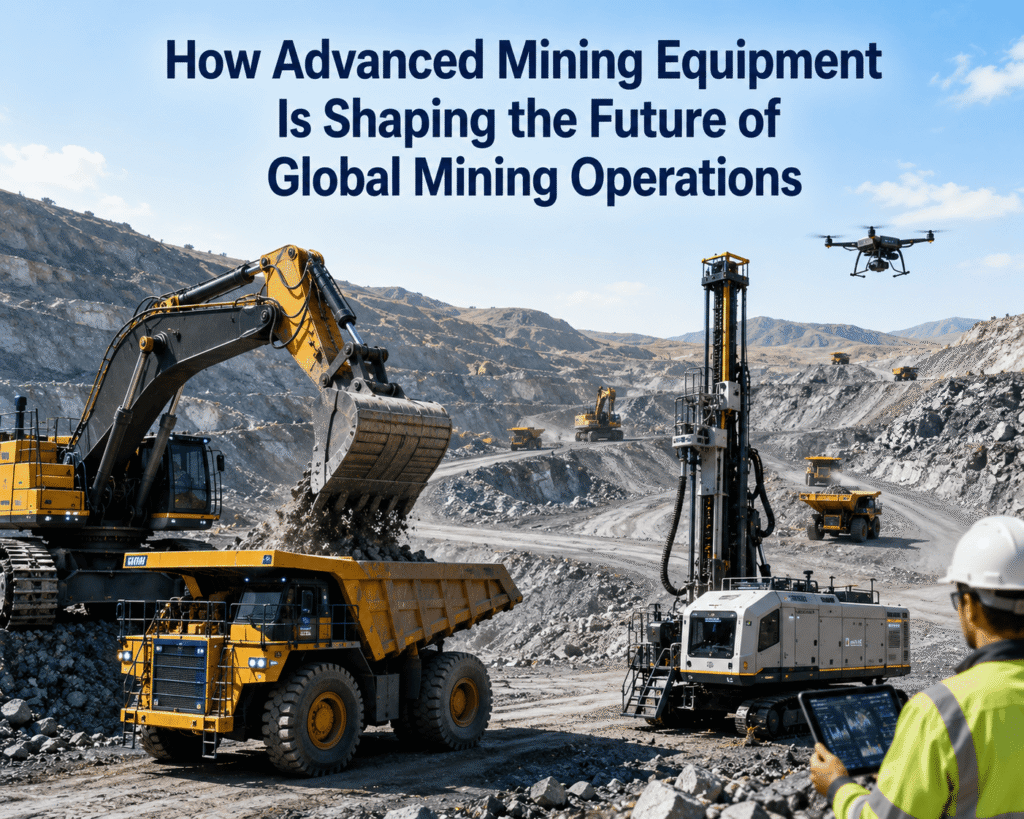

The global mining industry continues to play a vital role in supplying the raw materials required for infrastructure, manufacturing, clean energy technologies, and industrial development. As demand for critical minerals, metals, and industrial resources increases, mining companies are investing in advanced equipment that improves productivity, safety, and operational efficiency. From surface mining to underground operations, modern mining equipment is transforming extraction processes through automation, digital technologies, and sustainable engineering solutions.
According to a study published by MarkNtel Advisors, detailed insights can be found in this global mining industry analysis. The Global Mining Equipment Market was valued at around USD 101.2 billion in 2025 and is projected to grow from USD 110.23 billion in 2026 to USD 154.84 billion by 2032, exhibiting a CAGR of 5.8% during the forecast period. The report also highlights that Asia-Pacific is expected to account for approximately 60% of the global market share in 2026, supported by expanding mining activities, industrialization, and rising investments in mineral extraction across the region.
Modern Mining Requires Smarter Equipment
Mining operations today demand equipment capable of handling larger workloads while maintaining high levels of efficiency and safety. Excavators, haul trucks, loaders, drilling machines, bulldozers, crushers, and underground mining vehicles have become increasingly sophisticated, incorporating technologies that improve precision and reduce operational downtime.
Modern equipment enables mining companies to extract resources more efficiently while minimizing fuel consumption and equipment wear. These improvements help lower operating costs and increase overall productivity across mining sites.
As ore deposits become more challenging to access, reliable and high-performance equipment becomes even more critical.
Automation Is Transforming Mining Operations
Automation has become one of the most significant developments in the mining industry. Autonomous haul trucks, automated drilling systems, remote-controlled loaders, and intelligent fleet management solutions are reducing human exposure to hazardous environments while improving operational consistency.
Automated equipment can operate continuously with greater precision, increasing production efficiency and reducing operational interruptions. Real-time monitoring systems also provide valuable insights that support predictive maintenance and better resource planning.
Digital transformation is enabling mining companies to optimize every stage of the extraction process.
Asia-Pacific Continues to Lead Mining Activity
Asia-Pacific remains one of the world’s largest mining regions, supported by strong demand for coal, iron ore, copper, bauxite, nickel, rare earth elements, and other critical minerals. Rapid industrialization, infrastructure development, and manufacturing growth continue driving investments in new mining projects throughout the region.
The expansion of mining operations requires reliable fleets of heavy equipment capable of operating efficiently under diverse geological and environmental conditions.
Continued investments across Asia-Pacific are expected to strengthen demand for advanced mining machinery over the coming years.
The World Bank recognizes responsible mineral development as an important contributor to economic growth, industrial development, and infrastructure expansion across emerging economies.
Electrification and Sustainability Are Driving Innovation
Mining companies are increasingly adopting environmentally responsible practices to reduce emissions and improve energy efficiency. Equipment manufacturers are responding by developing electric mining vehicles, hybrid machinery, energy-efficient hydraulic systems, and lower-emission engines.
These technologies help reduce fuel consumption while supporting corporate sustainability objectives. Electrified equipment also contributes to lower maintenance requirements and quieter mining operations, particularly in underground environments.
Sustainability is becoming a major factor influencing future equipment investments.
Artificial Intelligence Improves Productivity
Artificial intelligence is enabling mining companies to analyze equipment performance, monitor production activities, and identify maintenance requirements before equipment failures occur. AI-powered predictive maintenance reduces unexpected downtime while extending equipment lifespan.
Machine learning algorithms also optimize drilling patterns, material handling operations, and fleet utilization, helping operators maximize productivity while reducing operating costs.
Data-driven decision-making continues transforming mine planning and equipment management.
Worker Safety Remains a Top Priority
Mining remains one of the world’s most demanding industrial sectors, making workplace safety a critical priority. Modern mining equipment incorporates advanced safety technologies such as collision avoidance systems, operator assistance features, fatigue monitoring, remote operation capabilities, and real-time environmental monitoring.
These innovations reduce operational risks while improving working conditions for equipment operators and maintenance personnel.
The International Labour Organization (ILO) promotes occupational safety and health practices that help improve working conditions across mining and other industrial sectors worldwide.
Digital Connectivity Strengthens Mine Management
The integration of Internet of Things (IoT) sensors, cloud-based fleet management systems, and digital analytics platforms is allowing mining companies to monitor equipment performance continuously. Managers can track machine utilization, fuel consumption, maintenance schedules, and operational efficiency from centralized control centers.
Real-time visibility supports faster decision-making while improving asset utilization across mining operations.
The International Organization for Standardization (ISO) develops internationally recognized standards that support mining safety, equipment quality, environmental management, and operational excellence across the global mining industry.
Looking Ahead
Mining equipment is becoming increasingly advanced as automation, artificial intelligence, electrification, and digital technologies reshape global mining operations. Modern machinery enables mining companies to improve productivity, enhance worker safety, reduce environmental impacts, and maximize resource efficiency while meeting growing global demand for minerals.
As investments continue across infrastructure, renewable energy, manufacturing, and critical mineral production, demand for high-performance mining equipment is expected to remain strong. Supported by continuous technological innovation and sustainable mining practices, advanced equipment will continue playing a central role in the future development of the global mining industry.