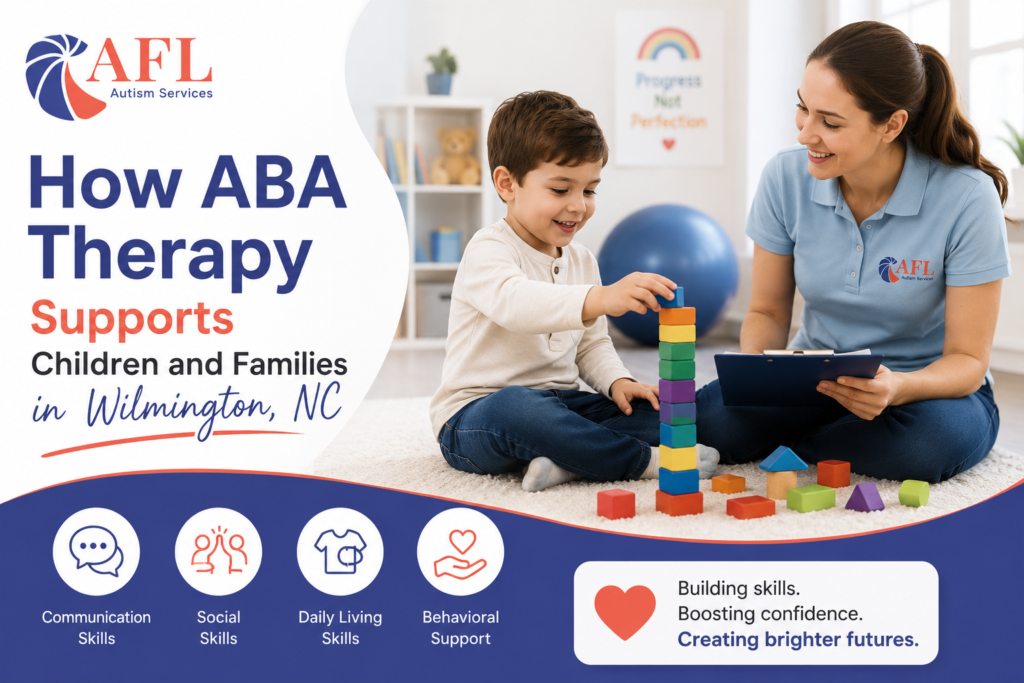

Wilmington’s autism community has grown steadily over the past several years, and with that growth comes a rising need for reliable, evidence-based care. More parents in the area are searching for answers about how to help their child communicate, build friendships, and gain independence. Early support makes a real difference, and ABA therapy has become one of the most trusted approaches for helping children with autism develop meaningful life skills that carry into school, home, and community life.
This guide walks through what ABA therapy actually looks like, why families in Wilmington choose it, and how it supports children across communication, social skills, behavior, and daily routines.
What Is ABA Therapy?
ABA stands for Applied Behavior Analysis. It’s a structured, evidence-based approach that focuses on understanding behavior and teaching skills through consistent reinforcement and practice.
ABA isn’t one-size-fits-all. Every child receives a personalized treatment plan built around their specific strengths, challenges, and goals. A plan for a nonverbal three-year-old will look very different from one for a school-age child working on peer conversations.
Treatment plans are designed and overseen by Board Certified Behavior Analysts (BCBAs). These professionals assess each child, set measurable goals, and adjust the program as the child grows. Registered Behavior Technicians (RBTs) typically carry out the day-to-day sessions under the BCBA’s supervision, giving families both expert oversight and consistent hands-on support. You can learn more about our clinical team and approach on our About Us page.
Why Families in Wilmington Choose ABA Therapy
Individualized Programs
No two children with autism present the same way. ABA programs start with a detailed assessment, then build goals around what each child actually needs, whether that’s requesting a snack, tolerating a haircut, or joining a group activity at school.
Family-Centered Care
Good ABA providers don’t just work with the child. They work with the whole family, making sure parents and siblings understand the strategies being used so progress continues outside of sessions.
Measurable Progress
ABA relies on data. Therapists track skills over time, so families can see concrete evidence of growth rather than guessing whether therapy is working.
Long-Term Benefits
Skills learned through ABA tend to generalize over time. A child who learns to ask for help in therapy often starts using that same skill at school, at home, and in the community.
Communication Skills Development
Communication is often the first and most urgent concern for parents. Many children who start ABA therapy have limited ways to express their needs, which can lead to frustration for both the child and family.
ABA therapy addresses communication in a few key ways:
- Expressing needs: Children learn functional ways to request items, activities, or breaks, whether through speech, gestures, or an augmentative communication device.
- Language development: Therapists build vocabulary step by step, starting with high-interest words and expanding into full sentences.
- Functional communication: The goal isn’t just talking, it’s communicating in ways that actually work in real situations.
- Everyday communication skills: Greetings, answering questions, and following simple instructions all get practiced regularly.
For example, a child who used to cry when they wanted juice might learn to point to a picture card, then eventually say “juice please.” That small shift can dramatically reduce frustration for the whole family.
Social Skills Development
Social skills don’t always come naturally to children with autism, but they can be taught step by step, just like any other skill.
ABA therapy often targets:
- Peer interaction: Learning how to approach another child, make eye contact, or join a group activity.
- Sharing: Practicing turn-taking with toys or materials in a structured, low-pressure setting.
- Turn-taking: Building patience and understanding of back-and-forth exchanges, whether in conversation or play.
- Building friendships: Working toward sustained play and genuine peer connection over time.
A practical example: a therapist might set up a simple board game session where a child practices waiting for their turn, celebrating a friend’s move, and handling the disappointment of losing a round. These small, repeated practice moments build skills that transfer to the playground or classroom.
Daily Living Skills and Independence
Independence matters just as much as communication and social growth. ABA therapy often includes goals around everyday routines that help children function more confidently at home and school.
Common focus areas include:
- Dressing: Learning to put on shoes, zip a jacket, or choose weather-appropriate clothing.
- Personal hygiene: Building routines around brushing teeth, washing hands, and toileting.
- Mealtime routines: Practicing sitting at the table, using utensils, and trying new foods.
- School readiness: Following a schedule, transitioning between activities, and sitting for structured tasks.
These skills might seem small, but for many families, a child who can dress themselves or handle a mealtime without a meltdown represents a major shift in daily life.
Behavioral Support Through ABA Therapy
Challenging behaviors, like tantrums, aggression, or self-injury, are often a form of communication. ABA therapy works to understand what’s driving a behavior and teach a better way to meet that same need.
This process typically involves:
- Positive reinforcement: Rewarding desired behaviors to encourage them to happen again.
- Emotional regulation: Teaching children to recognize and manage big feelings before they escalate.
- Building replacement skills: Replacing a problem behavior with a functional one, such as asking for a break instead of shutting down.
- Reducing challenging behaviors: Tracking patterns and adjusting strategies so behaviors decrease over time.
For instance, a child who hits when overwhelmed in a loud classroom might be taught to raise their hand or ask for a quiet space instead. Over time, the replacement behavior becomes the child’s default response.
Home, Clinic, and Community-Based ABA Therapy
Where therapy happens matters. Many Wilmington families benefit from a mix of settings, since skills practiced in one environment don’t always transfer automatically to another.
Home-Based Learning
Our in-home ABA therapy approach lets therapists address real routines, like bedtime, mealtime, or sibling interactions, right where they happen.
Clinic-Based Learning
Clinic settings offer structured environments with fewer distractions, along with access to peer interaction and specialized equipment.
Community-Based Learning
Practicing in real-world settings, like a grocery store or playground, helps children apply skills where they’ll actually need them.
Working across multiple environments helps ensure a skill learned in one place, like requesting a break, shows up consistently everywhere else too.
The Importance of Parent Involvement
ABA therapy works best when parents are active participants, not just observers.
- Parent training: Families learn the same strategies therapists use, so support stays consistent.
- Home reinforcement: Practicing skills outside of sessions speeds up progress and helps it stick.
- Consistency: Children thrive when expectations are the same at home, school, and therapy.
- Working with therapists: Regular check-ins let parents ask questions, share observations, and adjust goals as needed.
A parent who understands why their child is being taught to request a break, and how to reinforce that at home, helps that skill become second nature much faster.
Benefits Families Often Notice
Over time, many Wilmington families report meaningful changes, including:
- Improved communication, both verbal and nonverbal
- Greater independence in daily routines
- Better social participation with peers and siblings
- Increased confidence in new or unfamiliar situations
These changes often build on each other. A child who communicates more clearly tends to feel less frustrated, which supports better behavior and more willingness to engage socially. You can read more about the progress families have shared in our Testimonials.
Choosing Autism Services in Wilmington, NC
Not all ABA providers offer the same level of care. When evaluating ABA Therapy Wilmington NC, it helps to look for:
- Qualified BCBAs who oversee every treatment plan
- Individualized treatment plans built around your child’s specific goals
- Family support that includes training and open communication
- Progress monitoring with regular data review and goal updates
- Comprehensive services, including therapy, testing, and support across settings
Taking time to ask questions during a consultation, about staff credentials, session structure, and how progress is tracked, can help families feel confident in their choice. You can also explore our full list of ABA Therapy Locations across North Carolina, Kentucky, Indiana, and Illinois.
Frequently Asked Questions
- What is ABA therapy?
ABA therapy is an evidence-based approach that uses reinforcement and structured teaching to help children with autism build communication, social, behavioral, and daily living skills. - How does ABA therapy help children with autism?
It breaks down complex skills into manageable steps, reinforces progress consistently, and helps children generalize those skills across home, school, and community settings. - When should therapy begin?
Early intervention is generally recommended as soon as autism is identified, since young children’s brains are highly responsive to structured learning during this period. For a closer look at what progress typically looks like early on, see How Long Does ABA Therapy Take to Show Results. - Can parents participate?
Yes. Parent involvement is a core part of effective ABA therapy, and most programs include parent training so families can reinforce skills at home. - How is progress measured?
BCBAs collect data during every session, tracking specific goals over time so families can see clear, measurable evidence of growth.
Conclusion
ABA therapy gives children with autism the tools to communicate more clearly, build stronger social connections, manage behavior in healthier ways, and grow more independent in daily life. For Wilmington families, having access to individualized, evidence-based support close to home can make a lasting difference in a child’s development and confidence.
If you’re looking for trusted ABA Therapy in Wilmington NC, Adapt For Life – AFL Autism Services provides individualized ABA therapy, autism testing, speech therapy, and family support designed to help children thrive. Visit aflaba.com or call +1 502-965-1116 to learn more.