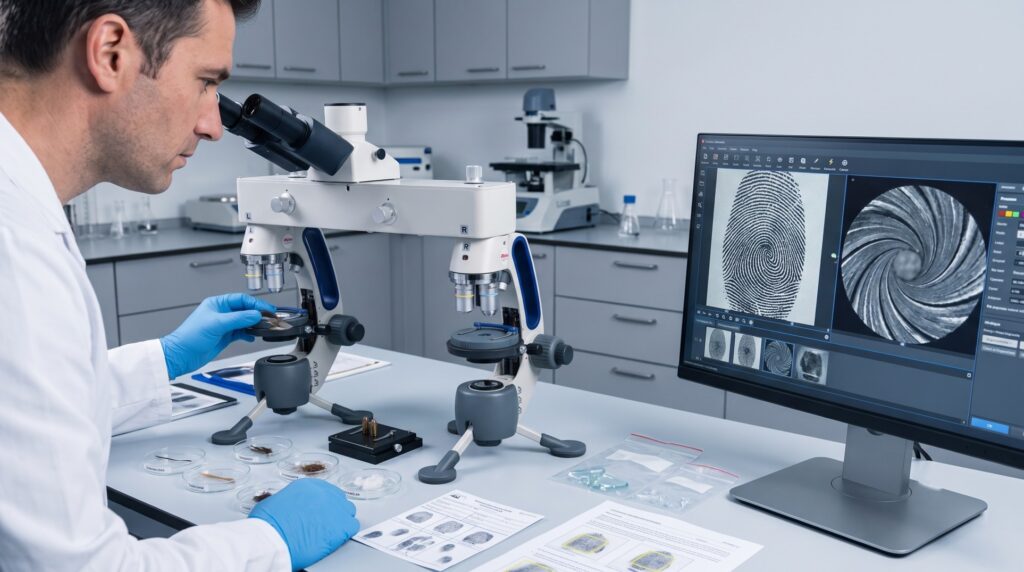

Some cases never make it to an interrogation room. They get settled quietly, on a lab bench, under a lens, by someone who spent three hours comparing two bullet striations nobody else could tell apart.
Trace evidence is patient. It sits on a jacket, a door frame, or a paint chip until the right instrument finds it. That instrument, more often than not, is a forensic microscope, and what it reveals in a single session can redirect an entire investigation.
This article covers how these tools work, what they examine, and why choosing the right one matters more than most labs initially expect.
What Makes a Forensic Microscope Different from a Standard Lab Microscope
Most lab microscopes are built for one job. A forensic microscope is built for several, and the margin for error on any of them is close to zero.
Here’s where the gap shows up in real use:
- Comparison bridges connect two independent stages so an examiner can view a crime scene sample and a reference sample in the same optical field at the same time. Standard scopes have no equivalent for this.
- Camera integration is built in, not bolted on. Every image needs embedded metadata, timestamps, and calibration data to hold up as court documentation.
- Magnification range is significantly broader. Evidence rarely cooperates with a fixed magnification setting.
- Illumination options including reflected light, polarized light, and UV capability serve different evidence types that a single session might require.
- Ergonomic design supports sessions that can run five or six hours without a break.
A standard scope shows you what something looks like. A forensic scope shows you what it means.
Core Applications: What a Forensic Microscope Actually Examines
The range here surprises people. Most assume these tools are strictly for ballistics work. In practice, a well-equipped forensic lab uses microscopy across a much wider set of evidence categories.
Hair and Fiber Analysis
Human hair carries more identifying detail than most people realize. Cortex pigmentation, medullary pattern, cuticle scale shape, and cross-sectional geometry all vary between individuals. Fiber evidence, pulled from clothing, carpet, or vehicle upholstery, gets examined for diameter, color consistency, and weave structure. Polarized light microscopy is especially useful here because it separates synthetic from natural fibers based on optical behavior rather than appearance alone.
Ballistics and Toolmark Examination
Barrel rifling leaves a pattern on every bullet it touches. No two barrels produce identical striations. A comparison microscope places the crime scene bullet and a test-fired bullet in the same field of view so an examiner can assess that match directly. Toolmarks on forced entry points follow the same logic. The mark a specific crowbar leaves on a door frame is as individual as a fingerprint, if you have the right instrument reading it.
Document and Ink Examination
Altered contracts, traced signatures, and forged dates show up clearly under magnification. Ink layering, paper fiber disruption, and printing inconsistencies are all visible at the microscopic level in ways that standard review misses entirely. UV attachments extend this further, revealing chemically erased text or hidden security features.
Soil, Glass, and Paint Particle Analysis
This is where forensic light microscopy does some of its quietest and most convincing work. Paint chip cross-sections reveal factory layer sequences that can identify a specific vehicle. Glass fragments carry refractive index signatures. Soil samples hold mineral compositions that connect a suspect to a location without a single witness saying a word.
What to Look for When Choosing a Forensic Microscope
Buying the wrong scope is an expensive mistake. Not just financially, but operationally. The wrong instrument creates documentation gaps, limits what your lab can examine, and in the worst cases, produces findings that don’t survive courtroom scrutiny.
Here’s what actually matters when evaluating options.
Magnification Range That Matches Your Caseload
A scope optimized for document work will underperform on ballistics, and the reverse is equally true. Before shortlisting anything, map out the evidence types your lab handles most frequently and match the magnification range to that reality.
Camera Integration and Documentation Output
This is non-negotiable. Every forensic microscope your lab relies on needs to produce images with embedded metadata, timestamps, and calibration data. If the documentation output won’t support chain-of-custody records or courtroom admissibility, the optics don’t matter.
Comparison Bridge Availability
For any lab doing fiber, hair, or ballistics work, a comparison bridge is not an optional add-on. It needs to be either included or compatible. Side-by-side examination in a single optical field is what makes a match defensible.
Illumination Flexibility
Reflected light, transmitted light, polarized, and UV capability each serve different evidence types. A lab that handles varied casework needs a forensic light microscope with illumination options that can shift between those modes without requiring a separate instrument for each.
Accreditation and Calibration Support
Labs pursuing ISO 17025 or ASCLD certification need instruments that come with documented calibration protocols and verifiable service records. Ask the manufacturer directly how they support that process before purchasing.
Ergonomics
This one gets overlooked constantly. An examiner working through fatigue in hour five of a session makes more errors than one who isn’t. Comfort is not a preference, it is a quality control variable.
Common Challenges Forensic Labs Face Without the Right Microscope
Outdated or underpowered equipment doesn’t just slow a lab down. It quietly compromises the work in ways that only become obvious when a case falls apart.
- Inconclusive comparisons happen when optical resolution isn’t sharp enough to confirm or rule out a match with confidence. An examiner can only work with what the instrument shows them.
- Evidence backlogs build faster when documentation is manual, inconsistent, or requires repeat sessions because the first pass didn’t capture what it needed to.
- Court challenges become more frequent when image quality is poor or calibration records are incomplete. Defense attorneys look for exactly these gaps.
- Cross-contamination risks increase when a scope isn’t designed with forensic handling protocols in mind.
- Examiner fatigue on poorly designed instruments affects concentration during extended sessions, and that affects accuracy.
A forensic light microscope that isn’t fit for purpose doesn’t just limit what you find. It limits what you can prove.
Conclusion
Forensic science moves at the pace of its instruments. When the tools are right, the findings hold. When they aren’t, the gaps show up at the worst possible moment.
A forensic microscope doesn’t solve cases on its own. But it gives examiners something more valuable than speed or convenience. It gives them certainty, and certainty is what separates a strong finding from a challenged one.
The evidence was always there. What changes is whether the instrument in your lab was built to find it.