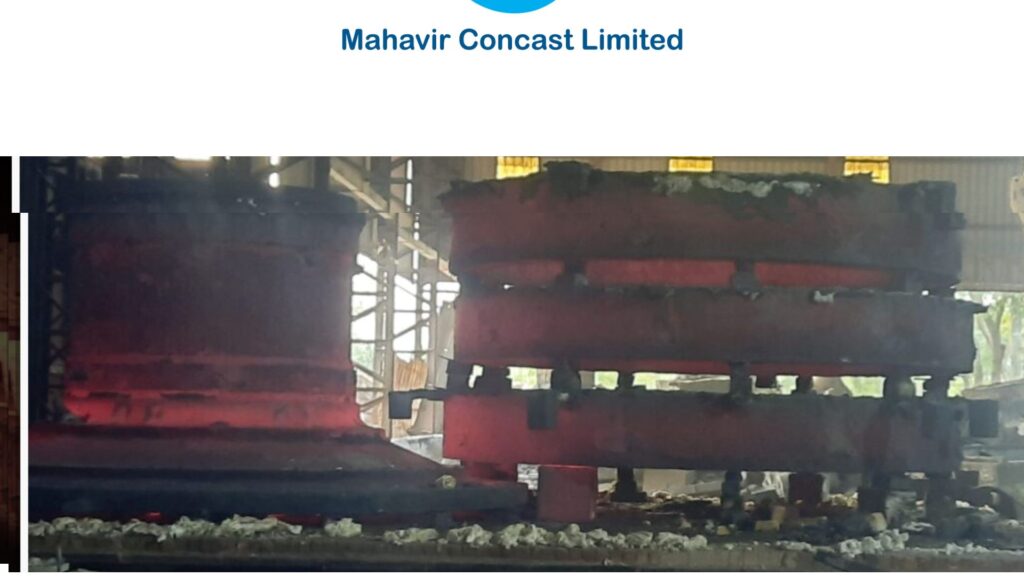

At Mahavir Concast, we understand that the true potential of steel is unlocked not just by its initial chemistry, but through the precise application of heat treatment. This transformative series of thermal processes is the unseen art that imparts steel with its final, functional properties—dictating its strength, toughness, hardness, and durability. For industrial components operating under extreme stress, abrasion, and impact, the correct heat treatment isn’t a mere finishing step; it is the defining factor between a part that meets specifications and one that exceeds performance expectations for years to come.
The Science and Stages of Heat Treatment
Heat treatment involves the controlled heating and cooling of steel to alter its physical and mechanical properties without changing its shape. The process modifies the internal microstructure of the metal—the arrangement of its atoms—which directly governs its behavior in real-world applications.
For the heavy-duty castings we produce at Mahavir Concast, a comprehensive heat treatment regimen is non-negotiable. It typically follows a staged approach, with three core processes working in concert to achieve the optimal balance of properties.
- Annealing: Stress Relief and Refinement
Annealing is often the first major thermal process after a steel casting solidifies and cools in the mold. The casting is heated to a specific temperature within or above its critical range, held for a calculated duration to achieve uniformity, and then cooled slowly (usually in the furnace).
- Primary Purpose: To relieve internal stresses induced during the solidification and cooling phases. These locked-in stresses can lead to dimensional instability or premature failure in service.
- Key Benefits: Softens the steel, improves machinability, refines the grain structure, and enhances homogeneity. This creates a uniform, stable foundation for any subsequent hardening treatments.
- Hardening (Quenching): Achieving Maximum Strength
Following annealing and machining, hardening is employed to develop high strength and wear resistance. The steel is heated to a temperature that transforms its microstructure into austenite, then rapidly cooled or “quenched” in oil, polymer, or water.
- Primary Purpose: To transform the steel’s structure to martensite, an extremely hard and strong phase.
- Key Consideration: While quenching maximizes hardness, it also makes the steel very brittle. A part in this state is like glass—hard but prone to cracking under impact. Therefore, hardening is almost always followed immediately by the critical third step: tempering.
- Tempering: The Art of the Balance
Tempering is the masterstroke that perfects the steel’s properties. The quenched part is reheated to a temperature well below its critical point, held, and then air-cooled.
- Primary Purpose: To reduce the brittleness caused by quenching by trading a controlled amount of hardness for vastly improved toughness and ductility.
- Precision Control: The final properties are precisely dialed in by the tempering temperature and time. A lower tempering temperature retains more hardness for abrasion resistance, while a higher temperature prioritizes toughness and impact resistance for parts like crusher jaws or hammer heads.
The Mahavir Concast Difference in Heat Treatment
Our commitment at Mahavir Concast is to move beyond standardized cycles to application-specific thermal engineering. We recognize that a grinding table liner, a pump impeller for abrasive slurry, and a gear for a high-torque drive all have fundamentally different performance requirements.
- Process Customization: Our metallurgists don’t just run parts through a furnace; they design the heat treatment protocol. We tailor the soak temperatures, hold times, quenching mediums, and tempering schedules based on the steel grade (from high-carbon to high-alloy steels) and the component’s end-use environment.
- Quality Integration: Heat treatment is not an isolated step. It is integrated with our entire quality assurance workflow. We conduct pre- and post-treatment testing—including hardness surveys, mechanical testing, and microstructural analysis—to validate that each batch has achieved the specified properties throughout the component’s cross-section.
- Ensuring Homogeneity: For large, complex castings (weighing several tonnes), ensuring uniform temperature and cooling rates is a significant challenge. We employ specialized furnace technology and fixturing to guarantee that every section of a massive grinding table or kiln part receives the same precise thermal cycle, eliminating soft spots or uneven stress.
From Furnace to Field: The Tangible Impact
This meticulous approach to heat treatment translates directly into superior performance for our clients:
- Extended Service Life: Components withstand abrasive wear and cyclic loading far longer, reducing the frequency of downtime for replacements.
- Enhanced Reliability: Optimized toughness prevents catastrophic brittle fracture, ensuring safety and continuous operation in critical applications.
- Predictable Performance: Engineers can design with confidence, knowing the mechanical properties of the casting are guaranteed and consistent from part to part.
In essence, at Mahavir Concast, Heat Treatment Processes for Steel where the inherent strength of steel is sculpted into functional resilience. It is a core pillar of our promise to deliver not just a metal casting, but a high-performance engineered component built for the relentless demands of industry.