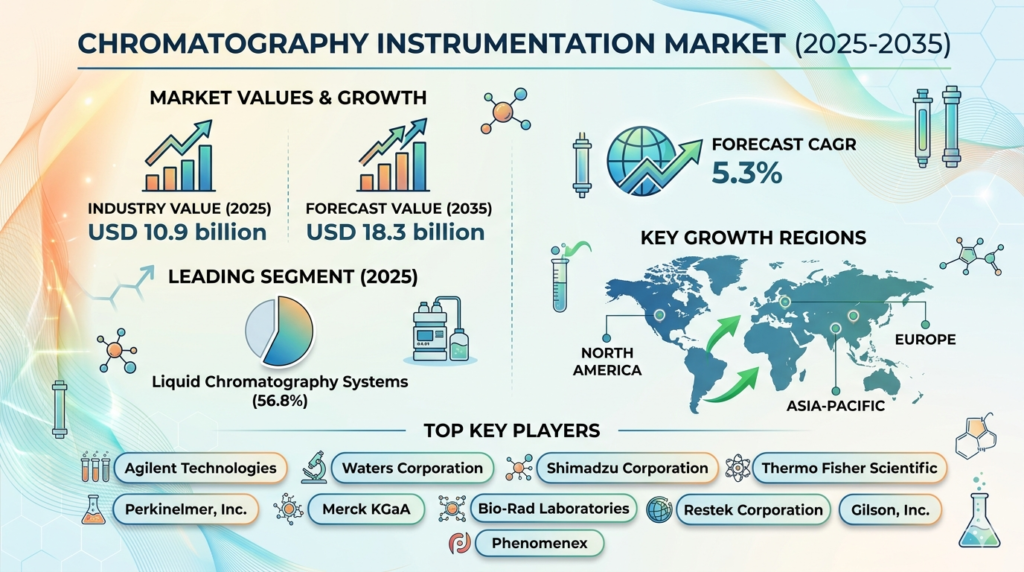

The global chromatography instrumentation market is projected to witness strong expansion over the next decade, supported by expanding research and development (R&D) activities and rising demand for high-precision analytical techniques across laboratory settings. The market is expected to grow steadily, reaching approximately USD 18.3 billion by 2035, registering a CAGR of 5.3%, according to the latest analysis by Future Market Insights (FMI).
Market growth is being shaped by increasing government mandates for product purity, growing consumer awareness regarding food safety, and rapid adoption of advanced automated laboratory technologies. Chromatography systems have evolved from specialized research tools into essential regulatory requirements across pharmaceutical and commercial testing facilities. While traditional analytical separations continue to dominate operations, laboratories are increasingly integrating advanced systems such as automated sample handlers and ultra-high-performance liquid chromatography (UHPLC) to comply with modern quality validation expectations and improve testing throughput outcomes.
Chromatography Instrumentation Market Snapshot (2025–2035)
- Market size outlook toward 2035: USD 18.3 billion
- Forecast CAGR: 5.3%
- Dominant technology category: Liquid Chromatography Systems (56.8% market share)
- Fastest-growing country segment: South Korea (~7.6% CAGR)
- Key growth regions: North America, Asia-Pacific, Europe
- Primary demand channel: Pharmaceutical and biotechnology firms
Momentum in the Market
Beginning from steady international adoption levels, the global chromatography instrumentation market demonstrates accelerated growth throughout the forecast period as analytical quality compliance becomes mandatory across multiple industries. Between 2026 and 2035, expanding biologics manufacturing and rising R&D expenditure are expected to significantly boost demand for integrated analytical systems. Increasing industrialization and higher regulatory scrutiny are encouraging laboratories and manufacturers to prioritize advanced compound separation technologies.
From 2035 onward, innovation in intelligent data management systems and integration with automated workflows is expected to further strengthen market expansion. Smart systems capable of adapting sample handling and providing remote monitoring capabilities are emerging as key differentiators in new laboratory models.
The Reasons Behind the Market’s Growth
Demand for chromatography instrumentation is rising due to multiple structural and technological factors reshaping the global scientific ecosystem.
- Stringent Government Purity Regulations: Governments across various nations are enforcing mandatory testing requirements to validate biopharmaceuticals and align with global health standards. Accurate instrumentation is increasingly becoming a non-negotiable component in product safety approvals.
- Growing Pharmaceutical Production and Sales: Rapid expansion of biotechnology manufacturing hubs, particularly in North America and Asia-Pacific, is driving large-scale industrial adoption of high-performance separation platforms.
- Rising Food Safety Awareness: Regulatory bodies are prioritizing testing for food additives, chemical contaminants, and preservatives, accelerating adoption across the agriculture and food safety testing sectors.
- Proteomics and Metabolomics Expansion: The rise of complex clinical research and biopharmaceuticals, including vaccines and monoclonal antibodies, is creating demand for highly specialized separation platforms tailored to complex molecular analysis.
Top Segment Application Type
Pharmaceutical Firms Lead Market Demand Pharmaceutical firms account for the majority of chromatography installations across global markets, supported by increasing private research funding and strict regulatory mandates requiring precise identification of impurities and verification of chemical concentrations.
System Type and Application Analysis
- Liquid Chromatography Systems: ~56.8% market share, driven by universal adoption for non-volatile and thermally unstable compounds.
- Pharmaceutical Application: ~42.1% market share, supported heavily by drug discovery and quality control workflows.
- United Kingdom: ~6.6% CAGR, supported by expanding clinical and academic research operations.
- South Korea: ~7.6% CAGR, representing the fastest-growing major country market during the forecast period.
Regional Development: International Ecosystem Drives Expansion
The global landscape is rapidly evolving into an advanced network for safety and precision analytics, supported by cost-efficient local facilities and expanding corporate ecosystems.
- United States: Market leader reaching a projected valuation of USD 18.3 billion by 2035, driven by technological breakthroughs and top-tier biopharma presence.
- China: Reaching USD 2.7 billion by 2035, driven by environmental compliance monitoring and food testing mandates.
- Japan: Reaching USD 1.9 billion by 2035, supported by specialized clinical diagnostics and therapeutic drug monitoring systems.
Challenges, Trends, Opportunities, and Drivers
Drivers
- Mandatory pharmaceutical and environmental validation standards
- Rising investments in life science and biopharmaceutical research
- Increasing demand for high-throughput laboratory automation
- Expansion of proteomics, metabolomics, and genetic testing platforms
Opportunities
- Smart, cloud-connected analytical instruments
- High-sensitivity detectors for trace contaminant identification
- Eco-friendly and sustainable column materials
- Integration with digital lab data infrastructure
Trends
- Transition toward fully automated sample preparation setups
- AI-enabled data analysis and troubleshooting software
- Increased adoption of multi-dimensional chromatography configurations
- Miniaturization of instruments for field-based testing
Challenges
- High initial setup and equipment costs for modern setups
- Requirement for highly skilled operators to manage complex workflows
- Competition from alternative analytical methods like direct mass spectrometry
Country Growth Outlook
The market’s growth trajectory is closely tied to scientific investment and health regulation implementation across major regional economies:
- United States: Technology leadership and heavy pharmaceutical R&D reinforcement (5.7% CAGR).
- South Korea: Rapid commercial laboratory expansion and manufacturing agility (7.6% CAGR).
- United Kingdom: Accelerating healthcare diagnostics and academic research adoption (6.6% CAGR).
- Japan: Increasing integration into clinical healthcare and medicine monitoring (6.4% CAGR).
- China: Scaling up environmental protection programs and food safety audits (6.2% CAGR).
The Competitive Environment
The chromatography instrumentation market is moderately consolidated, with global analytical technology providers competing through product innovation, localized production, and strict adherence to shifting regulatory guidelines. Leading companies include:
- Agilent Technologies
- Waters Corporation
- Shimadzu Corporation
- Thermo Fisher Scientific
- PerkinElmer, Inc.
- Merck KGaA
- Bio-Rad Laboratories
These players are investing heavily in automated sample handlers, highly sensitive detection machinery, and cloud-integrated software systems while forming partnerships with regional laboratories to stabilize supply lines and accelerate new product development.
Future Outlook: Toward Intelligent and Safer Analytics
The global chromatography instrumentation market is entering a transformative decade shaped by automation, cloud connectivity, and stricter accuracy expectations. Future separation frameworks are expected to function as automated lab components working alongside digital intelligence platforms to deliver smart data tracing and predictable maintenance. As international analytics markets mature and public safety compliance strengthens, chromatography will remain a central pillar in achieving safer healthcare, cleaner environments, and robust consumer product security worldwide.
For a comprehensive strategic outlook and detailed analysis of technological developments shaping the industry, readers can explore the full report on the official Future Market Insights website: https://www.futuremarketinsights.com/reports/chromatography-instrumentation-market