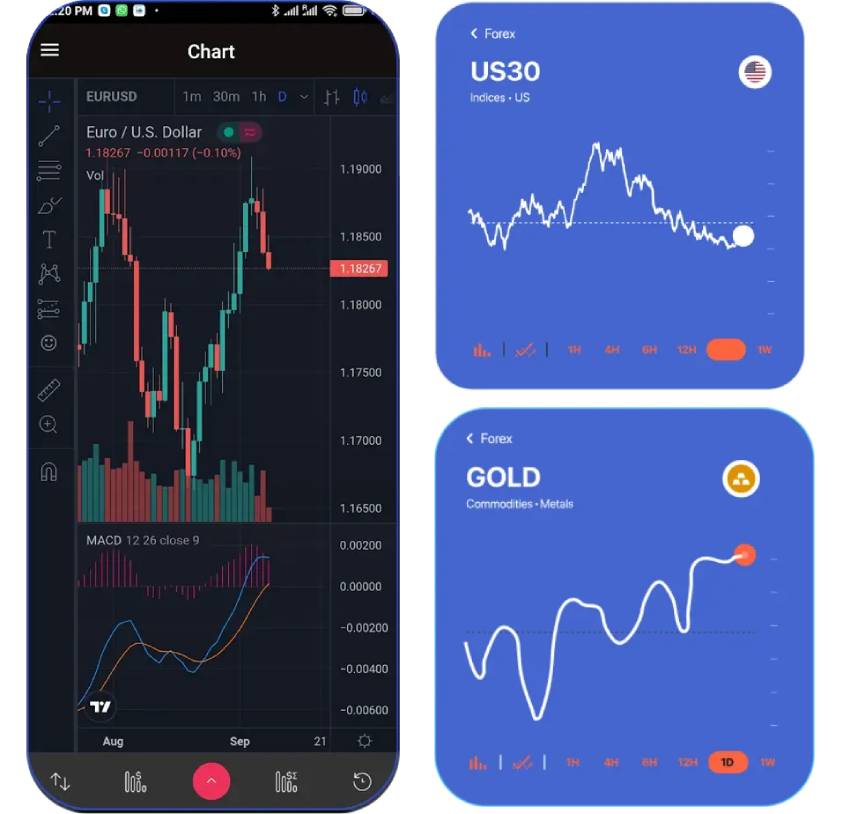

Trade futures and options in India on Tradex.live. Learn F&O basics, strategies, margin, lot size and start derivatives trading with up to 500x leverage.
What Are Futures and Options? (The Plain-English Version)
Futures and options are derivative contracts. That word — derivative — just means the contract’s value is “derived” from something else. That something else is called the underlying asset: a stock like Reliance or TCS, an index like Nifty 50 or Bank Nifty, a commodity like gold or crude oil, or even a currency pair.
You’re not buying the stock itself. You’re buying a contract about that stock’s future price.
A futures contract is an agreement between two parties to buy or sell an asset at a fixed price on a specific future date. Both sides are obligated. If you go long on Nifty futures at 24,500 and Nifty closes at 24,800 on expiry, you make the difference. If it drops to 24,200, you eat the loss. No way out — that’s the deal.
An options contract gives you the right, but not the obligation, to buy or sell the underlying at a set price (called the strike price) on or before a set expiry date. For this right, you pay a small upfront fee called the premium. If the trade goes your way, you exercise it. If not, you just let it expire and your loss is capped at the premium. That asymmetry is what makes options so interesting.
There are two basic option types:
- Call option — the right to buy the underlying at the strike price. You buy calls when you think prices will rise.
- Put option — the right to sell the underlying at the strike price. You buy puts when you think prices will fall.
That’s the entire foundation. Everything else — straddles, strangles, iron condors, covered calls — is just a combination of these basic pieces.
Futures vs Options — Which One Should You Actually Trade?
| Point | Futures | Options |
|---|---|---|
| Obligation | Both buyer and seller are bound | Buyer has a right, not an obligation |
| Upfront cost | Margin (12–20% of contract value) | Premium only |
| Risk for buyer | Unlimited both sides | Limited to premium paid |
| Profit potential | Linear — moves 1:1 with the underlying | Non-linear, can be very high vs cost |
| Best for | Directional bets, hedging large positions | Strategy-based trading, limited-risk plays |
| Complexity | Easier to grasp | More moving parts (premium decay, volatility, Greeks) |
Short version: futures are simpler but riskier in absolute terms. Options are more flexible and let you cap your downside, but you have to understand premium behaviour and time decay. Most beginners on Tradex1.live start with index options — usually Nifty or Bank Nifty — because the contracts are highly liquid and the moves are easier to read than individual stocks.
What Are Futures and Options? (The Plain-English Version)
Futures and options are derivative contracts. That word — derivative — just means the contract’s value is “derived” from something else. That something else is called the underlying asset: a stock like Reliance or TCS, an index like Nifty 50 or Bank Nifty, a commodity like gold or crude oil, or even a currency pair.
You’re not buying the stock itself. You’re buying a contract about that stock’s future price.
A futures contract is an agreement between two parties to buy or sell an asset at a fixed price on a specific future date. Both sides are obligated. If you go long on Nifty futures at 24,500 and Nifty closes at 24,800 on expiry, you make the difference. If it drops to 24,200, you eat the loss. No way out — that’s the deal.
An options contract gives you the right, but not the obligation, to buy or sell the underlying at a set price (called the strike price) on or before a set expiry date. For this right, you pay a small upfront fee called the premium. If the trade goes your way, you exercise it. If not, you just let it expire and your loss is capped at the premium. That asymmetry is what makes options so interesting.