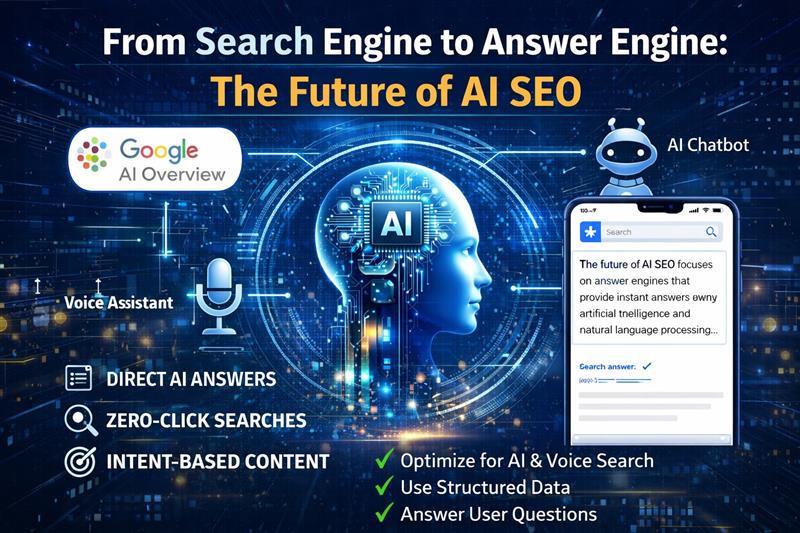

The digital marketing world is undergoing a massive transformation. What was once a traditional “search engine” ecosystem is rapidly evolving into an “answer engine” environment powered by Artificial Intelligence (AI). Platforms like Google, AI chatbots, and voice assistants are no longer just showing links—they are delivering direct answers to user queries.
This shift has completely changed how SEO works. Businesses that fail to adapt risk losing visibility, traffic, and conversions. In this comprehensive guide, we’ll explore how AI is transforming search, what “answer engine” really means, and how you can optimize your website for the future of AI SEO.
What is an Answer Engine?
An answer engine is an AI-powered system that provides instant, direct, and contextual answers to user queries instead of just listing web pages.
Traditional Search Engine:
- Shows a list of links
- Requires users to click and explore
- Focuses on keywords
Answer Engine:
- Provides instant answers
- Uses AI and NLP
- Focuses on user intent and context
Examples include:
- Google AI Overviews
- Voice assistants (Alexa, Siri)
- AI chatbots
Why Search is Shifting to Answer Engines
The shift is driven by user behavior and technological advancements. Today’s users want quick, accurate, and personalized answers without browsing multiple websites.
Key Reasons:
- Faster information access
- Mobile and voice search growth
- AI advancements in Natural Language Processing
- Demand for better user experience
This means SEO is no longer just about ranking—it’s about being the answer.
How AI is Transforming SEO
1. Search Intent is King
AI algorithms now understand:
- User intent
- Context
- Semantic meaning
Instead of focusing only on keywords, SEO now revolves around:
- Informational intent
- Transactional intent
- Navigational intent
2. Rise of Zero-Click Searches
Users often get answers directly on the search results page.
Impact:
- Reduced website clicks
- Increased importance of featured snippets
- Need for structured data
3. Natural Language Processing (NLP)
AI uses NLP to understand conversational queries.
Example:
Instead of typing:
“best SEO services India”
Users now ask:
“Which company provides the best AI SEO services in India?”
Your content must match this conversational style.
4. AI-Generated Content & Ranking
Search engines can now evaluate:
- Content quality
- Relevance
- Authority
Low-quality AI-generated content is penalized, while helpful, human-like content ranks higher.
LSI Keywords for This Topic
To rank better, include these LSI keywords naturally:
- AI SEO strategies
- answer engine optimization
- generative engine optimization (GEO)
- AI search algorithms
- voice search SEO
- zero-click searches
- semantic search
- AI content optimization
- search intent optimization
- future of SEO 2026
- AI digital marketing trends
- conversational search queries
Key Trends in AI SEO (2026)
1. Generative Engine Optimization (GEO)
GEO is the next evolution of SEO. It focuses on optimizing content for AI-generated answers.
Strategies:
- Provide clear, concise answers
- Use structured data
- Optimize for conversational queries
2. Voice Search Optimization
Voice search is growing rapidly.
Tips:
- Use natural language
- Target long-tail keywords
- Answer questions directly
3. Featured Snippets & Position Zero
To become an answer engine source:
- Use bullet points
- Add FAQs
- Provide clear definitions
4. E-E-A-T (Experience, Expertise, Authority, Trust)
Google prioritizes:
- Expert content
- Real experience
- Trustworthy sources
5. AI-Powered Personalization
Search results are now personalized based on:
- Location
- Search history
- Behavior
How to Optimize for Answer Engines
1. Create Intent-Based Content
Focus on solving user problems.
✔ Answer questions clearly
✔ Use simple language
✔ Provide value
2. Use Structured Data (Schema Markup)
Schema helps search engines understand your content better.
3. Optimize for Featured Snippets
- Use headings
- Add lists and tables
- Answer questions directly
4. Focus on Long-Tail Keywords
Long-tail keywords match conversational queries.
5. Improve Content Quality
- Write human-friendly content
- Avoid keyword stuffing
- Add real insights
6. Build Topical Authority
Create content clusters around your niche.
Role of AI Tools in SEO
AI tools help with:
- Keyword research
- Content optimization
- Competitor analysis
- Predictive analytics
These tools save time and improve accuracy.
Promote Your Business with AI SEO
If you want to dominate the future of SEO, partnering with experts is crucial. SAG IPL provides advanced AI SEO solutions designed for modern search engines and answer engines. From Generative Engine Optimization (GEO) to content strategy, technical SEO, and AI-driven analytics, SAG IPL helps businesses rank higher, gain visibility in AI-generated results, and drive high-quality traffic. Whether you’re a startup or an enterprise, their customized AI SEO services ensure long-term digital success.
Challenges in AI SEO
While AI SEO offers many advantages, there are challenges:
- Increased competition
- Constant algorithm updates
- Content saturation
- Dependence on AI tools
To succeed, businesses must combine AI + human creativity.
Future of AI SEO
The future is clear:
- Search engines will become answer engines
- AI will dominate search results
- Content quality will matter more than ever
Businesses must adapt to:
- AI-driven search
- Conversational queries
- Personalized experiences
Conclusion
The shift from search engine to answer engine is one of the biggest changes in digital marketing history. AI is redefining how users search, how content is ranked, and how businesses connect with their audience.
To stay ahead:
✔ Focus on user intent
✔ Optimize for AI and voice search
✔ Use structured data
✔ Create high-quality content
The future of SEO is not about ranking—it’s about becoming the answer.