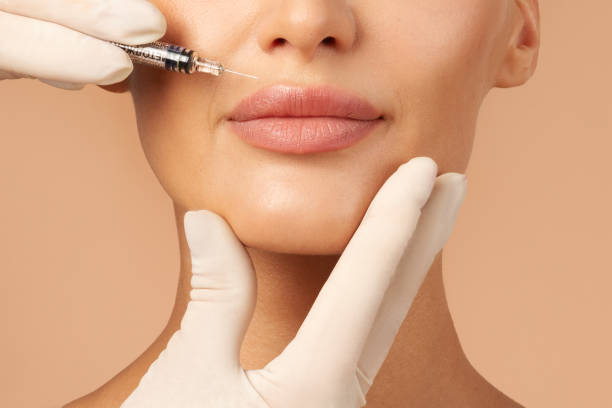

As we age, the midface undergoes a predictable biological shift: the malar fat pads descend and the underlying bone structure begins to resorb. This leads to the “flattening” of the cheeks and the deepening of the nasolabial folds (smile lines). Fillers in Dubai have moved beyond simply filling lines to a more structural approach known as “midface restoration.” By strategically placing high-viscosity gels atop the cheekbones, we can create a lifting effect that rejuvenates the entire lower face. In clinical settings, we observe that cheek augmentation is often the most impactful treatment for those seeking a “liquid facelift” without the downtime of surgery.
The Clinical Logic Behind Cheek Contouring
Cheek augmentation is less about “apple cheeks” and more about restoring the architectural framework of the face.
-
Structural Support: Using “High G-Prime” fillers—products that are firm and resistant to deformation—practitioners can mimic the lift provided by bone.
-
The “Ogee Curve”: This is the double S-curve seen from a three-quarter view of a youthful face. In clinical settings, we aim to restore this curve to provide a soft, healthy reflection of light.
-
Secondary Lifting: By lifting the midface, the skin of the lower face is naturally pulled upward, often softening the appearance of jowls and “marionette” lines without direct treatment.
-
Lateral vs. Medial Volumization: Lateral placement (toward the ears) creates a “contoured” look, while medial placement (toward the nose) restores lost youthful volume.
How Much Pain is Actually Felt During Cheek Injections?
Is the sensation of deep cheek fillers uncomfortable?
Because cheek fillers are often placed deep near the periosteum (the “skin” of the bone), the sensation is different from the “pinch” of lip fillers. Patients typically report a “deep pressure” or a “dull thud” sensation rather than sharp pain, rating it at a 3/10. Based on post-procedure follow-ups, the most significant sensation occurs during the first few seconds of injection as the product creates space in the deep tissue, followed by a localized “numbness” as the Lidocaine takes effect.
Who Should Reconsider Cheek Augmentation?
Are there safety limits for cheek fillers?
In clinical settings, we evaluate the “bony landmarks” of the face. If a patient has significant active sinus congestion or inflammation, we advise postponing the treatment, as the pressure from the filler can exacerbate sinus discomfort. Additionally, individuals with very thin skin must be treated with a specific “layering” technique to avoid the product being visible as a distinct ridge when they smile.
Step-by-Step Patient Sensations During the Contouring Phase
The cheeks are a “high-impact” area, meaning the results are immediate, but the internal settling follows a specific clinical timeline.
-
The “Pressure Shift”: As the filler is deposited, you may feel a sensation of your skin being “stretched” from the inside. This is the mechanical lift occurring in real-time.
-
The First 24 Hours: You may feel “heavy” in the midface. Patients often report that it feels like they are “wearing high-cheekbone prosthetics.”
-
Day 3-5: The tenderness when lying on your side is common. In clinical settings, we suggest sleeping on your back for the first few nights to prevent shifting the product before it integrates.
-
Week 2: The “firmness” softens. The filler now moves perfectly with your zygomaticus muscles when you laugh or talk.
Choosing the Right Contouring Strategy
Which cheek filler approach matches your anatomy?
-
For the “Snatched” Look: Focus on the “Zygomatic Arch” (the outer cheekbone) to create a shadow underneath, mimicking the effect of professional contouring makeup.
-
For Volume Loss Recovery: Focus on the “Sub-Orbital” area to bridge the gap between the lower eyelid and the cheek, eliminating the “tired” look.
-
For Facial Balancing: Using fillers to widen the mid-face slightly in patients with a very narrow or “long” facial structure.
Why Choose Tajmeels Clinic for Midface Restoration?
At Tajmeels Clinic, we understand that “over-filled” cheeks are a common fear. Our approach to Fillers in Dubai is rooted in “MD Codes,” a specialized system of injection points that ensures the filler is placed in the exact vectors needed for a natural lift. We use a combination of needle-point precision for bone-deep support and micro-cannulas for soft-tissue blending. By choosing Tajmeels Clinic, you are choosing a clinical team that prioritizes “Dynamic Symmetry”—ensuring your cheeks look as beautiful when you are laughing as they do when your face is at rest.
Genuine Patient Perspectives
“I was worried about looking like a ‘chipmunk,’ but the doctor at Tajmeels explained that they were building ‘scaffolding,’ not just adding fat. I felt a weird pressure during the treatment, almost like a dull ache, but it was over so fast. Now my jawline looks tighter just because my cheeks are lifted!” — Rania
“The difference was instant. I could see the ‘lift’ in my smile lines immediately. It felt a bit sore to sleep on my side for the first two nights, but by day four, I couldn’t feel the filler at all. It just feels like my own face, but from five years ago.” — Hassan
Frequently Asked Questions
Will cheek fillers make my face look wider?
If placed laterally, they can add slight width; if placed medially, they add forward projection. We balance this based on your face shape.
How long do cheek fillers last?
Because the cheeks are a low-movement area, high-density fillers often last between 12 and 24 months.
Can I wear sunglasses after the procedure?
In clinical settings, we advise avoiding heavy glasses that rest directly on the “apple” of the cheek for the first 48 hours.
Is there a risk of the filler “dropping”?
When injected into the correct anatomical plane (deep supraperiosteal), the filler stays anchored and does not migrate downward.
What if I have a “long” face?
Cheek fillers are excellent for adding horizontal balance to a long face, creating a more heart-shaped or oval silhouette.
Can I get a facial after cheek fillers?
We recommend waiting at least 2 weeks before any deep-tissue facial or massage to ensure the filler has fully settled.