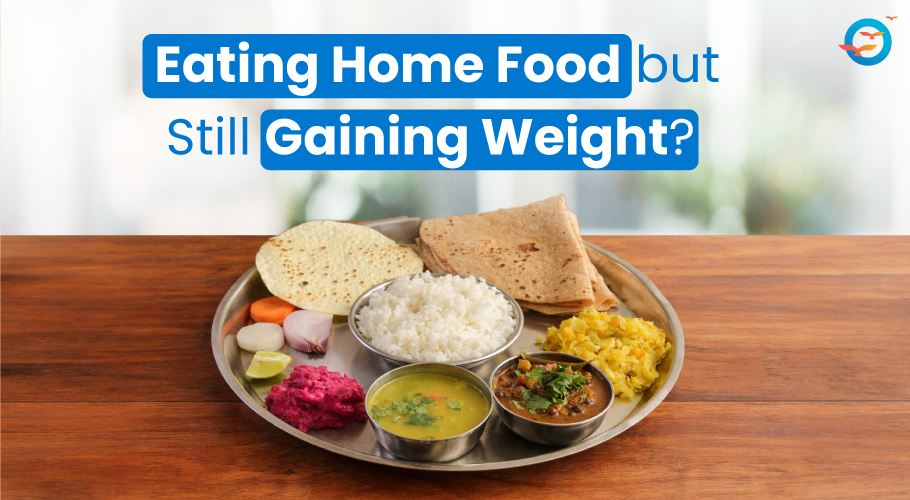

Eating Home-Cooked Food but Still Gaining Weight? Here’s the Real Reason
Many people often say, “I eat only home-cooked food and avoid junk food completely, so why am I still gaining weight?” This confusion becomes very common after the age of 35. Most individuals believe that homemade food automatically protects them from weight gain. While home food is usually healthier and more nutritious than processed food, it does not always guarantee weight control.
Weight gain is not determined only by the type of food you eat. It is also influenced by how many calories your body is capable of burning daily. As we age, the body’s metabolism gradually slows down. Because of this change, the same food quantity that once maintained your weight may slowly begin to increase it.
Understanding how metabolism and calorie balance work can help explain why weight gain happens even with healthy home-cooked meals.
Understanding the Calorie Balance Concept
To understand this situation clearly, imagine your body as a business. Every business has two important numbers: the top line and the bottom line. The top line represents the total revenue, while the bottom line represents the actual profit after expenses.
Food works in a very similar way. The total calories you eat each day represent the top line. The bottom line represents the number of calories your body can burn through metabolism and daily activity.
If your calorie intake is equal to what your body burns, your weight usually stays stable. But if the calories you consume are higher than what your body burns, the extra energy is stored as body fat. Over time, this gradual storage of extra calories leads to weight gain.
This is why calorie balance plays a critical role in weight management.
Why Weight Gain After 35 Is So Common
As we grow older, our metabolism naturally becomes slower. One of the key factors behind this is the reduction in BMR, which stands for Basal Metabolic Rate. BMR refers to the number of calories your body burns at rest just to maintain essential functions such as breathing, circulation, and organ activity.
During the twenties, many individuals have a BMR close to around 2000 calories per day. At this stage, the body burns calories more efficiently, even when physical activity levels are moderate.
However, as people enter their late thirties and forties, the metabolic rate often drops to around 1700 calories per day. This decline may appear small, but it has a significant impact over time.
Even a reduction of around 300 calories in daily calorie burning can slowly lead to weight gain if eating habits remain unchanged.
The Impact of a Small Daily Calorie Surplus
Let us understand this with a simple example. Suppose your body now burns approximately 1700 calories each day, but your daily food intake still provides around 2000 calories. That means you are consuming an extra 300 calories every day.
This daily surplus may seem minor, but when accumulated over time, it becomes significant. If 300 extra calories are stored each day, over the course of a year this equals roughly 90,000 additional calories.
Since approximately 9,000 calories can translate into about one kilogram of body fat, this surplus may lead to nearly 9 to 10 kilograms of gradual weight gain over a year.
This explains why many people feel confused and say they are eating the same food as before but still gaining weight.
Can Home-Cooked Food Still Lead to Weight Gain?
Home-cooked food is undoubtedly healthier compared to fast food or ultra-processed meals. It often contains fewer additives and better ingredients. However, it is still possible to gain weight from home food if portion sizes remain high while metabolism slows down.
For example, a typical Indian meal pattern may include two rotis at lunch, two rotis at dinner, occasional rice, and regular use of cooking oil or ghee. These meal patterns may have worked well during younger years when metabolism and physical activity levels were higher.
But after the age of 35, many people experience reduced activity levels due to work routines, sedentary lifestyles, or hormonal changes. When metabolism slows and calorie burning decreases, the same meal portions may exceed what the body can comfortably burn.
This is where calorie awareness becomes important.
The Importance of Creating a Calorie Deficit
The good news is that weight management does not always require extreme dieting or strict food restrictions. In many situations, a small calorie deficit is enough to bring weight back under control.
A calorie deficit means consuming slightly fewer calories than your body burns. This encourages the body to use stored fat for energy.
Even small dietary adjustments can create this deficit. For example, reducing one roti from a meal, avoiding the combination of rice and roti in the same meal, or slightly reducing excess cooking oil can help lower total calorie intake.
These small changes may create a deficit of about 300 calories per day, which is often enough to gradually reverse weight gain.
Many nutrition experts believe that portion correction is one of the most practical and sustainable approaches to maintaining a calorie deficit.
Why Smart Calorie Management Matters
The real lesson here is that weight gain after the age of 35 is not always caused by unhealthy food choices. Often it happens simply because metabolism slows down while eating habits remain the same.
Your body usually does not require extreme diets or complicated nutrition plans. What it needs is simple calorie awareness and balanced portion control.
When you begin focusing on how many calories your body actually needs, rather than assuming home food is always safe from weight gain, managing body weight becomes much easier.
Understanding the balance between calorie intake and calorie burning can help you maintain a healthy weight even as metabolism naturally changes with age.
To read more, visit:
https://www.freedomfromdiabetes.org/blog/post/eating-home-cooked-food-but-still-gaining-weight/5167