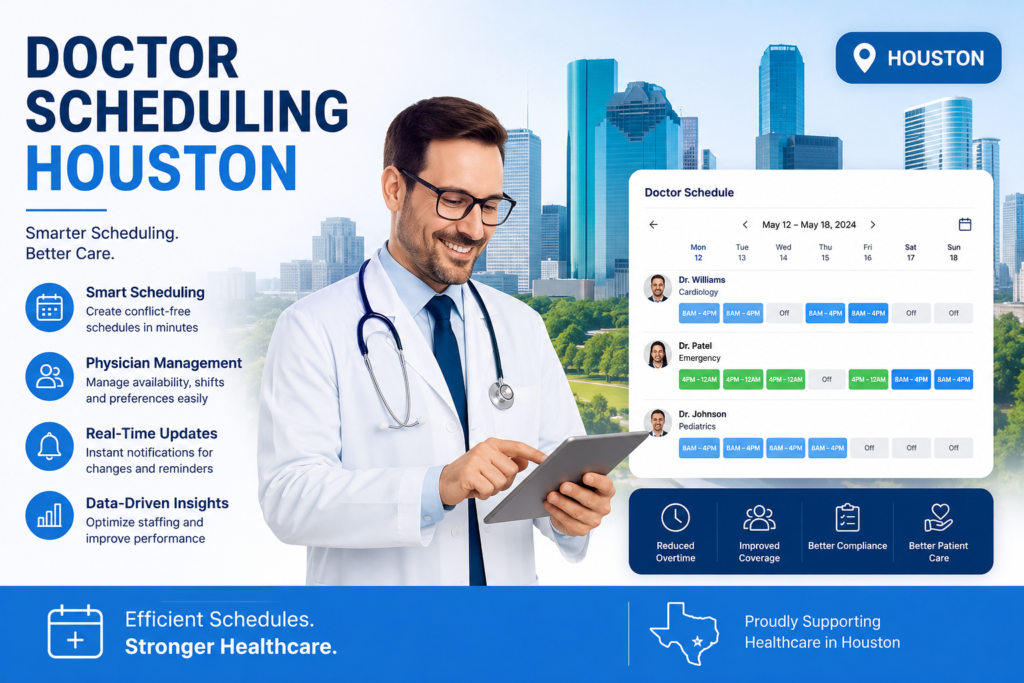

Houston is home to one of the largest and most diverse healthcare ecosystems in the United States. With world-renowned hospitals, specialty clinics, urgent care centers, and physician groups serving a rapidly growing population, healthcare administrators face increasing pressure to maintain efficient staffing while delivering exceptional patient care.
Traditional scheduling methods that rely on spreadsheets, emails, and manual coordination are no longer enough. Today’s healthcare organizations need smarter, faster, and more flexible scheduling solutions to keep up with changing demands.
Here are the top doctor scheduling trends every Houston healthcare administrator should know.
1. Automation Is Replacing Manual Scheduling
Manual scheduling consumes valuable administrative time and often results in conflicts, errors, and last-minute staffing shortages.
Healthcare organizations are increasingly adopting automated scheduling systems that can:
- Build schedules in minutes
- Reduce scheduling conflicts
- Balance physician workloads
- Automatically notify staff about new shifts
- Minimize human error
Automation allows administrators to focus more on operational improvements instead of spending hours adjusting schedules.
2. Mobile Scheduling Has Become Essential
Physicians no longer want to depend on printed schedules or lengthy email chains to know when they’re working.
Modern scheduling platforms provide mobile access that enables doctors to:
- View schedules anytime
- Accept or decline shifts
- Request time off
- Swap shifts with colleagues
- Receive instant notifications
Mobile scheduling improves communication while giving physicians greater flexibility in managing their work-life balance.
3. Shift Swapping Is Becoming More Structured
Unexpected schedule changes are inevitable in healthcare.
Instead of relying on phone calls or text messages, many Houston hospitals are implementing digital shift-swapping features that allow physicians to exchange shifts quickly while maintaining compliance with staffing policies.
Benefits include:
- Faster schedule adjustments
- Reduced administrative workload
- Better physician satisfaction
- Fewer uncovered shifts
A structured process helps ensure every shift remains fully staffed.
4. Data-Driven Scheduling Improves Workforce Planning
Healthcare administrators now rely heavily on analytics to make scheduling decisions.
Scheduling software can provide insights into:
- Overtime hours
- Staffing shortages
- Peak patient demand
- Physician workload distribution
- Shift coverage trends
These reports help organizations optimize staffing while reducing unnecessary labor costs.
Instead of guessing staffing needs, administrators can make informed decisions based on real operational data.
5. Physician Burnout Is Influencing Scheduling Strategies
Burnout remains one of the biggest challenges facing healthcare organizations.
Poor scheduling practices often contribute to:
- Excessive consecutive shifts
- Uneven workload distribution
- Limited recovery time
- Increased stress
Modern scheduling systems help administrators create fair schedules by balancing shifts across providers and honoring availability whenever possible.
A healthier scheduling strategy contributes to better physician retention and improved patient care.
6. Real-Time Notifications Reduce Communication Delays
Communication delays often create scheduling problems.
Today’s scheduling platforms send instant alerts when:
- New shifts become available
- Schedules are updated
- Shift swaps are approved
- Coverage is needed
- Time-off requests are accepted
Real-time notifications eliminate confusion and ensure physicians always have the latest schedule information.
7. Cloud-Based Scheduling Is Becoming the Standard
Cloud technology has transformed healthcare workforce management.
Cloud-based scheduling systems allow authorized users to access schedules securely from virtually anywhere.
Advantages include:
- Automatic updates
- Secure data storage
- Easy collaboration
- Reduced IT maintenance
- Remote access for administrators
This flexibility is particularly valuable for healthcare organizations with multiple facilities across Houston.
8. Compliance Is Built Into Scheduling Platforms
Healthcare organizations must comply with various staffing policies, credential requirements, and labor regulations.
Modern scheduling software can automatically identify issues such as:
- Credential expirations
- Maximum work-hour limits
- Required rest periods
- Specialty coverage requirements
Built-in compliance checks reduce administrative risk while helping maintain high standards of patient care.
9. Flexible Scheduling Is Improving Physician Satisfaction
Today’s physicians value flexibility more than ever.
Healthcare organizations are responding by offering:
- Self-scheduling options
- Flexible shift preferences
- Part-time scheduling
- Customized availability
- Easier shift trading
Greater flexibility helps attract talented physicians while improving long-term retention.
A satisfied workforce often translates into better patient experiences.
10. AI Is Beginning to Enhance Scheduling Decisions
Artificial intelligence is becoming an important part of healthcare scheduling.
AI-powered scheduling tools can analyze multiple factors simultaneously, including:
- Historical patient volume
- Physician availability
- Department demand
- Staffing patterns
- Leave requests
The result is smarter schedules that improve efficiency while reducing scheduling conflicts.
Although AI won’t replace administrators, it can significantly reduce the time required to build optimized schedules.
11. Integrated Workforce Management Is Growing
Many healthcare organizations now prefer integrated solutions instead of using separate systems for scheduling, communication, payroll, and workforce management.
Integrated platforms allow administrators to:
- Manage schedules
- Track attendance
- Monitor staffing levels
- Coordinate shift changes
- Improve communication
Centralized workforce management simplifies operations and reduces administrative complexity.
12. Patient Demand Is Driving Dynamic Scheduling
Patient volumes can fluctuate significantly depending on the season, specialty, or unexpected events.
Dynamic scheduling enables healthcare organizations to quickly adjust staffing levels based on:
- Emergency department demand
- Clinic appointments
- Seasonal illnesses
- Public health events
- Physician availability
This adaptability ensures healthcare providers can respond efficiently without overstaffing or understaffing.
Why These Trends Matter for Houston Healthcare?
Houston’s healthcare industry continues to expand, creating new opportunities and challenges for hospitals and medical groups.
Organizations that embrace modern scheduling technologies benefit from:
- Improved operational efficiency
- Better physician engagement
- Lower administrative workload
- Reduced scheduling errors
- Enhanced patient care
- Greater workforce flexibility
- Better compliance management
As competition for skilled physicians increases, efficient scheduling is becoming a strategic advantage rather than simply an administrative task.
Conclusion
Doctor scheduling is evolving rapidly, and healthcare administrators in Houston must adapt to meet the changing needs of physicians, patients, and healthcare organizations. Automation, mobile accessibility, AI-powered scheduling, cloud-based platforms, analytics, and flexible workforce management are shaping the future of physician scheduling.
Investing in the right scheduling solution not only improves operational efficiency but also enhances physician satisfaction, reduces burnout, and ensures consistent patient care. Shiftolic helps healthcare organizations simplify doctor scheduling with smart automation, real-time communication, mobile access, and flexible shift management, making it easier to build efficient schedules and support a more productive healthcare workforce.