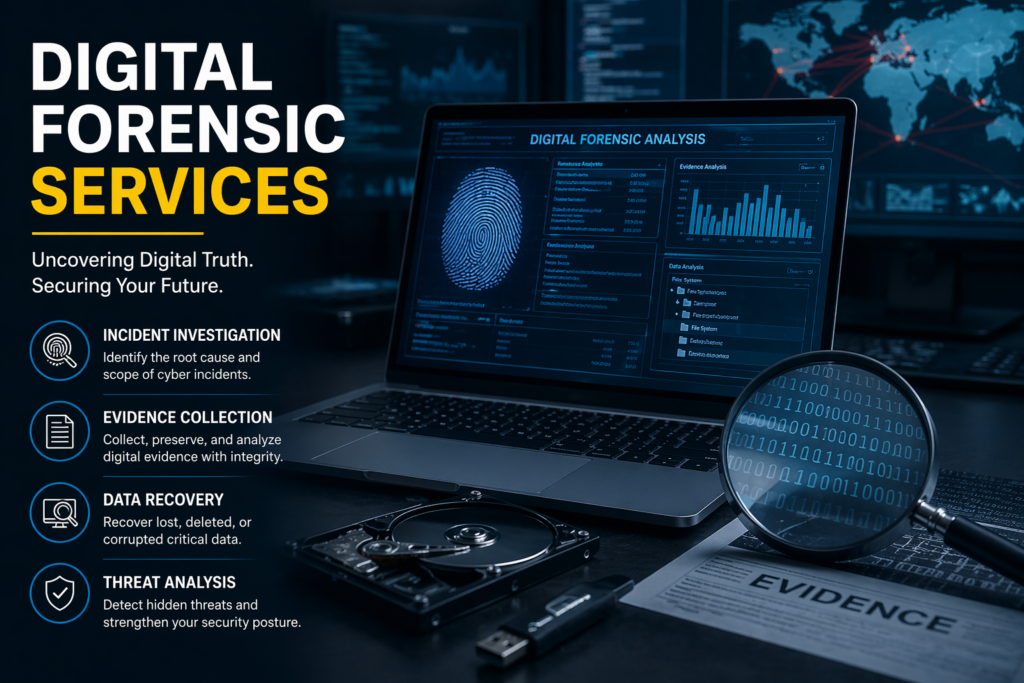

In today’s digital landscape, businesses are generating and storing more data than ever before. From customer information to financial records, everything exists in digital form. While this brings efficiency and growth, it also introduces serious risks. Cyberattacks, data breaches, and insider threats are no longer rare—they are becoming a regular challenge for organizations of all sizes.
But here’s the real concern: when something goes wrong, most businesses don’t know exactly what happened.
This is where Digital Forensic Services step in—not just to investigate, but to uncover the complete truth behind cyber incidents.
What Makes Digital Forensic Services So Important?
Digital forensics is the process of identifying, collecting, analyzing, and preserving digital evidence in a way that maintains its integrity . It goes far beyond basic troubleshooting by following a structured and legally sound approach.
In simple terms, it helps answer critical questions:
- How did the breach happen?
- What data was affected?
- Who was responsible?
- Is the threat still active?
Without these answers, businesses are left exposed to repeated attacks and ongoing risks.
The Shift from Prevention to Investigation
Most organizations invest heavily in cybersecurity tools like firewalls and antivirus systems. While these are important, they focus mainly on prevention.
However, modern cyber threats are sophisticated. Attackers often bypass security systems and operate silently within networks. By the time a breach is detected, damage may already be done.
Digital forensic services focus on what comes next—understanding the incident in depth.
They help organizations move from confusion to clarity by analyzing digital footprints left behind during an attack.
How Digital Forensic Services Work
A proper digital forensic investigation follows a systematic process to ensure accuracy and reliability.
1. Identification of Evidence
Experts locate potential sources of data such as servers, devices, emails, and network logs. Every digital interaction leaves a trace that can be analyzed.
2. Preservation of Data
Once identified, the data is secured to prevent tampering. Maintaining data integrity is critical because even minor changes can impact the investigation.
3. Analysis and Reconstruction
This is where the real investigation begins. Experts analyze system behavior, logs, and user activity to reconstruct the sequence of events and uncover hidden threats.
4. Reporting and Documentation
Finally, all findings are documented in a clear report. This includes the timeline of events, method of attack, and actionable recommendations.
This structured approach ensures that the investigation is both technically accurate and legally reliable.
Real-World Applications of Digital Forensic Services
Digital forensic services are used in a wide range of scenarios, not just large-scale cyberattacks.
Some common use cases include:
- Data breach investigations
- Ransomware attack analysis
- Insider threat detection
- Financial fraud investigations
- Legal disputes involving digital evidence
Digital evidence today plays a role in a vast majority of cases, as almost every activity leaves a digital footprint .
This makes digital forensics a crucial tool for both cybersecurity teams and legal authorities.
Why Businesses Can’t Ignore Digital Forensics
One of the biggest misconceptions is that digital forensics is only needed after a major incident. In reality, it is an essential part of a strong cybersecurity strategy.
Here’s why:
Clear Decision-Making
During a cyber incident, panic and uncertainty can lead to poor decisions. Digital forensics provides factual insights that guide the right response.
Faster Recovery
By identifying affected systems quickly, businesses can reduce downtime and resume operations faster.
Stronger Security
Every investigation reveals vulnerabilities. Fixing these gaps helps prevent future incidents.
Legal and Compliance Support
Properly handled digital evidence can be used in court and helps organizations meet regulatory requirements.
The Role of Digital Forensic Experts
Digital forensic investigations require specialized skills and tools. It’s not just about analyzing data—it’s about interpreting it correctly.
Experts use advanced techniques to:
- Recover deleted or hidden data
- Detect sophisticated malware
- Trace attacker activity across systems
- Ensure evidence remains admissible
Their expertise ensures that businesses get accurate, reliable, and actionable insights.
The Rising Complexity of Cyber Threats
As technology evolves, cyber threats are becoming more complex. With cloud computing, mobile devices, and IoT systems, digital environments are more interconnected than ever.
This means:
- More entry points for attackers
- More data to analyze
- More challenges in tracking incidents
Digital forensics adapts to these changes by using advanced tools and techniques to analyze data across multiple platforms.
Looking Ahead: The Future of Digital Forensic Services
The importance of digital forensics will continue to grow as businesses become more digital.
Future trends include:
- AI-driven forensic analysis
- Cloud and mobile forensics expansion
- Real-time incident investigation
- Integration with cybersecurity systems
Organizations that invest in digital forensic services today will be better prepared for tomorrow’s challenges.
Final Thoughts
Cybersecurity is no longer just about preventing attacks—it’s about understanding them.
Digital forensic services provide that understanding. They uncover hidden threats, reveal the truth behind incidents, and help businesses recover with confidence.