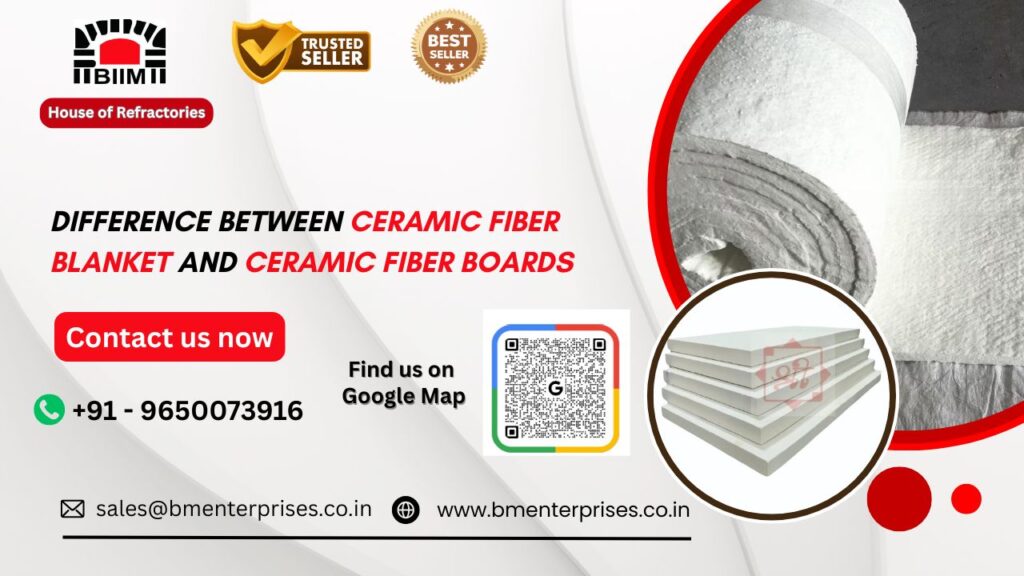
Selecting the correct insulation material is critical in order to ensure maximum energy efficiency and stability during high-temperature operations. Ceramic fiber blankets and ceramic fiber boards are some of the most commonly utilized types of refractory insulations. Although these two types of insulation are made using high-purity ceramic fibers, they differ greatly in terms of construction, resistance, and application.
BM Enterprises is one of the leading distributors of refractory materials across the globe. Our company helps our customers select the best type of insulation material required by their operations. The following discussion highlights the significant differences between these two types of insulation.
What are Ceramic Fiber Blankets?
Ceramic fiber blankets are lightweight and flexible materials that serve as insulating products made from needling ceramic fibers of high purity into a single continuous mat without binders. Ceramic fiber blankets have low thermal conductivity, great resistance to thermal shock, and good installability.
Ceramic insulating blankets find application wherever there is a requirement for flexibility and high heat retention properties. They are highly adaptable due to their unique composition and properties.
Technical Specifications
Highest Service Temperature: Available in three varieties – 1260°C, 1430°C, and 1600°C
Density Range: 64 kg/m³ up to 192 kg/m³
Thermal Conductivity: As low as 0.08-0.18 W/m•K, depending upon the temperature
Tensile Strength: Strong because of fiber interlock
Linear Shrinkage: Below 3% when operated at maximum temperature
Heat Storage Capacity: Very low, resulting in faster heating and cooling of the furnace
Chemical Composition: Fiber of alumina (Al₂O₃) and silica (SiO₂)
Thermal Shock Resistance: Highly resistant to thermal shock
Sound Insulation: Provides good sound absorption
Key Features of Ceramic Fiber Blankets
Lightweight and flexible construction
Superior thermal insulating capabilities
Low heat capacity
Very good thermal shock resistance
Easily cut and installed
Useful at temperatures between 1260°C and 1430°C and higher, based on grades
Common Applications
Furnace linings
Kiln insulation
Boiler insulation
Expansion joint packing
Insulation of pipes and ducts
Petrochemical processing plants
Heat treating furnaces
What are Ceramic Fiber Boards?
Ceramic fiber boards represent rigid insulating materials produced by the vacuum forming of ceramic fibers together with the use of specially formulated binders and additives. The end product is characterized by high rigidity and great heat insulation properties.
In contrast to ceramic fiber blankets, ceramic fiber boards have the capacity to support themselves and are strong enough to endure mechanical loads.
Technical Specifications
Maximum Operating Temperature: Grades available are 1260°C, 1430°C, and 1600°C
Density: Available in a density range of 250 kg/m³ to 450 kg/m³
Thermal Conductivity: Thermal conductivity is about 0.10 to 0.22 W/m.K
Compressive Strength: Has high compressive strength
Cold Crushing Strength: Cold crushing strength is very good compared to blanket insulators
Linear Shrinkage: Generally lower than 2% in operational temperature
Modulus of Rupture: Offers a high modulus of rupture
Surface Characteristics: Surface finish is smooth and hard
Thickness: Available in a thickness range from 10 mm to 100 mm and above
Gas Resistance: Offers excellent gas velocity resistance
Key Features of Ceramic Fiber Boards
High compression resistance
Strong and durable structure
High-dimensional stability
Low thermal conductivity
High erosion and gas resistance
Easy machining and fabrication
Common Applications
Backup refractory materials for furnaces
Hot face insulation material
Kiln car insulation material
Burner blocks
Refractory structural supports
Expansion joint panels
High temperature industrial equipments
Ceramic Fiber Blanket vs Ceramic Fiber Board: Key Differences
1. Physical Composition
Their composition is the key difference between them.
Ceramic fiber blankets are flexible and light and can be used around any shape pipes, tanks, or other vessels.
Ceramic fiber boards are hard and heavy and provide excellent stability in installation.
2. Mechanical Stability
Ceramic fiber blankets do not have good compressive strength and resistance to impact because of their flexible form.
Ceramic fiber boards show great stability under loads and are capable of supporting structures even in very high temperatures.
3. Installation Process
Ceramic fiber blankets are easy to install because they can be cut into different shapes and sizes.
Ceramic fiber boards are harder to install, but fit perfectly in places where you need something rigid and reliable.
4. Resistance to Gases Flow and Abrasion
For processes with a significant amount of gas flow, ceramic fiber boards prove to be more efficient because of their rigidity.
Ceramic fiber blankets require protective measures from gas flow.
5. Thermal Performance
Both materials exhibit high-quality insulation against heat and poor thermal conductivity. Ceramic fiber blankets usually have a marginally reduced capacity to store heat owing to their lesser density, whereas ceramic fiber boards possess greater structural integrity.
6. Economic Performance
Ceramic fiber blankets are cheaper when used in large-scale insulation operations.
The upfront cost of ceramic fiber boards may be relatively higher, but they offer mechanical strength in addition to increased longevity.
Technical Comparison Table
Property
Ceramic Fiber Blanket
Ceramic Fiber Board
Structure
Flexible
Rigid
Density
Low to Medium
Medium to High
Mechanical Strength
Moderate
High
Thermal Conductivity
Excellent
Excellent
Thermal Shock Resistance
Excellent
Excellent
Installation
Easy for curved surfaces
Ideal for flat surfaces
Erosion Resistance
Moderate
High
Cost
Economical
Slightly Higher
Typical Applications
Furnaces, Boilers, Pipes
Burner Blocks, Kilns, Structural Insulation
Which Insulation Material Should You Choose?
The decision to use either a ceramic fiber blanket or board depends on the particular needs of the application.
Ceramic fiber blankets should be considered when:
Flexibility of insulation is needed.
There are irregularly shaped surfaces for the equipment.
Lightweight insulation is essential.
Cost-effectiveness is key in terms of large surface coverage.
Ceramic fiber boards should be preferred when:
Strength is an essential quality.
There is mechanical wear on the insulation.
Resistance to air flow is necessary.
Dimensions are stable.
Many industrial processes employ both materials in combination to ensure maximum thermal performance.
Why Choose BM Enterprises?
Reputable supplier of superior-quality ceramic fiber blankets and ceramic fiber boards for industrial purposes requiring high temperatures.
Developed for effective heat resistance, energy conservation, and durability.
Suitable for applications involving furnaces, kilns, boilers, steel works, foundries, and petrochemical industries.
Ensures consistency in product quality along with technical and industrial knowledge.
Offers competitive pricing along with prompt delivery services to all industrial areas in India.
Customer-friendly support for choosing the most efficient heat-insulating material.
In BM Enterprises, we not only offer insulation products but also assist industries in becoming more thermally efficient.
Conclusion
Ceramic Fiber Blankets and Ceramic Fiber Boards both have significant roles to play in current industrial insulation applications. Whereas Ceramic Fiber Blankets give great versatility and easy installation, Ceramic Fiber Boards give greater strength and durability. Getting an understanding of what makes Ceramic Fiber Blankets different from Ceramic Fiber Boards will help industries achieve better thermal performance, save energy, and increase equipment longevity. If you require ceramic insulation that guarantees maximum performance, look no further than BM Enterprises, which offers top-of-the-line ceramic insulation products in all Indian markets.