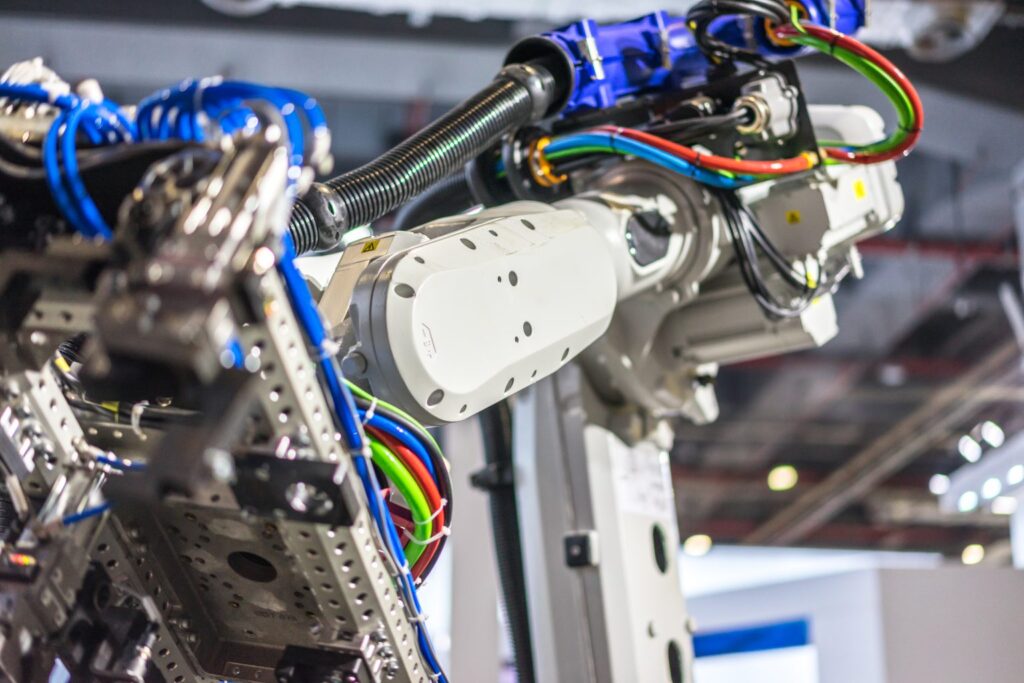

Spend enough time around industrial robotics and you start to notice a pattern. When a robotic system goes down unexpectedly, the first things people check are the controller, the software, the mechanical components. The wire harness is usually an afterthought right up until it turns out to be the actual problem.
This isn’t a criticism of how engineers think. It’s just a reflection of where attention naturally goes. Robots are complex, impressive machines, and the wiring that connects everything tends to be invisible until it fails. But the robot wire harness is doing some of the hardest mechanical work in the entire system, and it deserves a lot more consideration than it typically gets during the design phase.
What a Robot Wire Harness Actually Goes Through
Think about what happens to a wire harness routed through a six-axis industrial robot arm during normal operation. Every time the arm moves and in a production environment, that might be thousands of times per shift the harness flexes, twists, compresses, and stretches along with it. The conductors inside experience mechanical stress with every cycle. Over time, conductors with insufficient strand count develop fatigue cracks. Insulation that isn’t rated for continuous flexing develops micro-fractures. Terminations that weren’t designed with strain relief start to loosen at the contact point.
None of this happens dramatically. It happens gradually, which is worse because the failures tend to show up as intermittent faults that are difficult to diagnose and reproduce. A robot that occasionally misses a position or produces a random fault code and then recovers is often a robot with a harness that’s in early stages of failure.
The mechanical environment inside a robotic system is genuinely demanding, and the materials and construction methods used in a robot wire harness must be chosen with that reality in mind from the very beginning.
Conductor Selection Is Not a Minor Decision
For static wiring applications, conductor specification is relatively straightforward. For a robot wire harness, it’s one of the most consequential decisions in the design.
High-strand flexible conductors sometimes called fine-stranded or extra-flexible conductors are specifically engineered to resist the fatigue that comes from repeated bending and twisting. Compared to standard conductors of the same gauge, they have far more individual strands of finer wire, which distributes mechanical stress across a larger number of contact points and dramatically extends flex life.
Using standard conductors in a continuously moving robotic application isn’t a cost saving it’s a deferred failure. The conductor will fatigue, and when it does, the failure will happen inside an assembled robot that requires significant downtime to diagnose and repair. The cost of using the right conductor from the start is a fraction of that.
Connector Integrity Under Vibration and Motion
The other area where robot wire harness failures concentrate is at terminations. Connectors in robotic applications experience the same mechanical stress as the conductor’s vibration transmitted through the robot structure, forces applied during cable flexing, and in some cases direct mechanical stress from cable movement.
Over moulded connectors address this by encasing the termination zone in a protective material that physically prevents any pulling or twisting force from reaching the electrical contact. Strain-relieved designs accomplish something similar through mechanical features that absorb movement before it reaches the termination. In a static installation these features are nice to have. In a robot wire harness that moves continuously, they’re essential.
Sealed connectors add protection against contaminants coolant mist, metal particles, cleaning agents that are common in industrial environments and can cause corrosion or shorting at exposed contacts over time.
Signal Integrity in Mixed Environments
Modern robotic systems integrate motor power, encoder signals, sensor inputs, and communication bus signals often running in proximity through the same harness. Without proper shielding and cable organization, power conductors induce noise into signal lines, causing encoder errors, sensor dropouts, and communication faults that can be extremely difficult to trace back to their source.
Shielding design for a robot wire harness isn’t just about wrapping cables in foil. It involves understanding which signal types are susceptible to interference, what frequencies the power conductors generate, and how to route and terminate shielding properly to drain induced noise rather than creating ground loops. These are engineering decisions that require application knowledge, not just catalogue selection.
Why the Manufacturing Partner Matters
Stantek, based in Stanton, Kentucky, works specifically with robotics OEMs, automation integrators, and specialty robotic platform developers to design and manufacture custom robot wire harness assemblies from early prototype through low-to-mid volume production. Their engineering team provides manufacturability feedback during design which is where most harness problems are most efficiently resolved and builds every assembly to WHMA-A-620 Class 3 and ISO 9001:2015 standards with 100% electrical testing before delivery. For OEMs building systems that need to perform reliably in demanding automation environments, that combination of early engineering involvement and rigorous production quality makes a real difference.
Routing: The Detail That Often Gets Skipped
Cable routing through a robotic system affects both harness longevity and system performance. Conductors routed with insufficient bend radius at joints will fatigue faster regardless of conductor quality. Cables routed near heat sources without consideration of thermal ratings will degrade insulation prematurely. Harnesses that aren’t properly managed and secured will move unpredictably, causing interference with mechanical components and inconsistent flexing patterns that accelerate wear.
Good routing design accounts for the full range of robot motion, identifies the points of maximum flex stress, and ensures that the harness is supported and guided in a way that produces consistent, predictable movement with every cycle. This is typically handled during design review which is another reason why involving the harness manufacturer early in the design process pays off.
What to Look for When Sourcing a Robot Wire Harness
If you’re specifying or sourcing a custom robotics wiring harness, a few things are worth prioritizing. First, confirm that the manufacturer has actual experience with moving/flexing harness applications static wiring experience doesn’t automatically transfer. Second, ask specifically about conductor flex ratings and how they select conductors for robotic applications. Third, understand their testing protocols continuity testing and insulation resistance testing should be standard on every unit, not sampled. Fourth, evaluate whether they can support your development timeline with prototype builds before committing to production quantities.
The robot wire harness is not where most automation engineers want to spend their energy. But it’s where a significant share of robotic system reliability problems originates. Getting it right from the start, with materials and construction methods appropriate for the actual operating environment, is one of the more straightforward investments in long-term system performanc