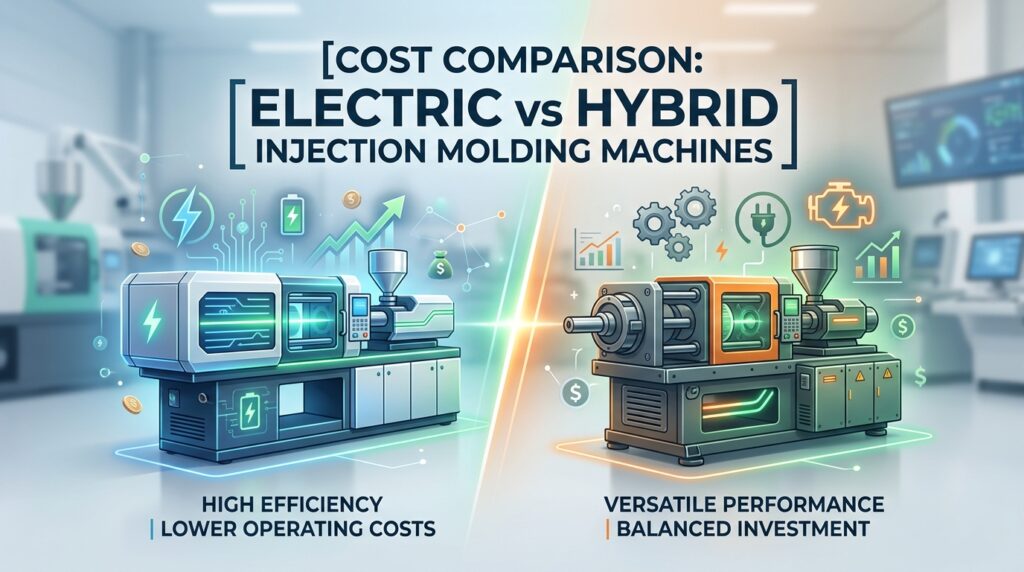

Investing in the right injection molding machine can shape the future of any manufacturing business. The machine you choose influences production speed, energy consumption, maintenance costs, product quality, and long-term profitability. That is why many manufacturers compare electric injection molding machines and hybrid injection molding machines before making a final decision.
Both machine types offer clear advantages over traditional hydraulic systems. However, they differ in operating efficiency, purchase cost, maintenance needs, and production performance. Some factories focus on lower upfront investment, while others prioritize long-term savings and precision.
So, which option is the better choice for modern production? The answer depends on your production goals, industry standards, and operating priorities. This guide explores the real cost comparison between electric and hybrid injection molding machines to help manufacturers make a smarter investment decision.
1. Understanding Electric Injection Molding Machines
Electric injection molding machines use advanced servo motors to control every key movement, including injection, clamping, screw rotation, and ejection. Because these functions are digitally controlled, the machine delivers excellent precision and repeatability. Many manufacturers prefer systems developed by a reliable electric injection molding machine manufacturer to ensure consistent quality and long-term performance.
Key Benefits of Electric Machines
- High accuracy and consistent part quality
- Lower energy consumption
- Quiet and clean operation
- Reduced maintenance requirements
- Faster response times
These machines are commonly used in industries such as electronics, medical manufacturing, packaging, and automotive components, where quality standards are strict.
2. Understanding Hybrid Injection Molding Machines
Hybrid injection molding machines combine electric technology with hydraulic power. Some functions are managed by servo motors, while others rely on hydraulic systems. This design aims to balance performance and cost.
Key Benefits of Hybrid Machines
- Lower purchase price than full electric systems
- Strong clamping force
- Good performance for general molding needs
- Better energy efficiency than traditional hydraulic machines
- Suitable for a wide range of products
Hybrid machines are often selected by manufacturers seeking a practical mix of affordability and productivity.
3. Initial Investment Comparison
One of the first factors businesses consider is the purchase cost. In many cases, hybrid machines are more affordable than electric machines at the time of purchase.
Electric machines usually cost more because they use advanced servo systems, high-precision controls, and premium components. Hybrid machines often provide a lower barrier to entry, especially for businesses with limited capital budgets.
However, focusing only on the purchase price can be misleading. A lower initial investment does not always mean lower total ownership cost.
4. Energy Consumption and Utility Costs
Energy costs have become a major concern for manufacturers worldwide. Machine efficiency can significantly affect monthly operating expenses.
Electric machines consume energy only when movement occurs. This makes them highly efficient during production cycles. Hybrid machines are more efficient than hydraulic systems, but they still use hydraulic components that can increase energy usage.
Why Electric Machines Often Win on Energy
- No continuous hydraulic pump demand
- Lower heat generation
- Efficient servo motor operation
- Better energy use during idle periods
For factories running multiple shifts, lower energy usage can create substantial long-term savings.
5. Maintenance Cost Comparison
Maintenance is another major factor in cost analysis. Electric machines typically require less maintenance because they do not depend heavily on hydraulic systems.
Electric Machine Maintenance Advantages
- No hydraulic oil management
- Fewer leak risks
- Reduced pump and valve servicing
- Cleaner machine environment
Hybrid machines still require maintenance of hydraulic components such as hoses, valves, seals, and oil systems. While maintenance needs are lower than traditional hydraulic models, they are usually higher than those of all-electric systems.
For manufacturers seeking predictable operating costs, electric machines often provide an advantage.
6. Productivity and Production Speed
Modern factories need machines that deliver speed without sacrificing quality. Electric injection molding machines are known for fast acceleration, precise stopping points, and consistent cycle performance.
Benefits of Electric Speed Control
- Shorter cycle times
- Improved repeatability
- Better synchronization
- Reduced variation between parts
Hybrid machines also offer strong productivity, but electric systems often perform better in high-speed and precision-demanding environments.
7. Product Quality and Scrap Reduction
Production waste affects profitability. Scrap parts increase raw material costs, labor loss, and machine downtime.
Electric machines provide superior control over:
- Injection speed
- Pressure accuracy
- Screw positioning
- Clamping movement
This higher control level often results in:
- Fewer short shots
- Less flash
- Better dimensional consistency
- Improved surface finish
Hybrid machines can produce excellent results, but electric systems usually perform better where tolerance requirements are tight.
8. Best Use Cases for Electric Machines
Electric machines are ideal for:
- Medical components
- Electronic connectors
- Thin-wall packaging
- Precision automotive parts
- Cleanroom production environments
Manufacturers that prioritize quality, energy savings, and low maintenance often choose electric systems.
9. Best Use Cases for Hybrid Machines
Hybrid machines are a strong choice for:
- General plastic product manufacturing
- Medium to heavy molded parts
- Businesses seeking a lower upfront cost
- Operations transitioning from hydraulic systems
They offer a practical balance between performance and investment.
10. Which Machine Offers Better Long-Term Value?
The answer depends on your priorities.
If your factory values:
- Lower operating costs
- Precision production
- High efficiency
- Reduced maintenance
- Better environmental performance
Then, electric machines are often the better long-term investment.
If your business values:
- Lower purchase cost
- Strong general performance
- Flexible application range
Then hybrid machines may be the right fit.
Conclusion
Choosing between electric and hybrid injection molding machines requires a complete view of cost, performance, and long-term value. While hybrid systems may offer a lower starting price, electric machines often deliver better efficiency, lower maintenance, improved quality control, and stronger long-term savings. Manufacturers should evaluate not only today’s budget but also tomorrow’s operating demands.
Paheej Machinery helps manufacturers select advanced injection molding solutions based on production goals, product quality standards, and business growth plans. With a focus on reliability, efficiency, and modern manufacturing technology, Paheej Machinery supports companies in making smart investments that improve productivity and long-term success.