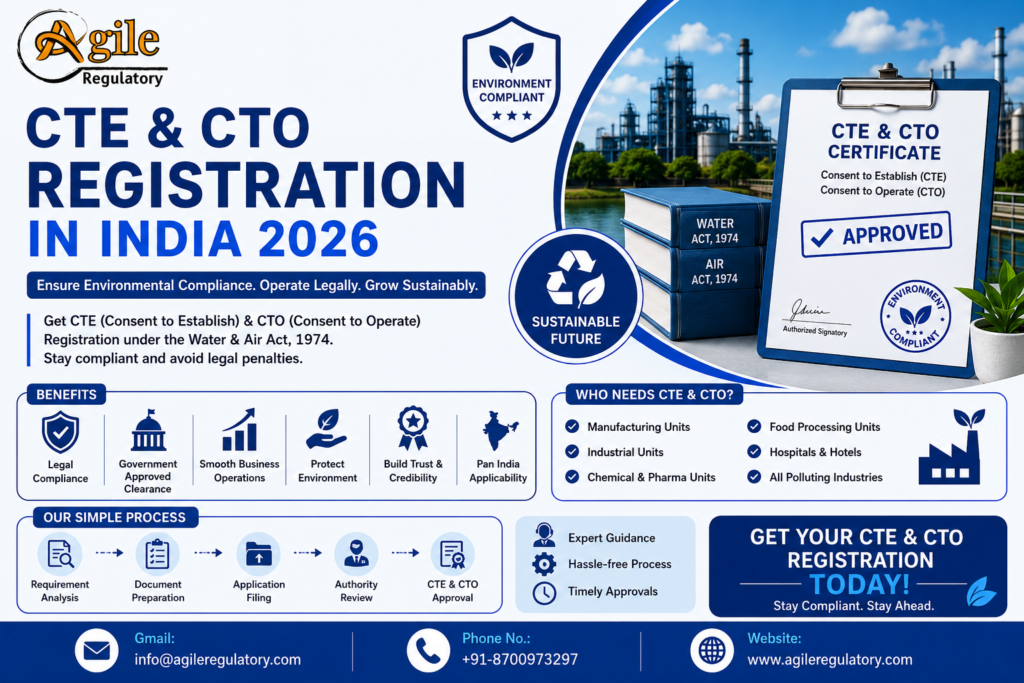

Understand Consent to Establish Requirements Before Starting Industrial Operations
Introduction
Before setting up a manufacturing unit, factory, processing plant, warehouse, healthcare facility, or commercial project, businesses must obtain various regulatory approvals to ensure legal compliance. One of the most important environmental approvals required during the project planning stage is Consent to Establish (CTE).
This approval is granted by the respective Pollution Control Board and confirms that the proposed project meets environmental requirements before construction or installation begins. Obtaining Consent to Establish at the right stage helps businesses avoid regulatory delays, penalties, and operational complications.
Whether you are establishing a new industry or expanding an existing facility, understanding the CTE process is essential for smooth project implementation.
What is Consent to Establish?
Consent to Establish is an environmental approval issued before a business begins construction, installation, or establishment of an industrial or commercial unit.
The approval allows authorities to review the proposed activities and assess potential environmental impacts.
Businesses generally need to obtain this approval before starting project development activities.
The objective is to ensure that adequate pollution control measures are incorporated during the planning phase.
Proper compliance helps support sustainable industrial development.
Why is Consent to Establish Important?
Environmental regulations require industries to evaluate pollution control measures before operations begin.
CTE helps authorities ensure that proposed projects comply with environmental norms related to air emissions, wastewater management, solid waste disposal, and pollution control infrastructure.
Obtaining approval at an early stage reduces future compliance challenges.
The approval also supports smoother licensing and operational clearances.
For many industries, CTE is a mandatory regulatory requirement.
Relationship Between Consent to Establish and Consent to Operate
After obtaining project approval and completing installation activities, businesses generally apply for Consent to Operate.
Consent to Establish is obtained before setting up the facility, while Consent to Operate is obtained before commencing commercial operations.
Both approvals are important components of environmental compliance.
Authorities evaluate compliance with approved conditions before granting operational permission.
Businesses should maintain continuous compliance throughout the project lifecycle.
Role of Pollution Control Board
The Pollution Control Board is responsible for reviewing applications and granting environmental approvals.
The authority evaluates project details, manufacturing processes, pollution potential, and proposed environmental safeguards.
Applicants must submit accurate documentation and comply with applicable regulations.
Understanding board requirements significantly improves approval efficiency.
Proper planning helps avoid unnecessary delays.
Pollution Control Board Online Registration
Many authorities now provide Pollution Control Board Online Registration systems to simplify application management.
Online platforms allow businesses to submit applications, upload documents, track status updates, and manage compliance requirements digitally.
The online process improves accessibility and reduces administrative burdens.
Digital systems also support faster communication between applicants and authorities.
Businesses should ensure that all submitted information is accurate and complete.
Role of State Pollution Control Board
Each State Pollution Control Board is responsible for implementing environmental regulations within its jurisdiction.
The authority processes applications, monitors compliance, conducts inspections, and grants environmental approvals.
Businesses must comply with state-specific requirements depending on the location of the project.
Understanding local regulatory obligations helps improve approval success rates.
Proper coordination with the relevant authority is essential.
Who Requires Consent to Establish?
Various industrial and commercial projects may require Consent to Establish.
These generally include:
- Manufacturing Units
- Food Processing Industries
- Chemical Plants
- Pharmaceutical Companies
- Engineering Units
- Packaging Industries
- Healthcare Facilities
- Warehousing Projects
Businesses should evaluate environmental compliance requirements before commencing project development.
Early approval helps prevent regulatory complications.
Documents Required for CTE Approval
Applicants generally need supporting documentation during the application process.
Common documents may include:
- PAN Card
- GST Registration Certificate
- Business Registration Documents
- Site Plan
- Land Ownership Documents
- Manufacturing Process Details
- Project Report
- Identity Proof
Providing complete and accurate documentation significantly improves processing efficiency.
Benefits of Obtaining Consent to Establish
Obtaining CTE offers several important advantages.
It supports legal compliance, facilitates project approvals, improves environmental planning, and strengthens regulatory standing.
Approved projects often experience fewer compliance-related obstacles during subsequent licensing procedures.
The approval also demonstrates commitment to environmental responsibility.
For many businesses, compliance contributes to sustainable growth.
Common Challenges During the Application Process
Applicants may encounter challenges related to documentation preparation, project classification, environmental compliance requirements, and procedural formalities.
Incomplete submissions can result in delays and additional clarification requests.
Understanding regulatory obligations before filing applications significantly improves efficiency.
Professional guidance often helps businesses avoid common compliance mistakes.
Proper planning remains essential throughout the approval process.
Why Choose Agile Regulatory?
Agile Regulatory provides comprehensive support for Consent to Establish and environmental compliance services across India.
Our services include eligibility assessment, documentation preparation, application filing, compliance review, regulatory coordination, and end-to-end approval assistance.
Our experienced professionals help businesses secure approvals efficiently while ensuring complete compliance with environmental regulations.
Conclusion
Consent to Establish is a critical environmental approval required before setting up industrial and commercial projects in India. Proper compliance helps businesses obtain regulatory clearance, avoid legal complications, and establish environmentally responsible operations. By understanding approval requirements, documentation obligations, Pollution Control Board procedures, and environmental compliance expectations, businesses can build a strong foundation for successful project implementation. Agile Regulatory provides complete assistance throughout the approval process, helping businesses secure permissions smoothly and efficiently.
Frequently Asked Questions (FAQs)
1. What is Consent to Establish?
Consent to Establish is an environmental approval obtained before setting up an industrial or commercial project.
2. Why is Consent to Establish important?
It helps ensure compliance with environmental regulations before construction or installation activities begin.
3. What is the difference between Consent to Establish and Consent to Operate?
Consent to Establish is obtained before project setup, while Consent to Operate is obtained before commencing operations.
4. What is the role of the Pollution Control Board?
The Pollution Control Board evaluates applications and grants environmental approvals.
5. Is Pollution Control Board Online Registration available?
Yes, many authorities provide online systems for application filing and compliance management.