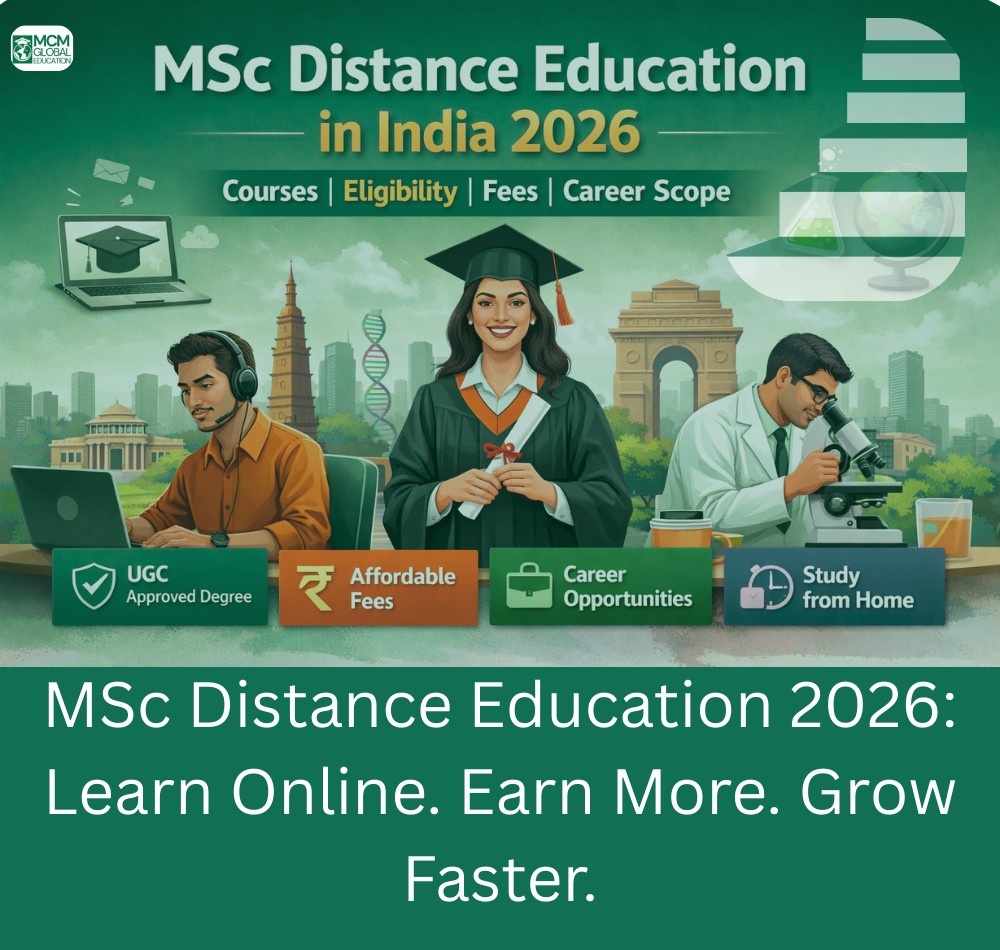

Complete Guide to MSc Distance Education for Working Professionals
MSc Distance Education is a postgraduate program designed for students who want to pursue advanced studies in science while managing work or other responsibilities. It is especially beneficial for working professionals who want to upgrade their qualifications without leaving their jobs.
This guide explains everything about MSc distance education in India, including eligibility, admission process, fees, specializations, career scope, and benefits.
What is MSc Distance Education?
MSc (Master of Science) Distance Education is a flexible postgraduate degree program that allows students to study science subjects remotely. Instead of attending regular classes, learners receive study materials, online lectures, and assignments.
The course focuses on advanced scientific concepts, research skills, and practical knowledge in various fields such as physics, chemistry, mathematics, computer science, and environmental science.
Why Choose MSc Distance Education?
Working professionals prefer MSc distance education for several reasons:
1. Flexible Learning
Study anytime without disturbing your job schedule.
2. Career Growth
An MSc degree helps in promotions and higher-level job roles.
3. Affordable Education
Lower fees compared to full-time MSc programs.
4. Skill Enhancement
Gain advanced knowledge in your specialization field.
5. Work-Study Balance
Continue earning while improving your qualifications.
Eligibility Criteria
To apply for MSc Distance Education in India, students generally need:
- A bachelor’s degree in Science (BSc) or equivalent
- Some universities accept related technical degrees
- Minimum marks as required by the institution
- No upper age limit in most universities
Top Universities for MSc Distance Education in India
Some recognized universities offering MSc or equivalent distance programs include:
- Indira Gandhi National Open University (IGNOU)
- University of Madras
- Annamalai University
- Dr. B.R. Ambedkar Open University
- Karnataka State Open University
Always confirm that the program is approved by the University Grants Commission before applying.
Popular MSc Specializations
MSc distance education offers various specializations depending on your interest:
- MSc Mathematics
- MSc Physics
- MSc Chemistry
- MSc Computer Science
- MSc Information Technology
- MSc Environmental Science
- MSc Biotechnology
Choosing the right specialization is important for career development.
Admission Process
The admission process is simple and mostly online:
- Visit the official university website
- Fill out the application form
- Upload required documents (degree certificate, ID proof, photos)
- Pay the application fee
- Receive confirmation of admission
Some universities may offer direct admission based on graduation marks.
Course Duration
- Minimum duration: 2 years
- Maximum duration: 4–5 years
This flexible structure helps working professionals complete the course at their own pace.
Fee Structure
The fees for MSc distance education vary depending on the university:
- Government universities: ₹6,000 – ₹25,000 per year
- Private universities: ₹25,000 – ₹80,000 total
Always compare universities before enrolling.
MSc Distance Education Syllabus Overview
The syllabus depends on the specialization but generally includes:
- Advanced core subject theory
- Research methodology
- Practical assignments
- Data analysis techniques
- Project work and dissertation
Is MSc Distance Education Valid?
Yes, MSc distance education is valid if pursued from a recognized institution approved by the University Grants Commission. Such degrees are accepted for:
- Government jobs
- Private sector roles
- Research positions
- Higher studies (PhD, NET, etc.)
However, practical skills and experience are also important for career growth.
Career Opportunities After MSc Distance Education
MSc graduates have strong career options in multiple sectors:
1. Research Scientist
Work in labs, research centers, and scientific organizations.
2. Data Analyst
Analyze data in IT and business companies.
3. Lecturer/Teacher
Teach in colleges after qualifying NET or PhD.
4. IT Professional
Work in software development and technology roles.
5. Environmental Scientist
Work in environmental protection and sustainability projects.
6. Quality Analyst
Work in manufacturing, pharma, and research industries.
Salary After MSc Distance Education
Salary depends on specialization and experience:
- Freshers: ₹3 LPA – ₹5 LPA
- Experienced professionals: ₹6 LPA – ₹12 LPA+
- Research/IT roles: Higher packages with experience
MSc Distance vs Regular MSc
| Factor | Distance MSc | Regular MSc |
| Flexibility | High | Low |
| Fees | Affordable | Higher |
| Campus Exposure | No | Yes |
| Suitable For | Working professionals | Full-time students |
Tips for Working Professionals
- Manage time effectively between job and studies
- Focus on practical application of concepts
- Stay consistent with assignments
- Use online learning platforms and resources
- Choose specialization aligned with career goals
Final Thoughts
MSc Distance Education is an excellent option for working professionals who want to enhance their scientific knowledge and career prospects without leaving their jobs. It provides flexibility, affordability, and valuable academic growth opportunities.
However, always choose a university approved by the University Grants Commission to ensure your degree is valid and widely accepted.
With the right specialization and consistent effort, MSc distance education can significantly boost your career in science, research, and technology fields.
https://www.mcmacademy.in/msc-distance-education/
https://www.homepros411.com/blog/msc-distance-education-advance-your-science-career
https://healingxchange.ning.com/profiles/blogs/mba-in-one-year-best-choice-for-working-professionals