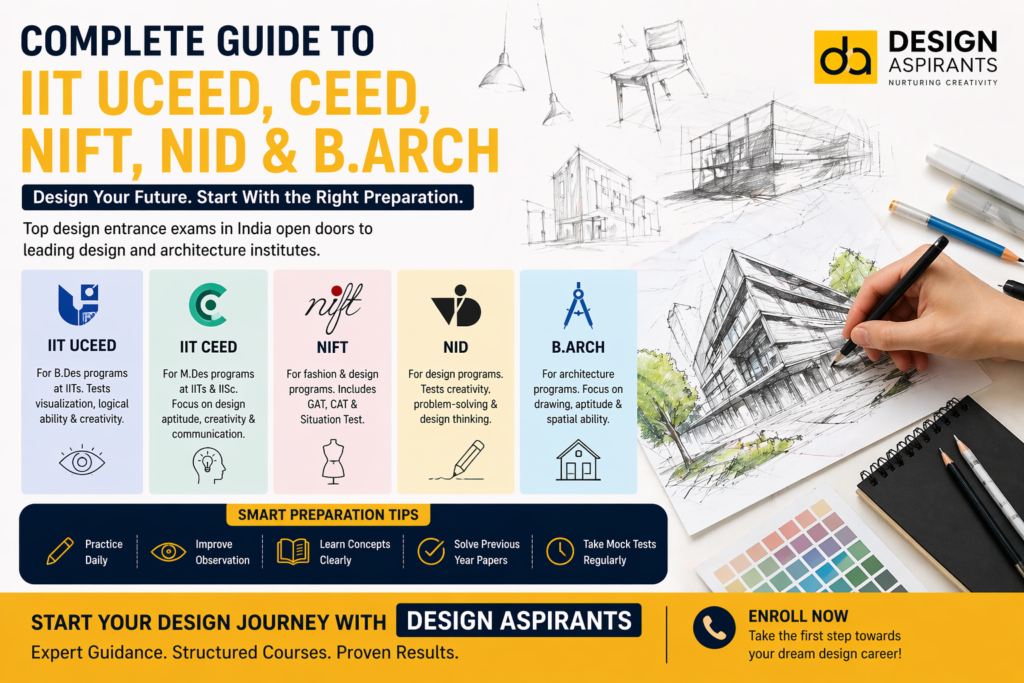

Design entrance exams like IIT UCEED, CEED, NIFT, NID, and B.Arch test creativity, design aptitude, visualization, and problem-solving skills. While UCEED and CEED focus on product and industrial design, NIFT and NID emphasize creativity and innovation, and B.Arch exams combine drawing with mathematical and spatial skills.
To succeed, students should focus on concept clarity, daily sketching, observation skills, and solving previous year papers. A structured approach with regular practice and mock tests helps improve performance and confidence.
Another important aspect of preparation is developing a strong portfolio mindset, even if it is not required for every exam. Working on small design projects, sketching real-life scenarios, and exploring different creative mediums can enhance your overall design thinking. It also helps in interviews, studio tests, and future academic work.
Students should also focus on self-evaluation and improvement. Regularly reviewing mistakes, analyzing mock test performance, and seeking feedback can significantly boost progress. With the right balance of creativity, discipline, and guidance, aspirants can confidently approach these exams and build a strong foundation for a successful career in design.
Additionally, staying updated with current design trends, architecture, and visual culture can give aspirants an edge. Consistency, creativity, and the right guidance play a key role in cracking these competitive exams and securing admission to top design institutes.
Exposure to different forms of art and design can significantly improve creative thinking. Students should explore areas like product design, graphic design, architecture, and visual storytelling to broaden their perspective. Visiting exhibitions, observing everyday surroundings, and analyzing good design examples can sharpen observation and interpretation skills.
Using the right study resources is equally important. Standard books, online tutorials, and guided courses can help in understanding complex topics more effectively. However, students should avoid overloading themselves with too many resources and instead focus on quality learning and consistent revision.
Staying motivated throughout the preparation journey is equally important. Setting small, achievable goals and tracking progress can help maintain focus and consistency. Engaging with a community of fellow aspirants, participating in creative challenges, and celebrating small improvements can boost confidence and keep the learning process enjoyable and effective.
Finally, consistency is the key to success in any design entrance exam. Even small daily efforts in sketching, idea generation, and problem-solving can lead to significant improvement over time. With dedication, structured preparation, and the right guidance, aspirants can confidently move closer to achieving their goals in the design field.
In addition, building confidence through regular practice and feedback is essential for steady improvement. Students should seek guidance from mentors, participate in discussions, and evaluate their progress consistently. Learning from mistakes and refining techniques over time not only strengthens skills but also prepares aspirants to perform effectively under exam conditions.
Time management plays a crucial role during both preparation and the actual exam. Students should practice solving questions within a fixed time frame to improve speed and accuracy. Creating a realistic study schedule that balances theory, sketching, and mock tests helps maintain consistency and reduces last-minute stress.
It is also important to build strong fundamentals in design basics, such as color theory, composition, perspective, and proportion. These concepts not only help in entrance exams but also form the foundation for future design studies. Understanding how and why a design works is more valuable than simply memorizing patterns.
Lastly, maintaining the right mindset is essential. Design exams are not just about correct answers but about creative thinking and originality. Staying motivated, being open to new ideas, and continuously experimenting with different approaches can help students stand out and perform confidently in competitive design entrance exams.
Start your preparation with Design Aspirants—get expert guidance, structured courses, and proven strategies to crack top design entrance exams and secure admission in leading institutes.