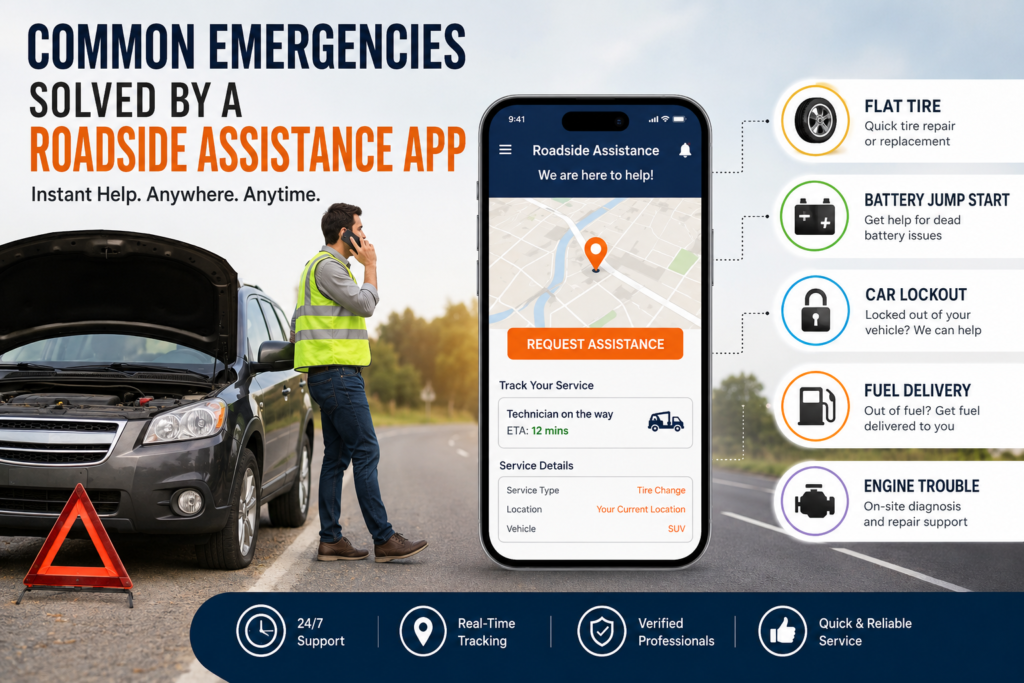

Road travel offers flexibility and convenience, but it also comes with uncertainty. Vehicles can develop problems without warning, leaving drivers stranded in unfamiliar areas, during bad weather, or late at night when help is difficult to find. Traditional methods of calling mechanics, searching for nearby workshops, or relying on local contacts often result in delays and confusion.
Mobile technology has changed how roadside support is delivered. With a few taps, drivers can share their location, describe the issue, track assistance in real time, and receive updates until help arrives. These capabilities have transformed emergency response from a stressful process into a more organized and predictable experience.
The growing demand for digital support solutions has increased interest in roadside assistance app development because such platforms streamline communication between drivers and service operators while improving response efficiency. Understanding the common emergencies these applications address helps explain why they are becoming an essential part of modern transportation ecosystems.
Why Modern Drivers Depend on Digital Emergency Support Tools
Drivers today expect services to be immediate, transparent, and easy to access. Roadside support applications meet these expectations by centralizing emergency requests and simplifying the process of finding nearby assistance.
Instead of making multiple phone calls or explaining their location repeatedly, users can submit a service request that contains important information automatically. These details may include:
- Current GPS location
- Vehicle model and registration details
- Nature of the emergency
- Preferred service type
- Contact information for updates
This structured flow reduces misunderstandings and shortens dispatch times. It also helps service teams prepare the correct tools and equipment before arriving at the scene.
For drivers travelling long distances or commuting regularly, having access to immediate assistance can reduce anxiety and improve confidence on the road. The convenience of digital support is especially valuable in unfamiliar locations where local service contacts may not be readily available.
Flat Tire Incidents and Faster Help Through Mobile Platforms
Flat tires remain one of the most common roadside emergencies worldwide. Punctures caused by nails, damaged roads, worn tread, or sudden pressure loss can stop a journey immediately.
Although some drivers know how to replace a tire, many lack the necessary tools or experience. Certain situations also make self-repair unsafe, particularly on highways, busy intersections, or poorly lit roads.
Roadside applications simplify the response process by allowing users to specify whether they need tire replacement, repair, or towing assistance. Service providers receive the request along with the exact location, reducing delays caused by inaccurate directions.
Several operational advantages improve response quality:
- Drivers can upload images of the damaged tire.
- Dispatchers can assign technicians with suitable equipment.
- Estimated arrival times can be shared automatically.
- Status notifications keep users informed throughout the process.
These capabilities demonstrate why organizations investing in roadside assistance app development prioritize real-time communication and location tracking as core features.
The result is a faster and more predictable solution for one of the most frequent vehicle emergencies.
Battery Breakdowns Resolved Quickly Through Real Time Service Alerts
Battery failures often occur without warning. Extreme temperatures, ageing batteries, electrical faults, or accidentally leaving headlights on can prevent a vehicle from starting.
Unlike mechanical issues that may develop gradually, battery problems frequently appear at the beginning of a journey when drivers are preparing to leave for work, school, or appointments. Delays in these situations can disrupt entire schedules.
Digital assistance platforms improve battery support by enabling precise service categorization. Drivers can request:
- Jump-start assistance
- Battery testing services
- Battery replacement support
- Electrical diagnostics
Once a request is submitted, the nearest available technician can be assigned immediately. Location tracking reduces travel time and helps technicians reach customers more efficiently.
Real-time alerts also improve transparency. Drivers know when the technician accepts the request, when the vehicle is dispatched, and when assistance is expected to arrive.
This level of visibility minimizes uncertainty and allows stranded motorists to make informed decisions while waiting for support.
Lockout Situations Managed Efficiently Using Smart Request Flows
Vehicle lockouts create frustration and inconvenience regardless of location. Keys may be left inside the vehicle, electronic locking systems may fail, or smart keys may stop functioning because of depleted batteries.
In the past, drivers often relied on local locksmith directories or recommendations from nearby businesses. This process consumed valuable time and frequently resulted in inconsistent service quality.
Roadside applications simplify lockout management through structured service requests. Users can select lockout assistance directly and provide details about:
- Vehicle manufacturer
- Vehicle model
- Type of locking mechanism
- Accessibility concerns
- Presence of children or pets inside the vehicle
Providing this information in advance allows service teams to prioritize urgent situations and dispatch personnel with appropriate tools.
Another advantage is verification. Many platforms include identity validation procedures to ensure that vehicle access is granted only to authorized users, improving both security and trust.
Efficient request handling and automated dispatching make lockout incidents significantly easier to manage compared with traditional support methods.
Fuel Delivery Requests Simplified During Unexpected Shortages
Running out of fuel remains surprisingly common despite modern navigation and fuel monitoring systems. Long journeys, traffic congestion, unfamiliar routes, and inaccurate fuel estimates all contribute to this issue.
The problem becomes more serious in remote areas where fuel stations are scarce or closed during late hours.
Roadside support applications solve this challenge by enabling users to request emergency fuel delivery directly from their smartphones. The request can include details such as:
- Fuel type
- Required quantity
- Vehicle location
- Accessibility conditions
Accurate GPS positioning ensures delivery personnel arrive without unnecessary delays. Drivers also receive updates regarding dispatch progress and expected arrival times.
This digital workflow removes much of the uncertainty associated with fuel shortages and reduces the likelihood of motorists attempting unsafe solutions such as walking long distances to locate fuel stations.
By combining location intelligence with service coordination, roadside applications create a safer and more efficient response system for fuel emergencies.
Engine Trouble Assessments Supported by Connected Assistance
Mechanical failures are among the most complex roadside situations because symptoms often vary significantly between vehicles and conditions.
Drivers may experience overheating, transmission problems, unusual noises, fluid leaks, or warning lights that indicate serious internal issues. Determining whether the vehicle can continue operating safely is often difficult.
Roadside applications help by collecting preliminary information before assistance is dispatched. Users can describe symptoms, upload photographs, and report dashboard warning indicators.
This information enables technicians to assess the situation more effectively and determine whether immediate repair or transportation is required.
In many cases, the following services may be coordinated:
- On-site diagnostics
- Minor mechanical repairs
- Vehicle transportation
- Workshop referrals
Collaboration with towing service app providers also helps ensure that vehicles requiring transport can be moved quickly to appropriate repair facilities.
The ability to route requests based on urgency and service requirements significantly improves operational efficiency and customer safety.
Seamless Coordination Between Drivers and Field Response Teams
One of the biggest strengths of digital roadside ecosystems is their ability to coordinate multiple participants simultaneously. Drivers, dispatchers, technicians, and support teams all operate through a shared information environment.
This coordination reduces communication gaps that traditionally caused delays and service duplication.
Important operational functions include:
- Automated technician allocation
- Dynamic route optimization
- Service history tracking
- Digital work confirmations
- Incident documentation
These capabilities improve both response speed and service accountability.
Organizations exploring roadside assistance app development frequently evaluate whether a custom platform or a white label roadside assistance app better aligns with operational requirements, scalability goals, and deployment timelines.
Regardless of implementation strategy, centralized communication remains one of the defining advantages of modern assistance platforms.
Improved coordination ultimately benefits both service operators and vehicle owners by creating a smoother emergency response experience.
Data Insights That Improve Response Planning and Reliability
Beyond immediate emergency support, roadside applications generate valuable operational data that can improve long-term planning and service quality.
Patterns in service requests allow organizations to identify trends related to geography, weather conditions, seasonal demand, and vehicle types.
Examples of useful analytical insights include:
- Areas with frequent tire incidents
- Peak hours for battery failures
- Regions requiring additional support vehicles
- Seasonal changes in service demand
- Average response times by location
These insights support better resource allocation and more accurate forecasting.
As roadside assistance app development continues to evolve, analytics capabilities are becoming increasingly important for improving operational performance and customer satisfaction.
Decision makers also examine the cost to build roadside assistance app solutions in relation to scalability, maintenance requirements, and expected service volume before selecting an implementation approach.
Data-driven planning helps organizations improve reliability while ensuring resources are deployed where they create the greatest value.
Conclusion
Digital roadside support systems have transformed how emergency situations are handled on modern roads. Faster communication, accurate location sharing, and improved service coordination allow drivers to receive assistance more efficiently than traditional methods ever permitted.
Whether dealing with flat tires, battery failures, lockouts, fuel shortages, or mechanical breakdowns, technology-driven response systems reduce delays and improve safety for everyone involved.
As vehicles become increasingly connected and transportation networks continue evolving, intelligent support platforms will play an even greater role in ensuring drivers can travel with confidence and receive dependable help whenever unexpected situations arise.