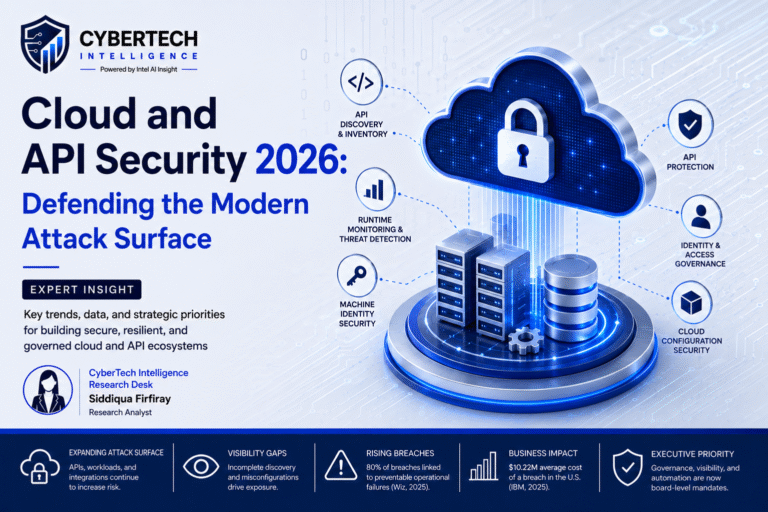

Cloud infrastructure and APIs have become the operational backbone of modern enterprises. From customer applications and SaaS platforms to AI-driven automation and multi-cloud ecosystems, organizations are accelerating digital transformation faster than ever before. But as enterprises scale their cloud environments, cybercriminals are evolving just as quickly.
Today’s attack surface is no longer limited to endpoints and traditional networks. APIs, cloud workloads, containers, identity systems, and third-party integrations are now among the most targeted entry points for attackers. Security leaders are facing a growing challenge: how do you secure an environment that is constantly expanding, highly interconnected, and increasingly decentralized?
Read More:
https://tinyurl.com/2rkykke7
The answer lies in building a modern cloud and API security strategy designed specifically for the realities of 2026.
Organizations across industries are now prioritizing visibility, runtime protection, API governance, Zero Trust architectures, and AI-powered threat detection to reduce exposure across hybrid and multi-cloud environments. Businesses that fail to modernize their security posture risk facing ransomware attacks, data breaches, API abuse, compliance failures, and operational disruptions.
One of the biggest concerns enterprises are dealing with today is API security. APIs have become the digital glue connecting applications, users, partners, and cloud services. However, many organizations still lack proper API inventory management, authentication controls, and continuous monitoring capabilities. Shadow APIs, exposed endpoints, and weak authorization mechanisms continue to create massive security gaps.
Cybersecurity analysts are seeing attackers exploit APIs for credential theft, data exfiltration, account takeover attacks, and lateral movement across cloud environments. As organizations integrate AI services and automation platforms into their operations, unsecured APIs are becoming even more dangerous.
Cloud environments are also becoming increasingly difficult to secure due to the rise of distributed workloads and dynamic infrastructure. Security teams are managing Kubernetes clusters, serverless functions, containers, remote users, and multiple cloud providers simultaneously. Traditional perimeter-based security models are no longer sufficient in this environment.
This shift is driving enterprises toward cloud-native security frameworks that focus on identity, context-aware access control, real-time visibility, and automated threat response.
Another major factor influencing cloud security strategies is regulatory pressure. Data privacy laws and compliance frameworks are forcing organizations to adopt stronger governance around sensitive data, third-party integrations, and cloud infrastructure management. Enterprises are now expected to continuously monitor their cloud posture, detect misconfigurations quickly, and demonstrate security resilience across the entire digital ecosystem.
At the same time, threat actors are leveraging automation and AI to accelerate attacks. Cybercriminal groups are now using AI-enhanced phishing campaigns, automated reconnaissance tools, and intelligent malware to target cloud environments more efficiently. This means defenders must also adopt AI-powered security operations to keep pace with increasingly sophisticated threats.
Security leaders are responding by investing in unified cloud security platforms that combine workload protection, API security, threat intelligence, identity governance, and continuous risk assessment. The goal is not only to prevent attacks but also to improve resilience and reduce response times when incidents occur.
Modern cloud security strategies now emphasize several critical priorities:
- Continuous API discovery and monitoring
- Zero Trust access control models
- Identity-first security frameworks
- Multi-cloud visibility and governance
- Runtime workload protection
- AI-driven threat detection and response
- Automated compliance monitoring
- Real-time risk analytics
These capabilities are becoming essential as enterprises prepare for the next phase of digital transformation.
The growing reliance on AI applications is also creating new cloud security considerations. AI models require massive amounts of data and interconnected infrastructure to operate effectively. Without proper controls, organizations may unintentionally expose sensitive information through insecure APIs, cloud storage misconfigurations, or vulnerable integrations.
This is why forward-looking enterprises are integrating cloud security directly into DevSecOps workflows. Security is no longer treated as a final checkpoint before deployment. Instead, organizations are embedding security validation, API testing, and compliance automation throughout the software development lifecycle.
The businesses that succeed in 2026 will be the ones that treat cloud and API security as strategic business priorities rather than isolated IT functions.
Understanding the evolving threat landscape is critical for CISOs, security architects, cloud engineers, and enterprise decision-makers looking to strengthen operational resilience. Organizations need actionable insights into emerging attack vectors, modern defense frameworks, and cloud-native security best practices.
To help enterprises navigate these challenges, this comprehensive whitepaper explores how organizations can defend the modern attack surface while adapting to the next generation of cyber threats.
The whitepaper provides valuable insights into emerging cloud threats, API security challenges, Zero Trust strategies, AI-driven cybersecurity, and practical approaches enterprises can adopt to secure complex digital ecosystems in 2026 and beyond.
As cloud adoption continues to accelerate globally, organizations must rethink how they approach cybersecurity. Reactive security models are no longer enough. Enterprises need proactive, intelligent, and scalable defense strategies capable of protecting highly dynamic environments.
Cloud and API security will define the future of enterprise resilience, operational continuity, and digital trust. Businesses that invest early in modern security architectures will be better positioned to reduce risk, strengthen compliance, and maintain customer confidence in an increasingly connected world.
Read More: https://tinyurl.com/2rkykke7