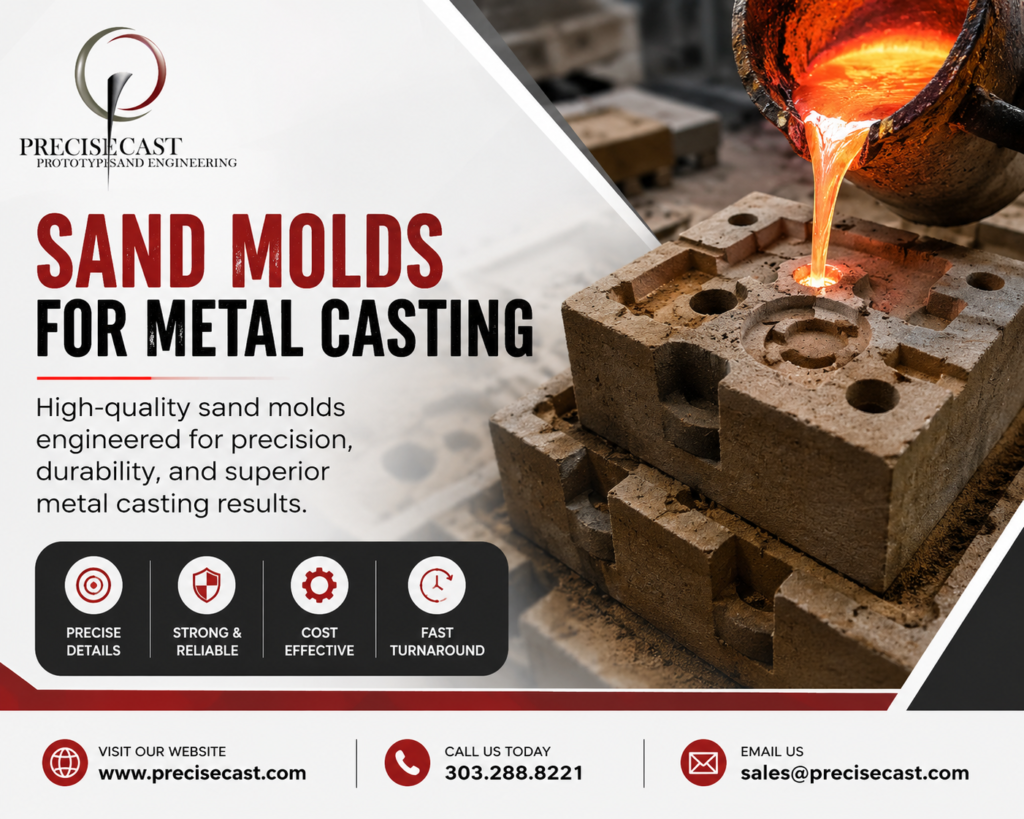

Bringing a new product to market often involves balancing quality, speed, and cost. Low-volume production plays a valuable role during product development, testing, and early-stage manufacturing. Selecting an appropriate casting process influences everything from lead times to part performance.
Manufacturers often evaluate several methods before making a decision. Factors such as material selection, production quantity, part complexity, and budget all deserve careful consideration. Among available options, sand molds for metal casting remain a practical choice for many low-volume projects because they support flexibility and relatively low tooling costs.
Why Casting Process Selection Matters?
A casting process shapes more than a metal component. It influences dimensional accuracy, surface finish, production efficiency, and overall project success.
When engineers choose a process that aligns with project goals, they often reduce waste, shorten development cycles, and improve product reliability. Early decisions regarding tooling and manufacturing methods frequently determine whether a project remains on schedule.
For low-volume production, flexibility usually carries significant value. Manufacturers may need to revise designs multiple times before reaching a final version. In such situations, sand molds for metal casting often support quick adjustments without requiring extensive tooling investments.
Understanding Low-Volume Production Requirements
Low-volume manufacturing generally involves production runs ranging from a few parts to several hundred units. This approach supports prototype validation, market testing, specialized equipment, and custom applications.
Unlike high-volume manufacturing, low-volume projects place greater emphasis on adaptability. Production teams need methods that accommodate design changes while maintaining consistent quality.
Material selection also becomes a major consideration. Engineers frequently compare aluminum, magnesium, steel, and zinc alloy metal based on strength, corrosion resistance, weight, and cost requirements.
Sand Casting for Flexible Production
Sand casting remains one of the most widely used manufacturing processes in modern foundries. It supports simple components as well as highly complex geometries across various industries.
A primary advantage lies in tooling affordability. Patterns typically require less investment compared to permanent mold systems, making sand casting attractive for limited production quantities.
Because sand molds for metal casting support a broad range of part sizes and designs, manufacturers often rely on this process during prototyping and product refinement stages. Design modifications generally require less time and expense than alternative casting methods.
Another benefit involves material compatibility. Sand casting accommodates numerous alloys, allowing engineers to evaluate different material options throughout development.
Investment Casting for Precision Components
Projects requiring tight tolerances and smooth surface finishes often benefit from investment casting. This process creates detailed components with minimal machining requirements.
Investment casting performs particularly well when intricate geometries present challenges for other manufacturing methods. Medical devices, aerospace components, and specialized industrial equipment frequently utilize this process.
Although tooling expenses typically exceed those associated with sand molds for metal casting, investment casting may deliver value when precision requirements justify additional costs. Manufacturers often compare both methods during product planning stages to identify the most efficient solution.
Permanent Mold Casting and Die Casting
Permanent mold casting uses reusable molds, making it suitable for medium-volume production and repeatable part quality. The process generally produces improved surface finishes and stronger mechanical properties compared to some expendable mold techniques.
Die casting represents another option for projects requiring high precision and rapid production rates. It works particularly well with non-ferrous materials, including zinc alloy metal, which offers excellent dimensional stability and detailed feature reproduction.
While these methods provide impressive consistency, tooling investments tend to be higher. For limited production quantities, manufacturers should evaluate whether expected production volumes justify initial tooling expenses.
Material Selection and Casting Performance
Material choice plays an equally important role in determining project outcomes. Different alloys deliver distinct advantages depending on operating conditions and performance expectations.
Aluminum remains popular because of its lightweight properties and corrosion resistance. Magnesium supports applications where weight reduction remains a priority. Meanwhile, zinc alloy metal offers excellent castability, strength, and dimensional accuracy for numerous industrial applications.
Material selection should align with functional requirements rather than focusing solely on cost. A lower-priced material may create performance limitations, while a more suitable alloy often improves long-term reliability and product lifespan.
Evaluating Cost, Lead Time, and Complexity
Every manufacturing project involves trade-offs. Faster production schedules may increase costs, while tighter tolerances may require more advanced processes.
Part geometry often serves as a deciding factor. Complex shapes with internal features may perform better with specialized casting methods. Simpler designs often benefit from economical approaches such as sand molds for metal casting.
Lead time also deserves attention. Rapid prototyping projects frequently require quick turnaround times to support testing and validation efforts. Manufacturing teams should evaluate process capabilities alongside project deadlines before selecting a production method.
A thorough assessment of these factors often prevents unexpected expenses later in the manufacturing cycle.
Balancing Prototyping and Production Goals
Many low-volume projects begin as prototypes and gradually transition into production parts. A casting process should support both immediate objectives and future scalability.
Manufacturers often select methods that provide room for growth while maintaining reasonable upfront costs. This approach reduces disruption if product demand increases after launch.
For example, an initial prototype may utilize sand molds for metal casting because of design flexibility. As production volumes grow, manufacturers may explore permanent mold or die casting solutions that improve efficiency at higher quantities.
Planning for future requirements helps create a smoother transition between development and production phases.
Conclusion
Choosing an appropriate casting process requires careful evaluation of part design, material requirements, production volume, and budget considerations. No single method fits every project, which makes understanding available options especially important.
Processes such as sand casting, investment casting, and die casting each offer distinct advantages. Material choices, including zinc alloy metal, further influence performance, durability, and manufacturing efficiency.
For many low-volume applications, sand molds for metal casting remain a practical solution because they support flexibility, manageable tooling costs, and efficient product development. When manufacturers align casting methods with project goals, they place themselves in a stronger position to achieve consistent quality and reliable results.