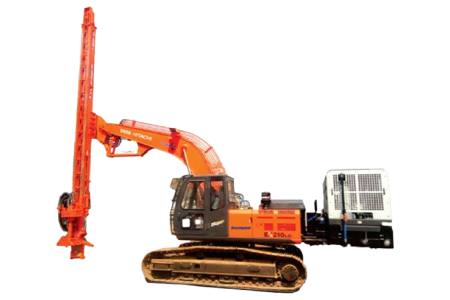

Selecting the right drilling rig is a critical decision that directly impacts productivity, cost efficiency, and project success. Among the most common options are excavator mounted drilling rigs and truck mounted drilling rigs. While both serve similar drilling purposes—such as geotechnical investigation, foundation work, mining exploration, and construction support—their design, mobility, and performance characteristics differ significantly.
Understanding these differences will help contractors, project managers, and engineers determine which solution best fits their operational needs.
Understanding Excavator Mounted Drilling Rigs
Excavator mounted drilling rigs are drilling attachments installed on a standard hydraulic excavator base. Instead of using the excavator for digging, the machine becomes a versatile drilling platform.
Key Advantages
- Superior Off-Road Capability
Excavators are built for rugged environments. Their tracked undercarriage distributes weight evenly, allowing them to operate on uneven, muddy, rocky, or steep terrain. For remote or unstable sites, this makes them highly reliable. - Enhanced Stability
The track system provides a solid base during drilling operations. Stability is especially important in deep drilling or when working on slopes. - Versatility
Because the drilling unit is mounted on an excavator, operators can often switch between drilling and other excavation tasks by changing attachments. This flexibility is beneficial for multi-purpose construction sites. - Compact Worksite Access
Excavator mounted rigs can maneuver in tight spaces, making them suitable for urban projects, confined construction areas, and challenging topography.
Potential Limitations
- Lower road mobility compared to truck-mounted rigs
- Requires transport via trailer for long-distance relocation
- May have slower setup time depending on site conditions
Understanding Truck Mounted Drilling Rigs
Truck mounted drilling rigs are installed directly onto a heavy-duty truck chassis. This design emphasizes road mobility and quick relocation between job sites.
Key Advantages
- High Mobility and Speed
Truck mounted rigs can travel directly on highways, eliminating the need for additional transport equipment. For projects spread across multiple locations, this significantly reduces downtime. - Faster Setup on Stable Ground
On flat and prepared surfaces, truck mounted rigs can be deployed quickly. Hydraulic outriggers provide stability during drilling operations. - Cost Efficiency for Urban and Roadside Projects
For projects near developed infrastructure—such as road construction, utility installations, and urban geotechnical surveys—truck mounted rigs offer operational convenience. - Higher Transport Efficiency
Equipment, tools, and crew can often travel together in a single unit, improving logistical coordination.
Potential Limitations
- Limited performance on soft, muddy, or uneven terrain
- Requires stable ground for safe operation
- Less effective in steep or highly rugged environments
Comparing Key Factors
1. Terrain Conditions
If your project is located in remote, mountainous, forested, or unstable terrain, excavator mounted rigs generally outperform truck mounted rigs. The tracked mobility ensures consistent access where wheeled vehicles might struggle.
For projects on paved roads, industrial sites, or stable ground, truck mounted rigs provide faster movement and easier relocation.
2. Project Duration and Frequency of Relocation
For long-term projects at a single site, excavator mounted rigs are often ideal due to their stability and adaptability.
For short-term contracts requiring frequent travel between sites, truck mounted rigs can save time and reduce transport costs.
3. Drilling Depth and Power Requirements
Both configurations can support powerful drilling systems. However, excavator bases often allow for greater flexibility in heavy-duty or specialized drilling attachments, depending on the excavator’s size and hydraulic capacity.
Truck mounted rigs may be optimized for specific drilling applications and can be highly efficient when matched to standardized project requirements.
4. Budget Considerations
Initial investment, fuel consumption, transport logistics, and maintenance costs all influence overall budgeting. Excavator mounted rigs may require additional transportation equipment, while truck mounted rigs can reduce hauling expenses but may face higher maintenance costs related to road travel.
Evaluating the total cost of ownership—not just the purchase price—is essential.
5. Safety and Stability
Excavator mounted rigs typically provide greater inherent stability due to their tracked base. This can enhance safety in uneven or sloped conditions.
Truck mounted rigs rely on outriggers for balance. When properly deployed on stable ground, they are safe and effective, but they require careful site preparation.
Industry Applications
Both types are widely used across industries such as:
- Construction foundation drilling
- Geotechnical soil investigation
- Mining and quarry operations
- Water well drilling
- Infrastructure development
The choice ultimately depends on environmental conditions, logistical needs, and project scope.
Making the Right Decision
There is no universal “better” option—only the one that aligns best with your operational demands. To choose wisely, ask yourself:
- What type of terrain will the rig operate on?
- How often will the equipment need to relocate?
- Is stability or mobility the higher priority?
- What are the long-term operational costs?
- Does the project require multi-function capability?
Careful evaluation of these factors ensures that your investment delivers maximum productivity and efficiency.
Final Thoughts
Choosing between excavator mounted and truck mounted drilling rigs is not just a technical decision—it’s a strategic one. Excavator mounted rigs offer unmatched terrain adaptability and stability, while truck mounted rigs excel in mobility and logistical efficiency.
By aligning equipment capabilities with project requirements, contractors can optimize performance, reduce downtime, and improve overall profitability. Taking the time to assess site conditions, workload expectations, and cost structures will ultimately lead to smarter equipment selection and long-term operational success.
Other recommended Link : Button Bits Manufacturers