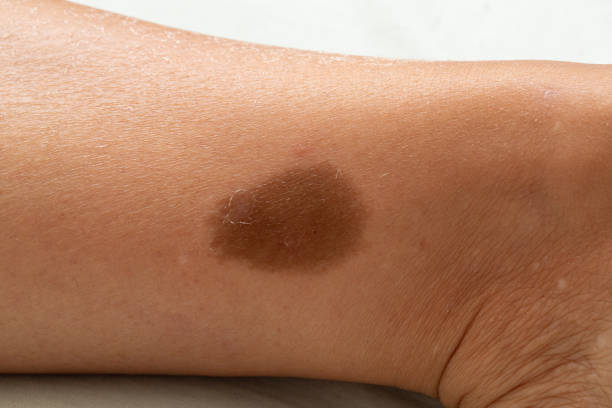

Café-au-lait spots—flat, light brown marks named for their “coffee with milk” appearance—are among the most common reasons patients seek birthmark removal in Dubai. Unlike some birthmarks that fade with age, café-au-lait spots are persistent and often grow proportionally with the body. In clinical settings, we observe that these marks are highly responsive to specific laser wavelengths. While the pigment is stubborn, a systematic approach to shattering the melanin can lead to permanent clearance, provided the source of the pigment is neutralized at the dermal-epidermal junction.
The Clinical Logic of Pigment Fragmentation
The permanent removal of a café-au-lait spot relies on the “photo-mechanical” effect. Because the pigment in these spots is often concentrated in the basal layer of the skin, we use Q-switched or Picosecond lasers to deliver energy in ultra-fast bursts. This energy is absorbed by the melanin, causing it to vibrate and shatter into particles so small that the body’s scavenger cells (macrophages) can carry them away through the lymphatic system. Since the body does not “replace” this shattered pigment, the results are typically permanent once full clearance is achieved.
Comparison: Removal Methods for Café-au-Lait Spots
| Feature | Q-Switched Nd:YAG | Picosecond Laser | Intense Pulsed Light (IPL) |
| Primary Action | Shatters pigment (Nanoseconds) | Shatters pigment (Picoseconds) | Heats and fades pigment |
| Clearance Speed | Moderate (6–8 sessions) | Fast (4–6 sessions) | Slow (8+ sessions) |
| Recurrence Risk | Low | Very Low | Moderate |
| Best For | Defined, dark brown spots | Stubborn/Light brown spots | Very faint, diffuse spots |
Does Café-au-Lait Removal Hurt?
What is the actual pain level during the removal of a café-au-lait spot?
Patients describe the sensation as a sharp, rhythmic “snapping” against the skin, similar to a rubber band. Because these spots are flat and do not require deep tissue ablation, the discomfort is usually low. We use topical numbing and a continuous stream of chilled air to keep the sensation at a manageable 2/10 or 3/10 on the pain scale.
Based on post-procedure follow-ups, what feels “uncomfortable” is the slight heat retention in the skin for about an hour after the session. What feels “surprisingly easy” is the lack of any real “wound” care; the skin remains intact, and most patients find the experience much less traumatic than they initially feared.
“I had a large spot on my back that always bothered me at the beach. The laser felt like tiny hot sparks, but it was over so fast. By the third session, it was already half-gone.” — Faisal
The Permanent Result Timeline
How many sessions does it take to see the spot disappear?
While some surface fading is visible after the first session, permanent clearance usually requires 4 to 8 sessions spaced 6 weeks apart. This interval is critical because it allows the body’s immune system to “clean up” the shattered pigment from the previous session before we target the next layer.
In clinical practice, we observe this specific healing cycle:
-
Days 1–3: The spot darkens and may look “muddy.” This is a sign the pigment has been disrupted.
-
Days 4–7: A fine, sandpaper-like texture may form on the surface and naturally flake off.
-
Weeks 2–5: The mark appears to fade more each week as internal clearance continues.
-
Week 6: We assess the remaining pigment and adjust the laser intensity for the next session.
Who Should Be Cautious of “Recurrence”?
Is there a chance the café-au-lait spot will come back?
For the vast majority of patients, once the spot is gone, it is gone for good. However, in cases of “segmental” café-au-lait spots or certain genetic predispositions, the skin may attempt to produce new melanin in that area. We use a diagnostic-first evaluation to check the edges of the spot; if the borders are “jagged” (Coast of Maine) rather than “smooth” (Coast of California), it may indicate a higher need for follow-up maintenance.
Safety is paramount in the Dubai sun. We advise that any permanent result can be undermined by extreme UV exposure. If the “new” skin is not protected with SPF 50+, the body may trigger a “rebound” effect to protect the area, causing pigment to return. Using a physical zinc-based sunblock is the single best way to ensure your results stay permanent.
Why “Layered” Removal is Essential for Success
Why can’t the laser remove the whole spot in one visit?
Melanin in café-au-lait spots is often “stacked.” If we used enough energy to reach the bottom layer in one go, we would risk burning the surface skin. By using a layered approach, we safely remove the top “sheet” of pigment, let the skin heal, and then reach the deeper layers in subsequent visits.
What feels “tolerable” to patients is the gradual “thinning” of the mark until it eventually matches the surrounding skin tone. In clinical settings, we often see that the last 10% of the pigment is the most stubborn, sometimes requiring a shift in laser wavelength to finally clear the “ghost” of the original spot.
“My daughter had a spot on her arm that we started treating when she was ten. It took six sessions, but it’s been five years now and the skin is perfectly clear. It never came back.” — Reem
Frequently Asked Questions
-
Can café-au-lait spots be a sign of something else?
While most are harmless, having many spots (6 or more) can sometimes be associated with underlying conditions like Neurofibromatosis. We always perform a medical history check before starting cosmetic removal.
-
Will the skin look “white” after the spot is gone?
Initially, the treated area may look slightly lighter than the surrounding skin. This usually resolves within a few months as the skin’s natural tanning ability returns to that zone.
-
Is it safe to treat café-au-lait spots on the face?
Yes. These lasers are extremely precise and safe for facial use. We use specialized ocular shields to protect your eyes during the procedure.
-
How soon can I go in the sun after a session?
You should avoid direct sun for at least 2 weeks. If you are outdoors in Dubai, the area must be covered by clothing or a thick layer of physical sunblock.
-
Are results really permanent?
Yes. Because the laser physically shatters the pigment and the body removes it, the birthmark does not “regrow.” Only new sun damage or hormonal shifts could cause new pigment in that area.
Why Choose Tajmeels Clinic for Your Procedure?
At Tajmeels Clinic, we treat birthmark removal as a blend of medical science and personal confidence. We specialize in birthmark removal in Dubai by utilizing a diagnostic-first philosophy, ensuring your café-au-lait spot is correctly identified and mapped before treatment begins. Our clinicians are experts in Q-switched and Picosecond technology, providing customized energy settings that prioritize both the permanence of the result and the safety of your skin. We offer a professional, empathetic environment, ensuring you are supported from your first consultation to your final, clear result.