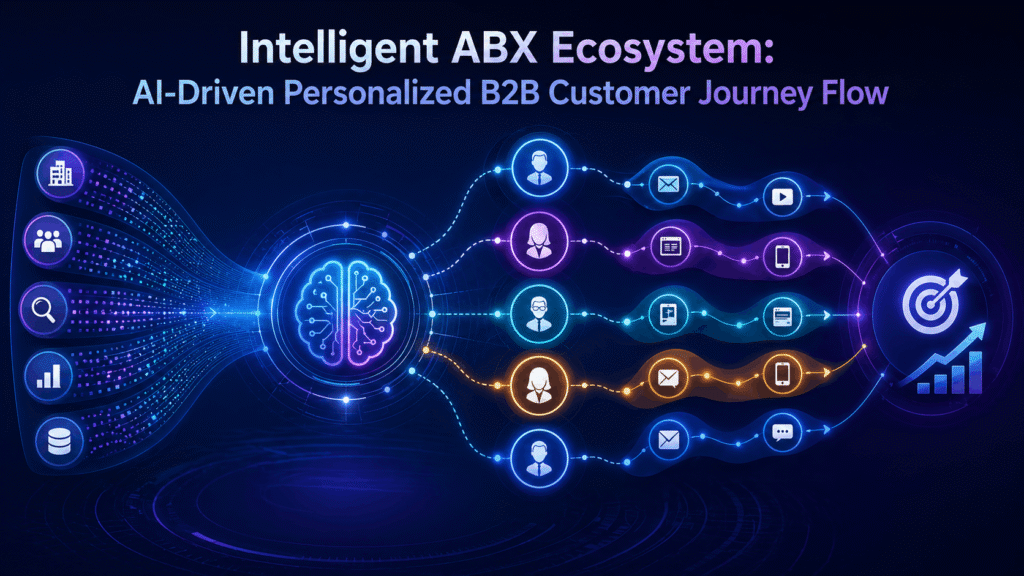

For years, Account-Based Marketing (ABM) has been the backbone of high-value B2B growth strategies. It helped organizations move away from broad, spray-and-pray campaigns toward highly focused targeting of key accounts. But as buyer behavior evolved, ABM began to show its limitations. Modern B2B buyers no longer move in linear funnels, and decision-making is no longer confined to a single stakeholder or channel.
This shift has given rise to a more advanced, more adaptive model: Account-Based Experience (ABX)—and more specifically, its intelligent evolution powered by AI, data, and real-time orchestration.
ABX is not just an upgrade to ABM. It is a fundamental rethinking of how organizations engage, nurture, and convert high-value accounts across the entire lifecycle.
From ABM to ABX: What Changed?
Traditional ABM focuses on identifying target accounts and running coordinated campaigns across marketing and sales teams. While effective, it often treats accounts as static lists rather than dynamic ecosystems.
ABX, on the other hand, shifts the focus from campaigns to continuous experiences.
Instead of asking:
- “Which accounts do we target?”
ABX asks:
- “What experience is each stakeholder having right now, and how do we improve it in real time?”
This evolution is driven by three major changes in B2B buying behavior:
- Multi-threaded buying journeys
Decisions are made by buying committees, not individuals. - Non-linear engagement paths
Buyers jump between research, evaluation, comparison, and validation stages unpredictably. - Digital-first expectations
Buyers expect consumer-grade personalization in B2B interactions.
ABX is designed to respond to these realities by delivering contextual, timely, and relevant experiences across every touchpoint.
What Makes ABX “Intelligent”?
The “intelligent” layer of ABX is what truly sets it apart from traditional ABM strategies. It is powered by AI, automation, and real-time data orchestration.
- Real-Time Data Activation
Intelligent ABX systems continuously ingest signals such as:
- Website behavior
- Content engagement
- Intent data
- CRM updates
- Third-party firmographics
This allows organizations to understand not just who the account is, but what they are doing right now.
- Predictive Engagement Models
AI-driven models help predict:
- Which accounts are likely to convert
- Which stakeholders are disengaging
- What content or message will influence next action
Instead of reacting to buyer behavior, teams can proactively shape it.
- Hyper-Personalized Journeys
ABX ensures that each stakeholder within an account receives:
- Relevant messaging based on role
- Content aligned with their stage of awareness
- Channel-specific engagement (email, ads, sales outreach, product touchpoints)
This creates a unified yet personalized experience across the entire account.
ABX as a Cross-Functional Strategy
One of the biggest shifts ABX introduces is breaking down silos between marketing, sales, and customer success.
In ABM, marketing often drives the strategy while sales executes outreach. In ABX, all teams contribute to a shared experience layer.
- Marketing builds awareness and engagement signals
- Sales uses real-time insights for contextual conversations
- Customer success ensures post-sale expansion and retention experiences
The goal is no longer just acquisition—it is lifecycle-wide experience optimization.
Why ABX Matters Now
The rise of ABX is not just a trend; it is a response to measurable market pressures.
- Rising Customer Acquisition Costs
Competition for enterprise accounts has intensified, making inefficient targeting expensive and unsustainable.
- Information Overload
Buyers are overwhelmed with content. Generic messaging no longer cuts through.
- Longer Sales Cycles
Complex B2B deals involve multiple stakeholders and extended evaluation cycles.
- Demand for Personalization
B2B buyers now expect the same level of personalization they experience as consumers.
ABX addresses all of these challenges by focusing on experience precision rather than campaign volume.
The Role of AI in ABX Transformation
AI is the backbone of intelligent ABX systems. It enables organizations to move from static segmentation to dynamic orchestration.
Key AI-driven capabilities include:
- Intent detection: Identifying when an account enters a buying cycle
- Next-best-action recommendations: Guiding sales and marketing actions
- Content intelligence: Matching content to buyer context automatically
- Journey orchestration: Coordinating multi-channel engagement sequences
Without AI, ABX would remain a conceptual upgrade. With AI, it becomes an execution engine for revenue growth.
ABX in Practice: What It Looks Like
Imagine a cybersecurity company targeting enterprise financial institutions.
Instead of running a static ABM campaign, ABX would:
- Detect increased research activity on ransomware protection from a target account
- Automatically trigger personalized content for security analysts within that account
- Notify sales to engage decision-makers with relevant case studies
- Adjust website messaging dynamically when the account revisits
- Align customer success teams once the deal progresses to onboarding
Every interaction is connected. Every signal informs the next step. Every stakeholder experiences a tailored journey
Challenges in Adopting ABX
While ABX offers powerful advantages, it is not without challenges:
- Data integration complexity across multiple systems
- Organizational alignment issues between teams
- Technology maturity gaps in AI and automation tools
- Content scalability demands for personalization at scale
Organizations that succeed in ABX adoption typically invest heavily in data infrastructure and cross-functional collaboration.
The Future of ABX
The future of ABX is moving toward fully autonomous revenue systems where AI not only recommends actions but executes them within defined guardrails.
We are heading toward:
- Fully adaptive customer journeys
- Real-time experience personalization at scale
- Continuous account intelligence loops
- AI-driven revenue orchestration platforms
In this future, ABX becomes less of a strategy and more of an always-on operating system for B2B growth.
Conclusion
The shift from ABM to ABX represents a fundamental transformation in how organizations think about customer engagement. It is no longer about targeting accounts—it is about designing experiences that evolve with them.
Intelligent ABX brings together data, AI, and cross-functional collaboration to create meaningful, contextual, and revenue-driving interactions at every stage of the buyer journey.
As B2B markets continue to become more complex and competitive, organizations that embrace ABX will not just improve marketing performance—they will redefine how enterprise relationships are built.