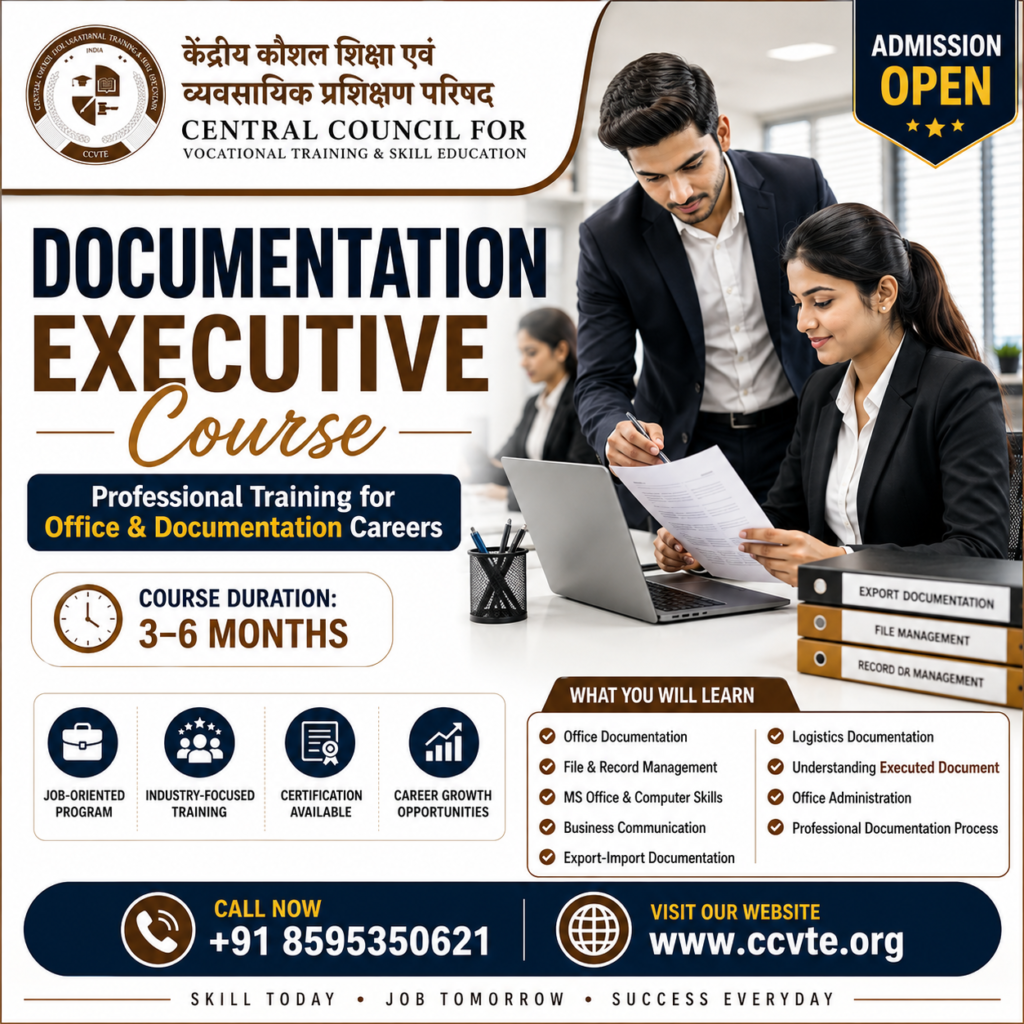

Finishing 10th or 12th brings one big question: what next? Many students search for a path that leads to quick, stable work without years of study. If that sounds like you, a Documentation Executive course could be your answer. It’s a practical, skill-based program that prepares you for real office jobs fast.
Documentation experts are needed everywhere. Logistics firms, hospitals, schools, export-import companies, and corporate offices all rely on accurate records. Because of this, documentation executive jobs continue to grow across India. Let’s see how this course can help you start a secure career right after school.
What is a Documentation Executive Course?
A Documentation Executive course is a short, job-focused program that teaches you to create, organize, and verify business documents. You learn office systems, record-keeping, and the paperwork companies handle every day.
A documentation executive prepares reports, manages files, and makes sure every record stays correct. Their work covers invoices, contracts, shipping bills, and official forms. Accuracy is everything here.
Why does this matter? Because organizations cannot run smoothly without proper records. One missing file can delay payments, stall a shipment, or cause legal trouble.
So how does a document executive differ from regular office staff? General staff juggle many small tasks. A documentation specialist focuses on managing and processing files with care and precision.
Strong executive documentation keeps a workplace organized and compliant. That’s why trained professionals earn trust and respect in modern offices.
Why Choose a Documentation Executive Course After 10th & 12th?
This course fits students perfectly. Here’s why it stands out.
Career-Focused Learning
You learn exactly what offices need. Instead of broad theory, the training targets practical skills that lead straight to jobs.
Quick Job Opportunities
The course is short, so you can start working within months. For students eager to earn early, that speed is a real advantage.
Affordable Skill-Based Education
Compared to long degrees, this program costs much less. You gain useful skills without heavy fees or years of study.
Professional Office Career Path
You don’t just get a job—you get a career. With time, you can grow into senior and managerial roles.
Growing Demand Across Industries
Companies in many sectors need documentation support. That steady demand keeps your skills valuable for years to come.
Overall, skill education courses like this help students become job-ready faster than traditional routes.
Eligibility for Documentation Executive Course
The good news? Eligibility stays simple and welcoming.
Most institutes accept students who have passed 10th or 12th grade. So yes, you can join right after school. Basic computer knowledge helps, but training usually starts from the basics.
There’s typically no strict age limit either. This course suits:
- School leavers wanting quick employment
- Freshers searching for their first office job
- Job seekers who need stable work soon
- Working people wanting a skill upgrade
If you enjoy neat, organized work, documentation training is a great fit for you.
read more: How a Documentation Executive Course Can Boost Your Career
Course Duration and Training Structure
The course balances flexibility with strong, practical learning.
Course Duration
You can pick a duration that matches your goals:
- 3 months: A quick certificate covering core skills.
- 6 months: A wider program with more practice.
- 1 year: A detailed course with strong industry modules.
- 2 years: An advanced track for complete office and documentation expertise.
Shorter options suit fast employment. Longer ones build deeper skills and stronger resumes.
Theory + Practical Learning
Good programs mix both. First, you learn the concepts. Then, you apply them through real tasks. This blend helps lessons stick.
Hands-On Documentation Practice
You won’t just read about invoices or files. You’ll actually prepare and manage them. This hands-on exposure mirrors real office work, so you graduate confident and job-ready.
Subjects Covered in Documentation Course
The syllabus is broad and practical. You usually study:
- Documentation management
- File and record handling
- Computer applications and MS Office
- Business communication
- Email drafting
- Office administration
- Export-import documentation
- Understanding an executed document (a signed, legally completed file)
- Working as a documentation executive in logistics
- Office workflow systems
Together, these subjects give you a strong foundation for any paperwork-heavy role.
Career Opportunities After Documentation Executive Course
After finishing, several job paths open up. Popular roles include:
- Documentation Executive
- Office Executive
- Back Office Executive
- Administrative Assistant
- Data Entry Operator
- Logistics Documentation Assistant
- Export Documentation Executive
- Record Management Executive
These roles fit many industries, so you’re not tied to one field. You can work in:
- Logistics and shipping
- Healthcare sector
- Educational institutions
- Government offices
- Corporate companies
- Export-import businesses
Because the skills transfer easily, you can switch sectors as your interests grow.
Documentation Executive Jobs & Salary Scope
Entry-level pay is realistic and steady. In India, beginners often earn around ₹15,000 to ₹25,000 per month. With experience, this can rise to ₹35,000 or more.
Growth follows your effort. You can move from executive to senior executive, then team lead or documentation manager. An export documentation executive who understands trade rules often earns above average.
The future looks bright too. Trade and digital records keep expanding, so demand for documentation executive jobs stays strong. That means more stability for trained professionals.
Skills You Learn During Documentation Training
Beyond paperwork, you build skills that employers value:
- Communication skills for clear emails and reports
- Documentation handling with speed and accuracy
- Computer proficiency in office software and data tools
- Accuracy and organization to manage records well
- Record management for smooth office systems
- Office administration skills for daily operations
These abilities make you useful in almost any workplace.
Why Skill Education Courses Are Important for Career Security
Today’s employers want people who can perform from day one. That’s why skill education courses matter so much now.
A degree alone is no longer enough. Many graduates struggle because they lack practical skills. Job-oriented certification programs fill that gap.
Vocational training also builds confidence. You learn by doing, so you feel ready when you enter the workplace. For students after 10th or 12th, that head start can shape a secure, successful future.
How to Choose the Best Documentation Course?
Not every program offers the same value. Keep these points in mind before you enroll:
- Certification validity: Choose a course with a recognized certificate.
- Updated curriculum: Make sure it covers current office and export documentation.
- Practical training: Prefer programs with real, hands-on tasks.
- Placement support: Look for institutes that help you find jobs.
- Institute reputation: Read reviews and check the track record.
- Industry exposure: Pick courses that connect you with real work practices.
A little research now leads to better results later.
Why Choose Our Documentation Executive Course?
Our program is designed to make you job-ready quickly and confidently. Here’s what sets it apart:
- Industry-relevant syllabus: Lessons match what real offices need.
- Practical training: You work on actual documents, not just notes.
- Expert faculty: Experienced trainers guide you at every step.
- Affordable fee structure: Quality learning that fits a student budget.
- Certification support: Earn a certificate that adds value to your resume.
- Career-focused learning: We prioritize skills that lead to real jobs.
In short, we offer everything a beginner needs to launch a strong office career.
Conclusion
For students after 10th and 12th, a Documentation Executive course is one of the smartest career choices available. It’s quick, affordable, and practical. You learn real office skills, qualify for many roles, and enjoy steady demand across industries.
Your secure future can start now. Choose quality documentation training, build job-ready skills, and step confidently into the working world. Enroll today and take your first move toward a stable, professional career.
Frequently Asked Questions
- What is a Documentation Executive course?
It’s a short, job-focused program that teaches you to create, manage, and verify business documents for offices, logistics, and export-import work. - Can I join a Documentation Executive course after 10th?
Yes. Most institutes accept students who have completed 10th, making it ideal for early starters. - What jobs can I get after documentation training?
You can work as a documentation executive, office executive, back office executive, data entry operator, logistics documentation assistant, or export documentation executive. - What is the salary of a documentation executive?
Beginners in India usually earn around ₹15,000 to ₹25,000 per month, with higher pay as you gain experience and skills. - Is a Documentation Executive course a good career option?
Yes. Demand stays strong across logistics, healthcare, and corporate offices, offering steady work and clear growth paths.