
Market Overview
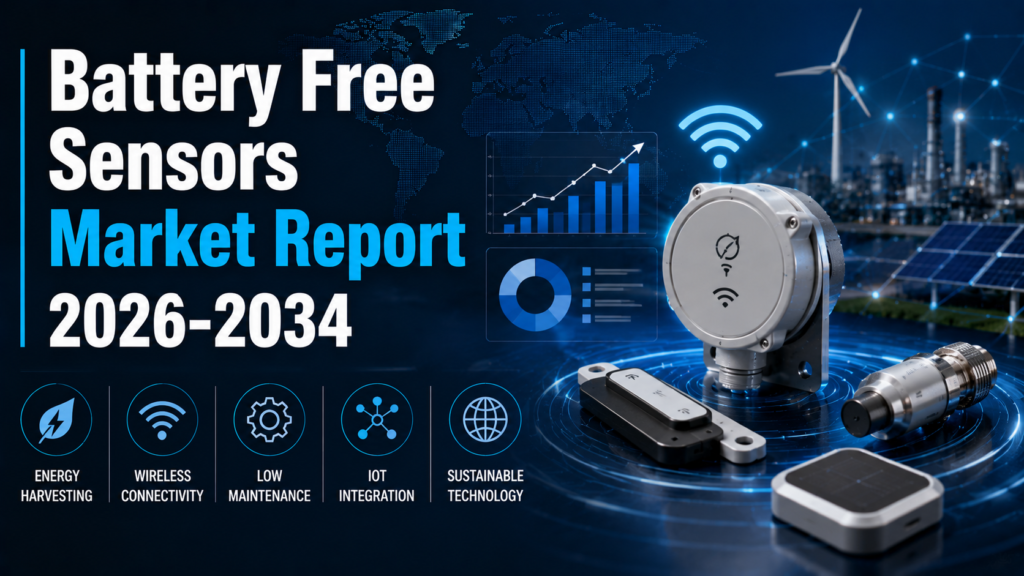
The global battery-free sensors market size reached USD 68.1 Million in 2025. Looking forward, IMARC Group expects the market to reach USD 393.4 Million by 2034, exhibiting a growth rate (CAGR) of 20.88% during 2026-2034.. Growth is driven by advancements in energy harvesting technologies, expanding IoT applications, and rising demand across sectors like healthcare, agriculture, and environmental monitoring, all of which favor eco-friendly, maintenance-free sensing solutions.
Battery free sensors operate without an internal power cell, drawing energy instead from ambient sources such as radio frequency signals, light, heat, vibration, or motion. This design eliminates the need for battery replacement, reduces electronic waste, and allows sensors to be deployed in locations that would otherwise be difficult or costly to service. The technology plays an increasingly important role in industrial monitoring, asset tracking, healthcare, and smart infrastructure, where continuous, low maintenance data collection is essential.
Market Snapshot
- Ultra high frequency sensors represent the largest segment by frequency, valued for long range communication and efficient power consumption in logistics and asset tracking.
- Temperature sensors hold the largest share by sensor type, given their critical role in industrial process control, healthcare, and environmental monitoring.
- Automotive stands out as the leading end use industry, supported by demand for vehicle monitoring, safety systems, and predictive maintenance.
- Asia Pacific dominates regionally, driven by rapid industrialization, expanding IoT networks, and heavy investment in smart infrastructure across China, Japan, India, and South Korea.
- Europe and North America follow closely, supported by strong regulatory frameworks and advanced industrial and healthcare ecosystems.
Battery-Free Sensors Market Trends and Drivers
Rising demand for IoT devices: Battery free sensors are integral to expanding IoT ecosystems, providing data collection and monitoring capabilities without battery power. This enhances device longevity and network efficiency while enabling advanced automation and real time analytics across manufacturing, healthcare, and agriculture.
Advantages in remote and harsh environments: These sensors are increasingly favored for deployment in remote or harsh settings due to their robustness and reliability. Removing the battery eliminates the risk of power failure in extreme conditions, which is especially valuable in oil and gas, mining, and logistics operations where equipment sits in hard to reach locations.
Cost efficiency and maintenance benefits: By removing the need for battery replacement and disposal, these sensors reduce long term operating costs and labor. Their low maintenance requirements and extended lifespan make them attractive for businesses seeking to optimize costs while maintaining reliable, continuous monitoring.
Growing focus on sustainability: Battery free sensors align with environmental goals by cutting battery waste and lowering the carbon footprint tied to sensor deployment. Their energy harvesting capabilities support a greener approach to monitoring, resonating with regulatory and corporate mandates pushing sustainable practices across industries.
Key Technological Developments
Several real world applications illustrate how quickly this technology is advancing:
- Researchers at ETH Zurich developed a mechanical sensor that harvests vibrational energy from sound waves to distinguish specific words and trigger electronic devices, with potential use in infrastructure monitoring and medical devices such as cochlear implants.
- A paper-like, AI enabled sensor patch called PETAL, developed by the National University of Singapore and A*STAR’s Institute of Materials Research and Engineering, monitors wound recovery with 97 percent accuracy using colorimetric sensing and no external power source.
- MIT researchers built a battery free, wireless underwater camera that is roughly 100,000 times more energy efficient than existing undersea cameras, powered entirely by sound waves and capable of capturing color images in dark underwater environments.
- UHF RFID sensor devices are being used for predictive maintenance in industrial settings, connecting to existing infrastructure to provide low power, high resolution measurements without added hardware.
- Researchers at Ireland’s VistaMilk SFI Research Centre created a wire free, battery free system that monitors dairy cow health using antenna technology and cloud based AI processing, tracking body temperature, movement, and hydration.
Battery-Free Sensors Industry Segmentation
Breakup by Frequency:
- Low Frequency
- High Frequency
- Ultra High Frequency
Ultra high frequency sensors lead the market due to their long range communication, high data transfer rates, and efficient power use, making them well suited to supply chain management and large scale asset tracking.
Breakup by Sensor Type:
- Temperature Sensors
- Humidity or Moisture Sensors
- Pressure Sensors
- Motion and Position Sensors
- Light Sensors
- Others
Temperature sensors dominate this segment given their essential role across industrial process control, healthcare, and consumer electronics, where precise readings support safety and regulatory compliance without relying on battery power.
Breakup by End Use Industry:
- Automotive
- Logistics
- Healthcare
- Oil and Gas
- Food and Beverages
- IT and Telecommunications
- Others
Automotive leads this category, with battery free sensors supporting vehicle monitoring, safety systems, and predictive maintenance in electric and autonomous vehicle technologies.
Breakup by Region:
- North America: United States, Canada
- Asia Pacific: China, Japan, India, South Korea, Australia, Indonesia, Others
- Europe: Germany, France, United Kingdom, Italy, Spain, Others
- Latin America: Brazil, Mexico, Others
- Middle East
- Africa
Regional Analysis
- Asia Pacific holds the largest share, supported by rapid industrialization, expanding IoT networks, and strong government commitment to smart cities and digital healthcare across the region.
- North America benefits from advanced technological infrastructure, high IoT adoption, and robust industrial and healthcare sectors focused on predictive maintenance.
- Europe shows strong activity in Germany, France, and the United Kingdom, driven by strict regulatory frameworks and sustainability initiatives across automotive, manufacturing, and healthcare.
- Latin America is expanding gradually, fueled by growing IoT adoption in agriculture and logistics, while the Middle East and Africa show emerging potential tied to oil and gas monitoring, smart city projects, and resource management needs.
Download a sample copy of the report: https://www.imarcgroup.com/battery-free-sensors-market/requestsample
Competitive Landscape
Leading companies in the battery free sensors space are focused on innovation, developing advanced energy harvesting technologies, and broadening their product portfolios to serve more efficient and durable sensing needs. Strategic partnerships with IoT companies, healthcare institutions, and industrial players are widening market reach, while sustained investment in research and development continues to improve sensor functionality, reliability, and scalability.
Leading Companies Operating in the Global Battery-Free Sensors Industry:
- Axzon
- DCO Systems Ltd.
- Distech Controls Inc.
- EnOcean GmbH
- Everactive, Inc.
- Farsens
- Inductosense
- Powercast Corporation
- Semiconductor Components Industries, LLC
- Wiliot
Recent News and Developments in Battery-Free Sensors Market
January 2024: MIT researchers developed a battery free, self powered sensor capable of harvesting energy from the magnetic field around a wire. The sensor can be embedded in hard to reach places to gather long term data on power consumption and operations across factories, warehouses, and ships.
June 2025: Energous Corporation launched its e-Sense tag, a battery free, maintenance-free IoT platform designed for supply chain monitoring, expanding the use of wireless power networks to eliminate battery dependency in tracking applications.
March 2026: Ligna Energy showcased battery free indoor sensing solutions alongside ultra-thin energy storage technology at Embedded World 2026 in Nuremberg, Germany, highlighting sensors designed to run without primary batteries in discreet, space-constrained placements.
Opportunities and Growth Potential
The battery free sensors market carries substantial room for expansion as IoT ecosystems continue to scale across smart buildings, industrial automation, and consumer electronics. Healthcare applications present a particularly strong growth avenue, with sensors increasingly used for patient monitoring, medical equipment tracking, and pharmaceutical logistics where power efficient, autonomous operation is critical.
Smart agriculture and environmental monitoring also offer meaningful opportunities, as battery free sensors provide continuous data for precision farming, soil health tracking, and climate monitoring without the burden of battery replacement. Asset tracking and inventory management stand out as well, with real time visibility into goods and equipment helping logistics, retail, and manufacturing operations reduce losses and improve efficiency. Companies that combine energy harvesting innovation with interoperability and standardization stand to capture significant share as adoption accelerates across both established and emerging regional markets.