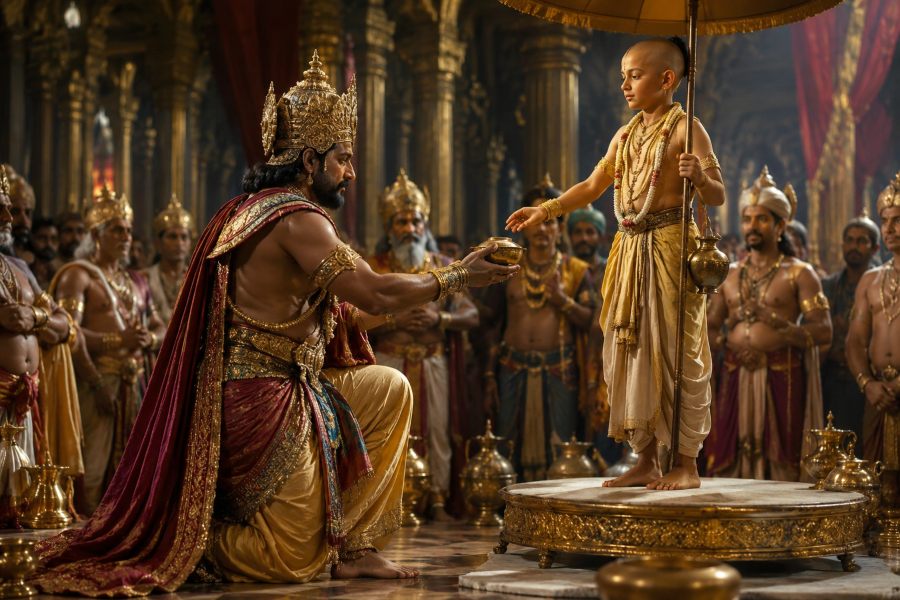

Bali Maharaja
Would you hand over your entire kingdom to a stranger who asked for just three steps of land? Most people wouldn’t give up a parking spot that easily, let alone an empire. Yet that’s exactly what Bali Maharaja did, and in doing so, he became one of the most quietly powerful figures in the entire Srimad Bhagavatam. His story isn’t really about losing a kingdom. It’s about what happens when a soul decides that keeping a promise matters more than keeping anything else. You can read the full account, along with hundreds of other Vaishnava classics, at the ISKCON Mayapur Store, where these stories live on in print and are still shaping how people think about surrender, dignity, and devotion today.
Who Exactly Was Bali Maharaja?
Bali Maharaja was a Daitya king — a descendant of the demon lineage through Prahlada Maharaja’s family. That detail alone throws people off. How does someone born into a demoniac dynasty end up so devoted that Lord Vishnu personally guards his palace gate? The answer lies in his grandfather.
Prahlada Maharaja, Bali’s grandfather, was famously devoted to Lord Narasimha despite constant persecution from his own father, Hiranyakashipu. That devotion didn’t stop with one generation. It passed down, quietly shaping Bali’s character long before he ever sat on a throne.
By the time Bali took over the kingdom, he wasn’t just powerful. He was disciplined, generous to Brahmanas, and strangely humble for someone who had defeated the demigods and taken control of the three worlds. That last part is where the real story begins.
A King Who Conquered Heaven Itself
Under the guidance of his guru, Shukracharya, Bali performed a series of powerful sacrifices and eventually defeated Indra, the king of heaven, taking control of Swarga loka along with the earthly and lower planetary systems. This wasn’t a small military win. It was a complete flip of cosmic order — the underdog dynasty now ruling everything.
Indra, humiliated and displaced, went straight to his mother Aditi in desperation. Aditi, in turn, prayed to Lord Vishnu for help. And that prayer is what set the entire Vamana story into motion.
The Dwarf Who Walked Into Bali’s Sacrifice
Here’s where the story gets interesting — not because of what happened, but because of how ordinary it looked on the surface.
Bali Maharaja was performing a grand Ashwamedha yajna on the banks of the Narmada river. Being a genuinely generous king, he had a standing policy: any Brahmana who approached him during a sacrifice would receive whatever they asked for, no questions attached.
Into this ceremony walked a short Brahmana boy — a dwarf, barely notable in appearance, carrying an umbrella and a waterpot. This was Vamanadeva, Lord Vishnu’s fifth incarnation, disguised in the simplest possible form.
Bali welcomed him with full royal hospitality, washed his feet, and offered him anything he desired — land, gold, cows, even entire provinces.
Vamana asked for something almost laughably small: three paces of land, measured by his own small footsteps.
Why Shukracharya Tried to Stop the Promise
This is the part most retellings skip past too quickly. Shukracharya, Bali’s guru and an expert in cosmic matters, immediately recognized who was really standing in front of them. He warned Bali directly — this “boy” was Vishnu himself, and once Bali gave away those three steps, he would lose everything, because Vishnu’s steps could span the entire universe.
Shukracharya told Bali to refuse the promise, or at least to lie about the commitment to protect himself and his empire.
And this is where Bali’s real character shows up.
Why Bali Refused to Break His Word — Even to Save His Kingdom
Bali had a choice most people never get tested on: keep a promise and lose everything, or break it and lose only his integrity.
He chose integrity.
Bali told his guru, quite plainly, that a king who breaks his word to a Brahmana — especially during a sacrifice — isn’t really a king at all. He said he would rather lose his kingdom, his wealth, even his life, than go back on a promise given with folded hands. Shukracharya was furious enough to curse him for refusing this advice, yet Bali didn’t budge.
This single decision is why devotees still talk about Bali Maharaja centuries later. He wasn’t fighting for land. He was fighting to stay true to his word, even when logic screamed at him not to.
The Moment Vamana Grew to Cosmic Size
Once Bali confirmed the gift by pouring water from his kamandalu, Vamana’s form began expanding. Within moments, he covered the entire earth with one step and the whole of the heavenly planets with the second. There was no third place left to put his foot.
Bali, without hesitation, offered his own head as the spot for the third step.
Read that again. A king who had just lost his entire empire in two steps offered his own body for the third, simply because a promise is a promise.
What Happened After Bali Lost Everything?
This is the part that changes how you see the whole story. Vishnu, moved by Bali’s absolute honesty and surrender, didn’t destroy him. Instead, he did something far more meaningful.
- He allowed Bali to keep the lower planetary region called Sutala, which was described as even more comfortable than heaven itself.
- He personally became the gatekeeper of Bali’s palace, guarding it day and night.
- Bali was granted a future position as Indra in a coming Manvantara — meaning his “loss” was actually a promotion in disguise.
Losing an empire earned Bali something no material kingdom could offer: the personal, constant company of the Supreme Lord.
The Wife’s Question That Reveals the Whole Point
There’s a small, often-overlooked moment in the Bhagavatam where Bali’s wife, Vindhyavali, asks Vamana why he took everything from a king who had given so generously. Vishnu’s answer is the heart of this entire narrative — he explained that he takes away wealth and position from those he especially favors, precisely so they stop identifying with material possessions and instead depend fully on him.
That single exchange reframes the whole story. Bali’s “defeat” wasn’t punishment. It was elevation.
The Real Lesson Behind Bali Maharaja’s Sacrifice
Most people read this story and think it’s about charity. It’s really about something sharper: detachment from outcome.
Bali didn’t calculate what he’d lose before making the promise. He didn’t hedge, negotiate, or look for a legal loophole once Shukracharya warned him. He simply honored his word, fully aware it would cost him everything he had built.
That kind of surrender doesn’t come naturally. It comes from generations of association with devotion, from a family lineage that valued truth over comfort — starting with Prahlada and carrying straight through to Bali.
Why This Story Still Matters Today
You don’t need to be a king facing a cosmic dwarf to learn from this. Almost everyone eventually faces a version of Bali’s dilemma: a moment where keeping your word costs more than breaking it would.
- Do you honor a commitment even when circumstances have changed?
- Do you stay generous even when generosity seems to work against your own interest?
- Do you trust that giving something up might actually open a door you can’t yet see?
Bali Maharaja’s answer to all three was yes, and the Bhagavatam holds him up as an example precisely because that kind of yes is rare.
How Bali’s Story Connects to Prahlada’s Legacy
It’s worth pausing on the family angle, because it explains a lot about why Bali behaved the way he did under pressure.
Prahlada Maharaja wasn’t just tolerated by Hiranyakashipu — he was tortured for his devotion. Thrown from cliffs, placed in fire, fed poison, and none of it shook his faith in Vishnu. That kind of conviction doesn’t just disappear once a generation passes. It becomes a family trait, almost a genetic memory passed through blood and upbringing.
Bali grew up hearing these stories firsthand, likely from Prahlada himself or from elders who witnessed his suffering and steadiness. So when Bali stood at his own crossroads — guru versus promise, empire versus word — he wasn’t improvising. He was drawing on a family template that had already been tested under far worse conditions.
This is part of why the Bhagavatam treats the Daitya lineage with unusual respect. Birth in a demoniac family doesn’t automatically make someone demoniac in nature. Association, upbringing, and personal choice matter more than bloodline, and Bali is one of the clearest proofs of that principle in the entire scripture.
The Role of Shukracharya’s Curse
Shukracharya’s anger wasn’t petty. As Bali’s spiritual guide, he had genuine reasons to feel that his student was making a catastrophic mistake, and his curse — that Bali would lose his kingdom for disobeying his guru — came from a real place of concern, not malice.
But here’s the twist: even a guru can be wrong about what’s actually good for a disciple. Shukracharya was thinking in terms of political survival. Bali was thinking in terms of truthfulness and surrender. The Bhagavatam sides with Bali, not because gurus don’t matter, but because Bali’s decision aligned with a higher principle than the one Shukracharya was protecting.
This tension — between practical advice and spiritual conviction — shows up constantly in devotional literature, and Bali’s story remains one of the sharpest examples of choosing surrender over strategic self-preservation.
Sutala: The “Loss” That Looked Like a Downgrade
People often assume Bali ended up somewhere lesser after his encounter with Vamana. The Bhagavatam is specific about this, and it’s worth spelling out clearly:
- Sutala is described as free from fatigue, illusion, fear, and the miseries typically associated with old age or disease.
- Bali retained his royal opulence there, simply relocated from the three worlds to this particular planetary system.
- Lord Vishnu personally stationed himself at Bali’s gate as a guard, an honor no other king in the Bhagavatam receives in quite the same way.
So the “punishment” was actually a permanent upgrade in the one currency that matters most in devotional life — nearness to the Lord. Bali didn’t just keep his comfort; he gained something material wealth was never going to give him: personal access to Vishnu, day and night, indefinitely.
A Few Details People Often Get Wrong
Since this story gets retold constantly, a few small inaccuracies tend to creep in:
- Bali wasn’t tricked. Shukracharya warned him clearly before the gift was confirmed. Bali knew exactly who he was dealing with and chose to proceed anyway.
- Vamana isn’t a villain in disguise. His three steps weren’t a trick to cheat Bali — they were designed to test and ultimately elevate him.
- Sutala isn’t a punishment zone. The Bhagavatam describes it as more comfortable and pleasant than even the heavenly planets, contradicting the common assumption that Bali was banished somewhere miserable.
Getting these details right matters, especially if you’re studying the Bhagavatam seriously rather than just picking up the story secondhand.
Where to Read Bali Maharaja’s Full Story
The complete narrative appears in the Eighth Canto of Srimad Bhagavatam, and reading it directly — rather than through summaries — reveals just how carefully Srila Prabhupada’s purports connect Bali’s choices to practical spiritual life. His commentary draws out details that are easy to miss on a casual read, particularly around why surrender and material loss aren’t opposites in Krishna consciousness.
If you want to go through the original verses along with authoritative translation and purport, the full Srimad Bhagavatam sets are available through trusted Vaishnava publishers, giving you access to Bali’s story exactly as it was meant to be understood — not as a simplified moral fable, but as a real account of what devotion actually demands.
Bali Maharaja gave up an empire in three steps. What he gained instead — a permanent place at Vishnu’s door — is the part of the story worth sitting with a little longer.