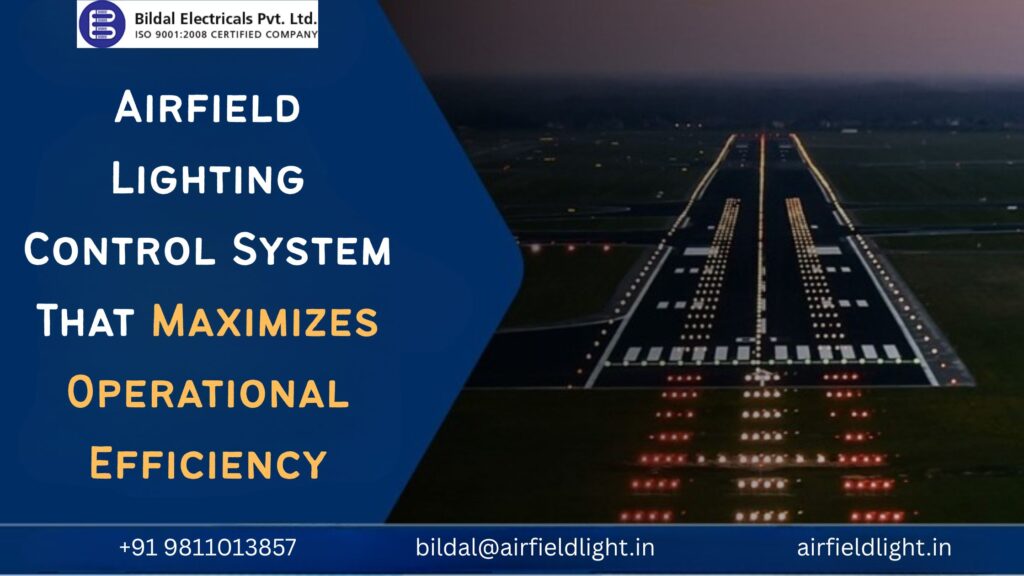

Every second counts at dusk on a runway where there is a lot going on. Pilots use visual clues, which are usually easily visible, ground teams organize distinctions, and air traffic controllers can deal with several operations simultaneously. Behind this seamless choreography lies a well-designed airfield lighting control system, quietly ensuring that safety and efficiency move hand in hand.
The Backbone of Safe and Smooth Airfield Operations
The airfield is much more than concrete. It is a dynamic environment where airport runway lights, taxiway indicators, and approach systems must work in perfect sync. With such components controlled by a centralized system of control, the business operations will be much easier and more predictable.
Instead of manually switching circuits or responding reactively, operators can monitor the entire airfield lighting system from a single interface. This is an operating control type that minimizes delay, enhances response times, and minimizes the number of human errors, particularly in operation in the night or bad weather.
How Intelligent Control Transforms Runway Performance
The conventional lighting systems tended to view the various components as independent systems. The systems of the present-day are smarter. By integrating runway lighting equipment into an intelligent control network, brightness levels can be adjusted based on visibility, traffic density, or specific operational needs.
For example, during low-visibility landings, runway landing lights can be intensified instantly, giving pilots better depth perception. The lighting can be dimmed down during the less busy hours without jeopardizing security. This flexibility is where the real key to operational efficiency will start manifesting itself.
Real-Time Monitoring Brings Confidence to Decision-Making
Think of an unexpected weather change coming relatively quickly. Having a strong control system, the staff in it can provide the side of the airfield to redirect the incoming aircraft with proper lighting regimes. Alerts and diagnostics assist in the detection of malfunctions before escalation occurs, and unexpected outage is avoided. This is a proactive strategy that spares time and resources. Maintenance teams are aware of the need for attention, and controllers are confident that the lighting environment helps to sustain any movement on the ground and in the air.
Energy Efficiency Without Sacrificing Safety
Speed is not the only concern of operational efficiency, but also of sustainability. Advanced control systems are designed to work seamlessly with LED-based airport runway lights, significantly lowering power consumption.
Airports can minimize energy wastage by planning the use of lights and also by automating the light intensity to achieve the corresponding light level, whereas in the daytime airports can lower the life span of the essential items. Such savings cumulate over time, and the airfield becomes less expensive without compromising on safety requirements.
Integration That Simplifies Complex Operations
An airfield today can hardly work alone. Lighting systems have to be connected with weather sensors, power backup stations, and air traffic management systems. An advanced airfield lighting control system acts as the central brain, bringing all these elements together.
That is why manufacturers such as Bildal Electricals are aware of this complexity. They have developed systems that are compatible with the existing infrastructure, and hence upgrades are easy and do not need expensive upgrades. The way this works out is a lighting environment that will evolve its functionality with changing operational needs.
Built for Reliability in High-Stakes Environments
Airports are twenty-four-hour open operations that are usually performed under harsh conditions. Every single part is put to the test of heat, rain, dust, and constant use. An effective control system is designed to handle these obstacles without leading to effects on its performance. The light system is also reliable even during peak traffic or in cases of emergencies since there are redundant controls, secure communication protocol, a user-friendly interface. This consistency is not attainable by chance; it is necessary.
Lighting the Path Toward Smarter Airfields
The intelligent control is the starting point of efficient airfield operations. When precision is applied in managing the lighting systems, the airports have improved ability to create greater safety margins, reduce the cost of running the operations, and ease the workflow. With an option that is made with reputable companies such as Bildal Electricals, the airfield operators are making a bold move to a more intelligent, efficient aviation environment, which can be said to be prepared for the challenge of tomorrow.