
Key Takeaways
- The next wave of autonomous operations happens at the edge, not the cloud, because latency and bandwidth cap real-time decisions long before model accuracy does.
- McKinsey measured cloud voice tasks at 1,000 to 2,200 milliseconds against 300 to 700 milliseconds on the edge, a gap that decides whether a machine reacts in time.
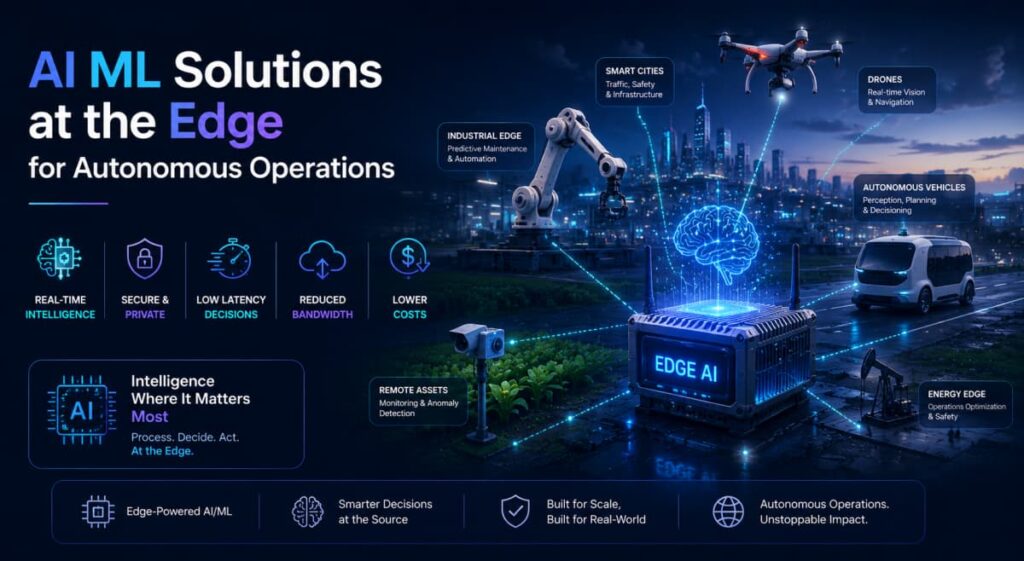
- Predictive maintenance, quality inspection, autonomous robotics, smart grids, and retail sensing all need inference where the data is created.
- Model compression, small language models, and a managed edge-cloud continuum make on-device intelligence practical for teams that plan for drift and device security.
- Fleet management, model updates, and edge MLOps decide whether a pilot survives contact with a thousand production sites.
A self-guided forklift that waits 1,800 milliseconds for a cloud verdict has already rolled past the pallet it was supposed to stop for. That single number explains why autonomous operations are moving off the cloud and onto the machine. The bottleneck is rarely the model. Modern AI ML solutions already classify a defect or predict a bearing failure with accuracy that satisfies most plant managers. What breaks the loop is distance: the round trip to a distant data center, and the cost of shipping every camera frame and vibration reading over a metered link. Latency and bandwidth, not model quality, set the ceiling on what a system does on its own.
That reframing changes where the work belongs. When decisions must land in tens of milliseconds, and when a site generates terabytes a shift, the sensible place for AI and Machine Learning Solutions is next to the sensor. This piece defines intelligent data processing at the edge, explains the physics behind the shift, and walks through the use cases, technologies, benefits, and operational headaches that decide whether an edge program reaches production or stalls in a lab.
Latency and Bandwidth Set the Ceiling, Not Accuracy
Physics is the honest constraint. A signal cannot cross a continent and return faster than the speed of light allows, and public networks add queuing, congestion, and retries on top of that floor. McKinsey’s analysis of voice-assistance tasks put cloud latency near two seconds, at 1,000 to 2,200 milliseconds, against 300 to 700 milliseconds for edge deployments. For a voice reply the difference is mild annoyance. For a robot arm sharing a cell with a worker, or a vehicle reading a crosswalk, a second of hesitation is the difference between a safe stop and an incident.
Bandwidth carries the second half of the argument. A single high-resolution inspection camera can generate several gigabytes an hour, and a mid-size factory runs dozens of them alongside vibration, temperature, and current sensors. Streaming all of it to the cloud for scoring wastes the link, inflates the bill, and fails outright when connectivity drops. Processing at the source flips the ratio: the model watches the full stream locally and sends up a defect flag, a maintenance alert, or a nightly rollup. The heavy data stays put; only decisions travel.
Accuracy still matters, but it is no longer the scarce resource. Teams reach for the edge once they accept that a slightly smaller model returning an answer in 40 milliseconds beats a larger one that answers in two seconds it does not have.
Where On-Device Intelligence Already Earns Its Keep
Edge deployments cluster where the cost of delay is concrete. Five patterns recur across industrial and commercial settings:
- Predictive maintenance: Vibration and acoustic sensors on pumps, motors, and gearboxes run anomaly-detection models on a local gateway, catching bearing wear days before failure and scheduling service before a line stops.
- Quality inspection: Cameras at the end of a production line score each part against a defect model in real time, pulling rejects automatically instead of sampling a batch hours later.
- Autonomous vehicles and robotics: Warehouse robots, mining haulers, and driver-assistance systems fuse camera, lidar, and radar data on board, because a safety decision cannot wait on a network.
- Smart grid and energy: Substation controllers run load-balancing and fault-detection models locally, isolating a fault in milliseconds and rerouting power before the disturbance spreads.
- Retail sensing: In-store cameras and shelf sensors track stock levels and queue lengths on site, alerting staff without streaming customer footage to an outside server.
Retail and services already lead edge investment, representing nearly 28% of edge spending in 2025 according to IDC, with manufacturing close behind. The pattern is consistent: wherever a decision must be fast, local, and resilient to a dropped connection, the processing follows the data.
The Autonomy Payoff
Each of these cases shares one trait. The system acts without asking a human, and often without asking the cloud. That autonomy depends on the local loop closing reliably, which is why the next question is engineering, not modeling. Vendors offering ai & machine learning services increasingly package edge deployment as a core capability rather than an add-on.
The Technologies Behind AI and Machine Learning Solutions at the Edge
Getting a model onto a constrained device takes a different toolkit than training it. Several technologies do the heavy lifting, and picking the right combination is where sound AI ML solutions separate from science projects. Well-built AI and Machine Learning Solutions treat the device, the model, and the network as one design, not three afterthoughts.
- Edge inference hardware: Purpose-built accelerators in gateways, cameras, and controllers run neural networks at low power. Deloitte projected that half of 2025 laptops would carry local generative-AI processing, and over 30% of smartphones, evidence that on-device silicon is now mainstream rather than exotic.
- Model compression and quantization: Pruning, distillation, and reducing weights from 32-bit to 8-bit shrink a model to fit device memory while holding most of its accuracy, often cutting size by a factor of four or more.
- The edge-cloud continuum: The cloud still trains models, aggregates fleet data, and hosts dashboards; the edge runs inference. Treating the two as one pipeline, rather than rival destinations, is the design that holds up.
- Federated learning: Devices improve a shared model by training on local data and sending back only weight updates, never raw records, which suits privacy-sensitive settings such as clinics and retail floors.
The through-line is restraint. A quantized model matched to available silicon, updated on a schedule the network can sustain, beats an oversized architecture that never leaves the workstation.
What AI ML Solutions Gain by Running on the Machine
The benefits stack in a predictable order. First, response time drops from seconds to tens of milliseconds, which is what makes closed-loop control and safety functions viable at all. Second, bandwidth and cloud egress costs fall sharply, because summaries replace raw streams. Third, operations keep running through network outages, since the decision logic no longer depends on a live uplink. A remote substation or an offshore rig keeps making calls locally even when the backhaul link drops for hours.
Privacy and compliance improve alongside performance. Keeping camera frames and patient or customer signals on site narrows the data that ever crosses a public network, which shortens audits and reduces exposure under GDPR and similar regimes. Gartner expects 50% of critical enterprise applications to reside outside centralized public cloud locations through 2027, a structural signal that latency, data gravity, and resilience are pulling workloads outward. The gains are real, and so are the obligations that come with running intelligence across a fleet.
The Hard Part Is Managing a Thousand Models in the Field
A single edge model in a demo is easy. A thousand of them across depots, stores, and substations is an operations problem that sinks unprepared programs. Four challenges deserve a plan before the first device ships:
- Device fleet management: Provisioning, monitoring, and retiring hardware across dozens of sites needs the same rigor as managing servers, with far less physical access to each unit.
- Security at the edge: Every device is a potential entry point. Signed firmware, encrypted local storage, hardware roots of trust, and mutual authentication move from nice-to-have to baseline.
- Model drift: Sensors age, lighting changes, and product lines shift, so a model that scored well at launch degrades quietly. Monitoring accuracy in the field and retraining on fresh data keeps decisions trustworthy.
- Edge MLOps: Shipping a new model version to thousands of devices without breaking a running line demands staged rollouts, version pinning, and instant rollback, all built into the pipeline rather than bolted on later.
Mature artificial intelligence and machine learning services treat these as first-class concerns from the design phase. The organizations that stall are usually the ones that solved the model and ignored the fleet.
Governance Follows the Model to the Edge
Distributing inference does not distribute accountability. Someone still owns which model version runs where, what data it saw, and how a wrong call gets caught. Building that ledger early is cheaper than reconstructing it after an audit.
The 2025-2026 Shift: Small Models and Agentic Edge
Two trends are reshaping the field. The first is the rise of small language models. Rather than calling a giant model in the cloud, teams now run compact models of a few billion parameters directly on gateways and industrial PCs, handling classification, summarization, and natural-language control on site. The economics moved with the hardware: local inference costs nothing per query and never leaves the building.
The second is the agentic edge, where local models do more than score and alert. They plan and act. An edge agent on a packaging line might detect a jam, adjust a conveyor speed, log the event, and escalate only if the fix fails. IDC put 2025 edge spending near $261 billion, growing at 13.8% toward $380 billion by 2028, with AI cited as the primary driver of that investment. That spend is funding exactly this move from passive sensing to local decision-making.
Both trends point the same way. Capable AI and Machine Learning solutions no longer require a data center on the other end of every request; the intelligence rides with the machine.
Where Autonomous Operations Head Next
The direction is toward tighter loops and thinner clouds. As accelerators get cheaper and models get smaller, more of the decision stack collapses onto the device, and the cloud settles into training, coordination, and oversight. Expect standardized edge MLOps platforms to make fleet updates routine, and expect regulators to ask sharper questions about where automated decisions are made and logged. Teams that treat the edge-cloud continuum as one system, rather than a lab-versus-production divide, will move fastest. The constraint was never intelligence. It was getting that intelligence to act in time, at the point where the work happens.
Autonomous operations in 2026 belong to teams that put AI ML Solutions where latency and bandwidth stop fighting them: at the edge. The physics is settled, the hardware is shipping, and the open questions are operational, which means fleet management, security, and model drift decide who scales past the pilot.
Damco Solutions helps enterprises design that path, and its AI and machine learning services cover model compression, edge deployment, and the MLOps discipline that keeps thousands of field models honest. The organizations that master intelligent data processing at the edge will run faster, cheaper, and more resilient operations than those still waiting on a round trip to the cloud. The edge is where the next decade of autonomy gets built.