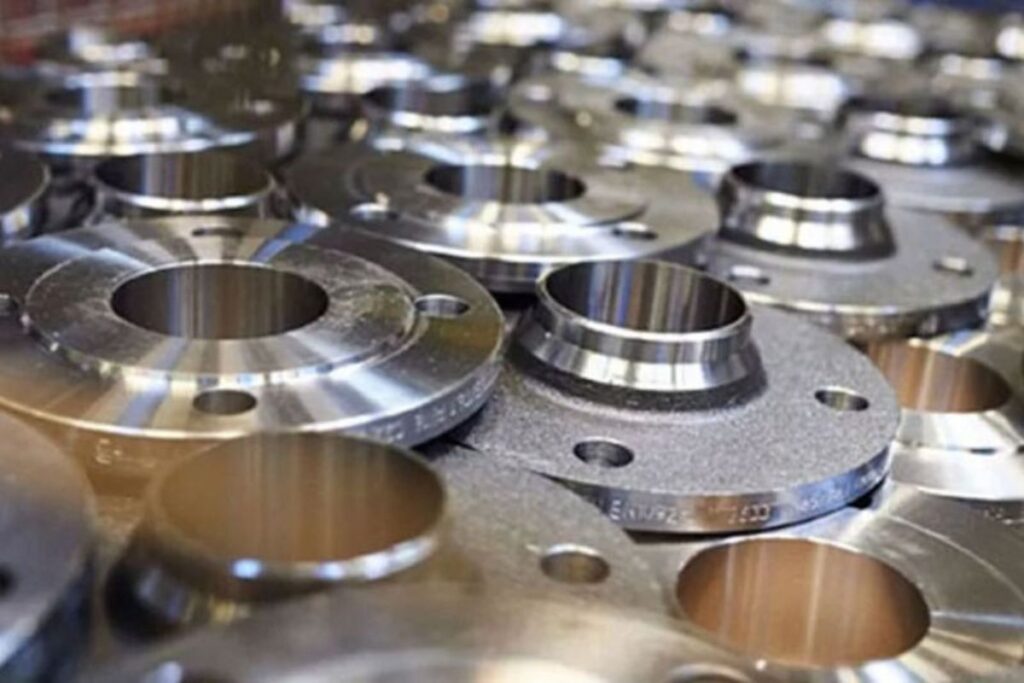

Duplex steel flanges are widely used in offshore platforms, chemical processing plants, desalination facilities, and oil and gas refineries because of their high strength feature and brilliant corrosion resistance in harsh chemical conditions. Conventional materials corrode rapidly in chloride-rich seawater, sour gas, acids, and high pressure systems. Corrosion resistant duplex flanges are a suitable choice for important piping systems. The combination of ferritic and austenitic structure gives good resistance to pitting, stress corrosion cracking and long-term industrial wear. Maintenance is reduced, and operational reliability is improved.
What Are Duplex Steel Flanges?
Duplex steel flanges are made up of duplex stainless steel grades, most often 2205 (UNS S32205) and 2507 (super duplex). The most important component is the balanced ferritic-austenitic microstructure of this material which gives nearly equal amounts of both phases which gives the material its specific combination of properties.
Most industrial pipe systems make use of Duplex 2205 Flanges. All basic styles weld neck, slip-on, blind, socket weld, threaded, and lap joint, are available to accommodate everything from high-pressure main pipes to low-pressure side fittings. The severity of your chemicals and the amount of pipe pressure determine whether you need grade 2205 or 2507.
Chemical Composition and Material Characteristics
Duplex grades consist of a high chromium, molybdenum, and nitrogen content, which gives them their corrosion resistance. Chromium then generates a passive oxide layer, which is resistant to oxidative attacks. Molybdenum protects the material against minor rust cracks and crevices in saturated water, which is the most significant cause of failure in marine piping components. Nitrogen keeps the metal’s internal structure complete, which makes it stronger and more resistant to chemical breakdown.
This combined effect delivers excellent resistance to pitting and crevice corrosion, plus strong resistance to chloride stress corrosion cracking, the mechanism that causes sudden brittle failure in sensitised austenitic grades. It also provides a yield strength roughly double that of standard 316L stainless steel. That strength advantage directly enables reduced wall thickness and lighter flanges for the same pressure rating.
Key Advantages of Duplex Steel Flanges
Refer to the key advantages below to see why Duplex Steel Flanges are preferred for demanding piping systems:
Outstanding Corrosion Resistance
The dual-phase structure offers a major performance step-change, resisting seawater, acid chlorides, and rapid environmental degradation.
High Mechanical Strength and Pressure Capability
Higher yield strength allows these components to safely handle elevated operating pressures while utilizing a thinner wall thickness.
Reduced Weight and Flange Thickness
Thinner profiles lower the installed weight, reducing structural loads on pipework and simplifying handling during offshore installation.
Lower Lifecycle Cost
Extended service intervals and minimal maintenance translate directly into a lower total cost of ownership over time.
Performance in Harsh Environments
Offshore and marine installations expose flanges to continuous seawater contact, tidal zone cycling, and marine atmosphere corrosion simultaneously. High-Strength Duplex Flanges handle all 3 without the pitting or crevice corrosion that degrades standard stainless flanges within a few years in the same conditions.
Acidic and chloride-rich process environments in chemical plants and refineries are equally demanding. Duplex Stainless Steel Flanges maintain their mechanical integrity under combined chemical and pressure loading that causes stress corrosion cracking failures in austenitic grades. In sour gas and brine service where hydrogen sulphide is present alongside chlorides duplex grades also meet NACE MR0175 sour service requirements, which standard austenitic grades often can’t satisfy.
Industrial Applications
Oil and Gas Industry
Offshore platforms, subsea pipelines, and refinery process units specify duplex flanges for mainline and branch connections in corrosive service. The combination of pressure capability and corrosion resistance covers the full range of offshore and downstream process demands.
Chemical Processing
Reactors, storage tanks, acid handling systems, and heat exchangers in chemical plants handle aggressive media under sustained pressure. Duplex flanges survive the combined chemical and mechanical loading where standard flanges require frequent replacement.
Marine and Shipbuilding
Seawater cooling systems, desalination plant piping, and ship internal piping networks use duplex flanges for their resistance to continuous seawater contact and the biological fouling environments that accompany it.
Power Generation
Cooling water circuits and flue gas desulphurisation systems both involve corrosive media under sustained pressure cycling. Duplex flanges maintain integrity through the thermal and chemical demands of both applications.
Water Treatment
High-pressure reverse osmosis systems and chemical dosing circuits in water treatment plants use duplex flanges where the combination of pressure and chemical aggressiveness exceeds the capability of standard carbon steel or austenitic stainless flanges.
Types of Duplex Steel Flanges
Read the following points to understand the different types of duplex steel flanges available for your piping system:
- For high-pressure and high-cycle mainline connections, Weld Neck Flanges are the preferred choice due to their superior structural reinforcement.
- When working with lower-pressure systems where full butt-weld integrity isn’t necessary, Slip-On Flanges offer a highly cost-effective and easy-to-install alternative.
- To safely terminate or isolate pipe ends under intense pressure, Blind Flanges are used to completely seal off the line for maintenance or testing.
- Designed for smaller-diameter piping, Socket Weld Flanges provide strong, leak-proof connections in high-pressure processing lines.
- In hazardous environments where welding isn’t practical or permitted, Threaded Flanges allow for secure mechanical connections without the use of heat.
- Ideal for systems requiring regular disassembly, Lap Joint Flanges are used alongside stub ends to make bolt alignment quick and effortless.
Standards and Specifications
Duplex flanges are made to high global standards to assure safety and performance. UNS S32205 / S31803 are the material grades for correct ordering. ASTM A182 is the standard for the manufacture of forged duplex stainless steel for high temperature and pressure service. The geometrical tolerances, pressure-temperature limitations, and flange face configurations are in accordance with the ASME B16.5 and B16.47 engineering requirements. According to the NACE MR0175 standard, the material is fully qualified for sour gas service with the harmful H2S under severe circumstances and corrosion.
Testing and Quality Assurance
A comprehensive quality framework guarantees the integrity and compliance of every manufactured flange. This process begins with Positive Material Identification (PMI) to confirm the exact alloy composition upon receipt or during third-party inspection. All components undergo rigorous hydrostatic and dimensional validation prior to logistics dispatch to verify absolute pressure containment and geometric compliance. Additionally, a complete mechanical and metallurgical assessment, including pitting tests indicates that the material complies with the structural standards of ASTM A182. Finally, each procurement contract is accompanied by EN 10204 3.1 Mill Test Certificates (MTC) to establish continuous heat traceability from the melt source to final component.
Selection Factors
Specifying the right duplex flange starts with characterising the process fluid: its chemical composition, chloride concentration, and pH. Operating pressure and temperature define the pressure class and wall thickness requirement. Required corrosion resistance and specifically whether sour service compliance is needed, determines whether 2205 or super duplex 2507 is the appropriate grade. The applicable industry standard (ASME, ASTM, or project-specific) should be confirmed before ordering, as dimensional and material requirements vary.
Conclusion
Duplex steel flanges are the technically acceptable alternative for pipe systems in extreme service situations. They overcome the practical constraints of traditional austenitic stainless steel and carbon steel alternatives by combining improved corrosion resistance, higher strength, decreased weight and lower lifecycle maintenance cost. Duplex grades provide longer service life and reduced unscheduled maintenance in marine, oil and gas, chemical processing and desalination applications where ordinary flanges break prematurely. The engineer needs to specify the proper grade for the environment, verify the standards and get it from a supplier that can support the material with complete certification and test evidence.