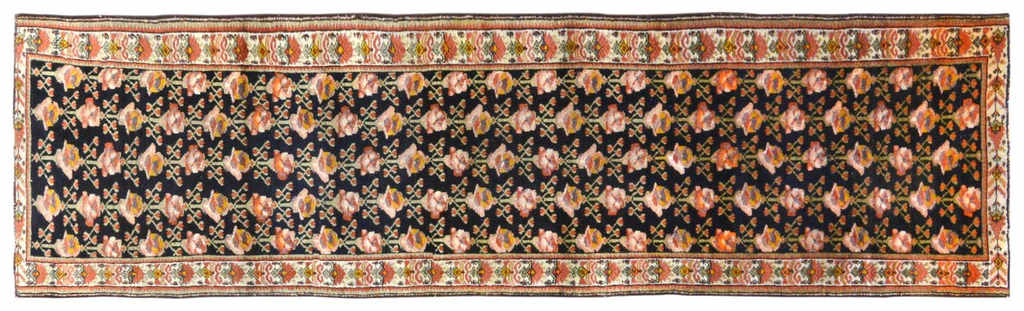

To love an antique rug is, inevitably, to become a small-scale historian. Every genuine antique rug carries within its knots and dyes the specific fingerprint of the region, workshop, and often the individual weaver who made it. For collectors and design enthusiasts hoping to move beyond a general appreciation of “Oriental rugs” toward real connoisseurship, understanding the major weaving traditions is where the journey properly begins.
Persian Rugs: The Foundational Vocabulary
No discussion of antique rugs can begin anywhere but Persia, the source of the design vocabulary that shaped weaving traditions across the region for centuries. Within “Persian,” however, lies enormous regional diversity. Antique Heriz rugs, woven in northwest Iran, are prized for their bold, geometric medallions and warm brick-red and indigo palettes — a look that reads as strikingly modern despite being over a century old. Tabriz weavings, by contrast, favor intricate curvilinear patterns and denser knot counts, reflecting the city’s status as a historic center of courtly, high-precision weaving. Further south, antique Kashan rugs are distinguished by their fine wool, sophisticated central medallion compositions, and a subtlety of color that rewards close, patient looking.
Turkish and Anatolian Weavings
Antique Oushak rugs, woven in western Anatolia, occupy a special place in the design world’s affection. Their soft, abstracted floral patterns and gently faded palettes of apricot, saffron, and dusty blue have made them the favored choice of interior designers seeking an antique rug that feels simultaneously grand and understated. Oushaks were historically woven with a looser knot density than their Persian counterparts, producing a plush, slightly irregular texture that ages exceptionally well and only grows more desirable with softening over time.
Caucasian Tribal Weavings
Where Persian and Turkish city workshops favored refinement, the tribal weavers of the Caucasus region — encompassing areas of present-day Azerbaijan, Armenia, and Georgia — produced boldly geometric, almost abstract compositions using saturated natural dyes. Antique Kazak and Shirvan rugs, with their dramatic stepped medallions and high-contrast color blocking, have found renewed appreciation among contemporary collectors precisely because their graphic confidence anticipates modern abstract art by nearly a century. These pieces tend to be smaller in scale, woven on portable looms by nomadic and village weavers, which makes surviving examples in strong condition particularly rare.
Central Asian and Turkoman Traditions
Antique Turkoman rugs, woven by nomadic tribes across present-day Turkmenistan and neighboring regions, are recognizable by their repeating octagonal “gul” motifs and deep, wine-red grounds achieved through painstaking natural dye work. These weavings carry a gravity and formality distinct from the more decorative Persian and Turkish traditions, and their restrained, almost architectural repetition has made them a favorite among collectors of modernist and minimalist interiors seeking pattern without visual clutter.
Why Regional Knowledge Changes How You Buy
Understanding these traditions transforms rug buying from a purely aesthetic decision into an informed one. Knowing that an Oushak’s loose weave and faded palette are historically consistent with genuine age — rather than signs of poor quality — helps you buy with confidence. Recognizing the geometric hallmarks of a Caucasian tribal weaving helps you identify a rare, museum-quality piece when you encounter one, rather than passing it over for something more conventionally “polished.”
This is exactly why working with a specialist source matters. A well-organized collection of antique rugs spanning Persian, Turkish, Caucasian, and Central Asian traditions gives collectors the range needed to find a piece that matches both their aesthetic sensibility and their design brief — whether that calls for the bold geometry of a Kazak or the faded elegance of an Oushak.
The deeper your understanding of these regional traditions, the more rewarding the search becomes. Every antique rug is, in the end, a small woven document of a specific place and time — and learning to read that document is one of the genuine pleasures of building a collection with real depth. For those ready to explore these traditions firsthand, Orientalist Home’s antique rug selection offers a considered starting point across the full range of weaving cultures.