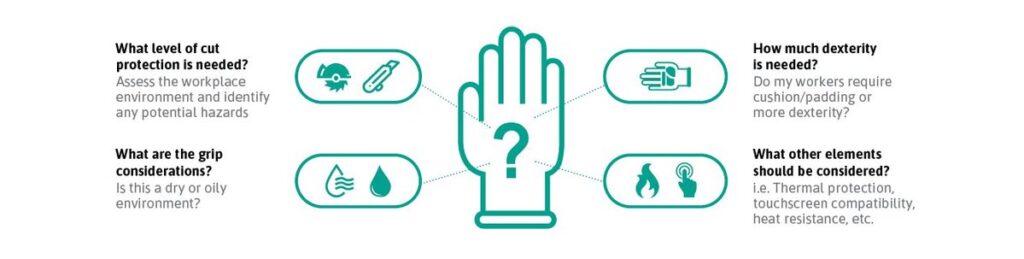

Cut related injuries remain one of the most common hazards in industrial work. Manufacturing, construction, metal fabrication, food processing, and logistics all present sharp edge risks. Choosing the right glove/ sarung tangan is not always straightforward, and the variety of global standards can add to the confusion. Understanding how these standards work helps safety managers select reliable hand protection that matches real jobsite needs. This overview breaks down the leading cut resistance standards for hand protection, explains how they are tested, and offers practical guidance for choosing the right level of protection.
Why Standards for Hand Protection Matter
Cut protection is only effective if it is verified. That is the central purpose of standards. They create consistent testing methods, performance classifications, and labels that users can trust. With clear benchmarks in place, manufacturers can show measurable performance, while buyers can compare gloves with confidence.
Across global markets, the two most recognized frameworks are the European EN 388 standard and the North American ANSI/ISEA 105 standard. While they share the same goal, they use different methods and rating scales. Companies that operate internationally need to be familiar with both to ensure proper compliance and product selection.
EN 388: The Benchmark for Europe and Many Global Markets
EN 388 is part of the broader EN glove family that covers mechanical risks. The cut component originally relied on the Coup Test. A rotating circular blade moves back and forth across the fabric with a fixed force until the material is cut through. The number of cycles determines the result, classified from Level 1 to Level 5.
However, newer high performance materials such as glass fiber and steel fiber caused inconsistencies in the Coup Test because they can dull the blade. To address this, EN 388 introduced the ISO 13997 test method. This method uses a straight blade drawn across the sample with increasing force. The test measures the force required to cut through the material. This allows more accurate measurements of advanced cut resistant materials.
Under the updated version of EN 388, the Coup Test score is still listed, but ISO 13997 is the trusted reference for high cut protection gloves. ISO results are labeled A through F, where F represents the highest cut resistance.
ANSI/ISEA 105: The Standard Across North America
ANSI/ISEA 105 uses a similar straight blade method, often referred to as the TDM test. Like ISO 13997, it measures the force required for the blade to cut through the fabric. The result is classified on a scale from A1 through A9. The wider range gives North American users more detail when selecting gloves for higher risk applications.
While the test methods between ANSI and ISO are closely aligned, the rating scales are not identical. For example, ANSI A5 does not equal EN 388 Level E. Buyers should always compare test values, not assume the levels translate directly.
Choosing the Right Standard for Your Needs
Organizations that operate internationally often need compliance with both EN 388 and ANSI/ISEA 105. For global distribution, manufacturers commonly test and label their products under both systems. When selecting gloves, consider these practical points:
Match the test method to the risk. High cut environments benefit from ISO 13997 or ANSI TDM based results, because these methods are more reliable for advanced materials.
Review the detailed test data. Do not rely only on the letter or number rating. Look at the measured Newton force to understand the exact performance.
Consider the full range of mechanical risks. Cut resistance is one part of the protection package. Abrasion, tear, and puncture performance also influence glove choice.
Select materials that match your workflow. High cut protection often involves engineered yarn blends that balance strength with comfort. Workers are more likely to wear gloves consistently when comfort is prioritized.
How Manufacturers Bring Standards to Life
Modern glove producers integrate engineered yarns, advanced weaving patterns, and reinforced coatings to achieve consistent cut performance. By aligning development with both EN and ANSI standards, they deliver hand protection that performs across global markets. Many companies now offer product families with tiered cut levels so buyers can match a glove to each task without overspecifying or overspending.
Final Thoughts
Understanding standards for hand protection is essential for selecting cut resistant gloves that provide real world results. While EN 388 and ANSI/ISEA 105 use different scales, both offer reliable information when interpreted correctly. By reviewing the test method, comparing performance values, and considering the full scope of workplace hazards