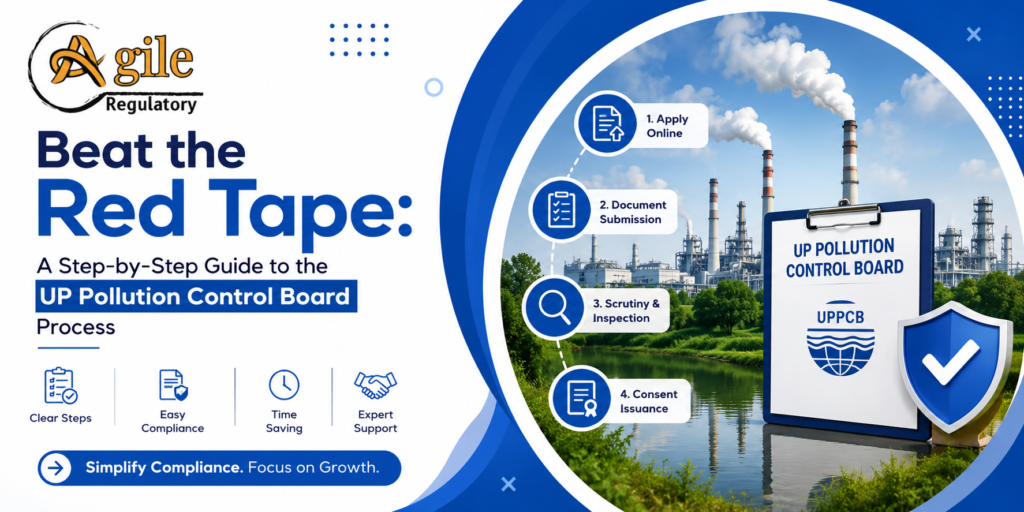

Starting a business in Uttar Pradesh requires more than just investment, planning, and infrastructure. Industries must also comply with environmental regulations before beginning operations. One of the most important approvals for industries operating in the state is obtaining permission from the UP Pollution Control Board.
Many entrepreneurs struggle with understanding environmental compliance requirements, application procedures, and approval timelines. Delays often happen because businesses are unaware of which consent they need, what documents are required, or how to complete the process correctly.
Whether you are setting up a manufacturing unit, expanding an existing facility, or starting a new commercial operation, understanding the process of obtaining a pollution license, pollution NOC, and other environmental approvals is essential.
This complete guide explains the step-by-step process of the UP Pollution Control Board, including Consent to Establish, Consent to Operate, required documents, benefits, common mistakes, and how Agile Regulatory can help businesses complete compliance smoothly.
What is the UP Pollution Control Board?
The UP Pollution Control Board is the government authority responsible for implementing environmental laws and controlling pollution levels across Uttar Pradesh. It works under the guidelines of the Central Pollution Control Board (CPCB) and regulates industrial activities that may impact air, water, and environmental quality.
The main objective of the board is to ensure that industries operate responsibly while following pollution control standards.
The UP Pollution Control Board monitors:
- Air pollution emissions
- Water pollution discharge
- Hazardous waste management
- Industrial waste disposal
- Environmental compliance
- Pollution control measures
Industries must obtain necessary approvals before starting operations to ensure they meet environmental standards.
Why Pollution Control Approval is Important
Environmental compliance is not only a legal requirement but also an important responsibility for businesses.
Obtaining approval from the pollution control board helps companies:
- Operate legally in Uttar Pradesh
- Avoid penalties and legal actions
- Maintain environmental standards
- Improve business credibility
- Receive approvals from other authorities
- Build trust among customers and stakeholders
Running a business without proper environmental approval can lead to fines, closure notices, and restrictions on operations.
Understanding Pollution Control Board Licenses
A pollution control board license is an approval issued by the concerned authority that allows businesses to operate after meeting environmental requirements.
The type of approval depends on the nature of the industry, pollution category, and stage of business activity.
Generally, industries require two major approvals:
- Consent to Establish (CTE)
- Consent to Operate (CTO)
Both approvals are issued under the Water (Prevention and Control of Pollution) Act and the Air (Prevention and Control of Pollution) Act.
What is Consent to Establish?
Consent to Establish is the first approval required before setting up an industrial unit or project.
It confirms that the proposed location, manufacturing process, equipment, and pollution control measures are acceptable according to environmental regulations.
Businesses must obtain this approval before:
- Starting construction
- Installing machinery
- Setting up production facilities
Who Needs Consent to Establish?
Industries requiring Consent to Establish generally include:
- Manufacturing units
- Processing industries
- Chemical industries
- Food processing units
- Pharmaceutical industries
- Construction projects
- Mining activities
- Waste processing facilities
The requirement depends on the pollution category and business activity.
What is Consent to Operate?
After completing construction and installing machinery, industries must obtain Consent to Operate before starting commercial production.
Consent to Operate confirms that the business has installed proper pollution control systems and is operating according to approved environmental conditions.
Businesses cannot legally begin operations without obtaining this approval.
Importance of Consent to Operate
A valid Consent to Operate helps businesses:
- Continue operations legally
- Avoid environmental penalties
- Demonstrate compliance
- Renew approvals smoothly
- Maintain regulatory records
The approval generally has a validity period and must be renewed according to applicable requirements.
Step-by-Step Process for UP Pollution Control Board Approval
Obtaining approval from the UP Pollution Control Board involves several important steps.
Step 1: Identify Your Industry Category
The first step is determining the pollution category of your business.
Industries are commonly classified into:
- Red Category
- Orange Category
- Green Category
- White Category
The category depends on the level of pollution generated by the activity.
Correct classification helps determine the applicable compliance requirements.
Step 2: Prepare Required Documents
Before applying, businesses must collect necessary documents.
Common documents include:
- Identity proof of applicant
- PAN card
- GST registration
- Company registration documents
- Site plan
- Layout plan
- Manufacturing process details
- List of machinery
- Raw material details
- Water consumption details
- Waste generation details
- Pollution control measures
- Land ownership or lease documents
Proper documentation reduces delays during approval.
Step 3: Submit Online Application
The application is submitted through the official online portal of the UP Pollution Control Board.
Applicants need to provide:
- Business details
- Industry information
- Project details
- Environmental compliance information
- Supporting documents
Incorrect information can result in application delays or rejection.
Step 4: Document Verification
The board reviews the submitted documents to ensure compliance with environmental requirements.
Officials may raise queries if additional information is required.
Step 5: Site Inspection
For applicable categories, officials may conduct a site inspection to verify:
- Location details
- Installed equipment
- Pollution control systems
- Waste management arrangements
- Compliance measures
Step 6: Approval Issuance
After successful verification, the board issues the required approval, such as:
- Consent to Establish
- Consent to Operate
- Pollution NOC
Businesses can then proceed according to the approved conditions.
Documents Required for Pollution NOC
A pollution NOC confirms that a business has received environmental clearance from the concerned pollution authority.
Documents generally required include:
Company Documents
- Certificate of Incorporation
- Partnership deed or LLP agreement
- GST certificate
- PAN card
Project Documents
- Project report
- Site layout plan
- Manufacturing details
- Production capacity details
- Machinery information
Environmental Documents
- Water consumption details
- Waste disposal plan
- Pollution control equipment details
- Emission details
- Waste management plan
Additional documents may be required depending on the industry category.
Benefits of Obtaining a Pollution License
A valid pollution license provides several advantages.
Legal Business Operations
The approval allows businesses to operate according to environmental regulations.
Avoiding Penalties
Compliance reduces the risk of fines, notices, and legal action.
Better Business Opportunities
Many companies, investors, and government departments prefer working with environmentally compliant businesses.
Smooth Expansion
Having proper approvals makes future expansion easier.
Improved Reputation
Environmental compliance improves public and stakeholder confidence.
Common Reasons for Approval Delays
Many businesses experience delays because of avoidable mistakes.
Incorrect Application Information
Wrong business details or incomplete information can slow down processing.
Missing Documents
Incomplete documentation often results in additional queries.
Wrong Industry Classification
Selecting the incorrect pollution category can create compliance issues.
Poor Pollution Control Planning
Industries must demonstrate proper waste and pollution management systems.
Ignoring Renewal Requirements
Expired approvals can create operational problems.
Role of a Pollution Control Board Consultant
Environmental approvals involve technical and legal requirements. Many businesses prefer working with experienced consultants to avoid mistakes.
A professional consultant helps with:
Application Preparation
Ensuring accurate information and complete documentation.
Industry Classification
Determining the correct pollution category.
Documentation Support
Preparing required reports and supporting documents.
Compliance Guidance
Helping businesses understand environmental obligations.
Query Resolution
Responding to authority questions efficiently.
Renewal Assistance
Supporting timely renewal of approvals.
Working with experts saves time and reduces compliance risks.
Why Choose Agile Regulatory for Pollution Control Board Approval?
Environmental compliance procedures can be complicated without proper guidance. Agile Regulatory provides complete assistance for businesses seeking approvals from the UP Pollution Control Board.
Our services include:
- Consent to Establish assistance
- Consent to Operate assistance
- Pollution NOC services
- Pollution license consultancy
- Pollution control board license support
- Documentation preparation
- Application filing
- Compliance consultation
- Renewal assistance
Agile Regulatory helps manufacturers, industries, and businesses complete environmental approval procedures efficiently while ensuring compliance with applicable regulations.
Tips to Get Faster Approval
Businesses can improve approval timelines by following these practices:
Apply Before Starting Operations
Do not begin construction or production without required permissions.
Maintain Proper Documentation
Keep all business and technical records updated.
Install Required Pollution Control Systems
Ensure compliance measures are planned from the beginning.
Provide Accurate Information
Avoid incorrect details in applications.
Respond Quickly to Queries
Timely responses help prevent unnecessary delays.
Take Professional Support
Experienced consultants can simplify complex approval processes.
Future of Environmental Compliance in Uttar Pradesh
Environmental regulations are becoming stricter as authorities focus on sustainable industrial development. Businesses are expected to adopt better pollution control systems, waste management practices, and environmentally responsible operations.
Industries that prioritize compliance from the beginning can avoid regulatory challenges and build stronger long-term business foundations.
Obtaining approvals from the UP Pollution Control Board is not just about meeting legal requirements—it reflects a company’s commitment toward responsible growth and environmental protection.
Conclusion
Starting or operating an industry in Uttar Pradesh requires proper environmental approvals. The process of obtaining Consent to Establish, Consent to Operate, and a pollution NOC ensures that businesses follow environmental standards and operate legally.
Understanding the requirements of the UP Pollution Control Board helps businesses avoid delays, penalties, and compliance issues. Proper documentation, accurate applications, and timely approvals are essential for smooth operations.
If you need professional assistance for obtaining a pollution license, pollution control board license, Consent to Establish, or Consent to Operate, Agile Regulatory provides complete consultancy support. Our experts help businesses manage documentation, applications, compliance requirements, and approval procedures efficiently.
With Agile Regulatory, businesses can focus on growth while ensuring environmental compliance with confidence.
Frequently Asked Questions (FAQs)
1. What is the UP Pollution Control Board?
The UP Pollution Control Board is a government authority responsible for regulating pollution control measures and ensuring industries comply with environmental laws in Uttar Pradesh.
2. What is Consent to Establish?
Consent to Establish is approval required before setting up an industrial unit. It confirms that the proposed project meets environmental requirements before construction and installation begin.
3. What is Consent to Operate?
Consent to Operate is approval required after completing setup and before starting commercial production. It confirms that the industry is operating with proper pollution control measures.
4. Who needs a pollution license?
Industries, manufacturing units, and businesses generating pollution or waste may require a pollution license based on their activity and pollution category.
5. How can I apply for a pollution NOC?
Businesses can apply for a pollution NOC through the prescribed process of the UP Pollution Control Board by submitting required documents and compliance details.
6. Why should I hire a pollution control consultant?
A consultant helps businesses understand requirements, prepare documents, submit applications correctly, handle queries, and complete approval procedures faster.
7. Why choose Agile Regulatory for pollution approvals?
Agile Regulatory provides end-to-end support for UP Pollution Control Board approvals, including Consent to Establish, Consent to Operate, pollution NOC, pollution license, and pollution control board license consultancy services. Our experts help businesses achieve smooth and hassle-free environmental compliance.