
Key Highlights
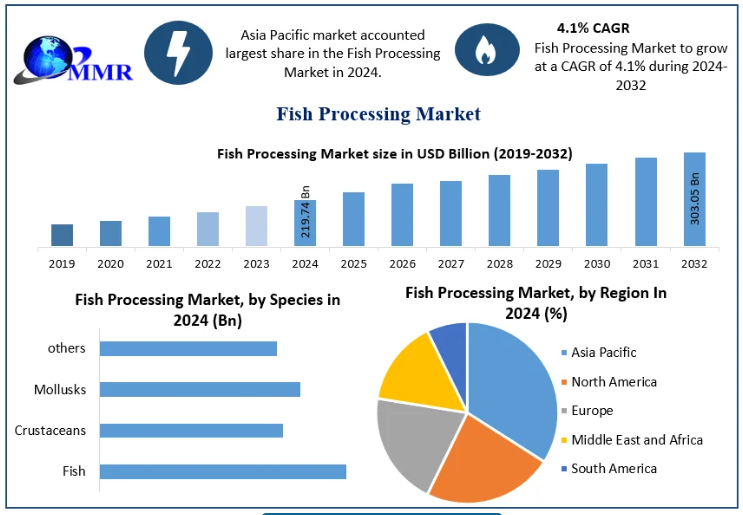
- Market valued at USD 219.74 billion in 2024.
- Forecast to reach USD 303.05 billion by 2032.
- Expected CAGR of 4.1% during 2025–2032.
- Frozen fish remains the largest processing segment.
- Food applications account for the majority of processed seafood demand.
- Fish species dominate global processing volumes.
- Asia Pacific holds 44% of the global market.
- Aquaculture expansion continues strengthening raw material supply.
- Rising demand for healthy protein supports long-term industry investment.
Why This Matters Now
Seafood has become one of the fastest-growing sources of animal protein worldwide. Consumers increasingly demand convenient, nutritious, and longer-lasting seafood products, while retailers require efficient cold-chain distribution. Fish processing technologies reduce waste, extend shelf life, improve food safety, and enable global seafood trade, making processing capacity a strategic advantage for producers and exporters.
Market Overview
The Fish Processing Market covers activities that transform freshly harvested fish and other aquatic species into preserved, frozen, dried, smoked, salted, canned, and value-added seafood products suitable for commercial distribution.
Fish processing plays a critical role in reducing spoilage because seafood remains one of the world’s most perishable food categories. Modern processing technologies preserve nutritional quality while maintaining flavor, texture, and food safety throughout transportation and storage.
Demand continues expanding because consumers increasingly recognize seafood as an important source of protein, omega-3 fatty acids, vitamins, and essential minerals. Food processors are simultaneously investing in freezing, packaging, and preservation technologies that improve product quality while reducing post-harvest losses.
Aquaculture expansion has also strengthened supply availability, creating a more stable raw material base for processors despite fluctuations in wild fisheries.
Environmental concerns, seafood contamination, and stricter food safety standards remain important industry challenges, encouraging greater investment in traceability and quality assurance.
Key Trends Driving Growth
Frozen seafood continues gaining market share because it extends shelf life without requiring heavy use of preservatives. Improved freezing technologies allow processors to maintain nutritional quality while expanding export opportunities.
Aquaculture investment is transforming global seafood supply. Farmed fish production reduces dependence on wild fisheries while providing predictable volumes for industrial processing operations.
Demand for omega-3-rich foods continues strengthening seafood consumption among health-conscious consumers. Fish oil production also creates additional revenue opportunities from processing by-products.
Food safety regulations encourage investments in advanced preservation technologies, traceability systems, and modern processing facilities capable of meeting international export requirements.
Global seafood trade continues expanding as processors utilize cold-chain logistics to supply distant markets with premium frozen and processed seafood products.
Segment Insights
Dominant Segment: Frozen Fish
Frozen products represent the largest processing category because freezing preserves freshness, minimizes spoilage, and eliminates the need for many chemical preservatives.
The segment also enables processors to supply inland markets where fresh seafood availability remains limited. Improved storage stability supports international trade while reducing food waste throughout distribution networks.
Fastest-Growing Segment: Crustaceans
Crustaceans are projected to record the fastest growth during the forecast period owing to rising global demand for shrimp, crab, and lobster products.
Premium seafood consumption, expanding restaurant demand, and increasing exports continue improving commercial opportunities for processors specializing in crustacean products.
Leading Species: Fish
Fish remains the dominant species segment due to high global consumption and expanding aquaculture production.
Growing per capita seafood consumption and stable farming practices provide processors with reliable raw material supplies while supporting higher production efficiency.
Explore detailed analysis, insights, and growth opportunities : https://www.maximizemarketresearch.com/request-sample/147841/
Primary Application: Food
Food applications account for the largest share of processed seafood demand. Processed fish products remain essential sources of protein across households, restaurants, institutional catering, and foodservice channels.
Commercial applications beyond food also contribute incremental demand through fish oil, animal nutrition, pharmaceuticals, and industrial ingredient production.
Regional Growth Story
Asia Pacific dominates the Fish Processing Market with approximately 44% market share. China, India, Japan, and Southeast Asia continue expanding fishing activity, aquaculture production, seafood exports, and processing capacity. Competitive labor costs and abundant marine resources strengthen the region’s manufacturing advantage.
North America is expected to witness significant growth due to increasing seafood consumption, investments in advanced processing facilities, and strong demand for frozen convenience products.
Europe remains an important seafood processing and consumption market supported by established fishing industries, advanced cold-chain infrastructure, and stringent food quality standards.
South America and the Middle East & Africa continue expanding seafood production through aquaculture development and export-oriented investments targeting international markets.
Competitive Landscape
Competition focuses on processing efficiency, cold-chain infrastructure, sustainable sourcing, and value-added seafood innovation.
Major companies including Charoen Pokphand Foods, Maruha Nichiro Corporation, Nippon Suisan Kaisha, Thai Union Frozen Company, Leroy Seafood Group, Marine Harvest, Marel, JBT Corporation, Optimar AS, and Royal Greenland continue strengthening processing capabilities through automation, integrated supply chains, and export-focused production.
Equipment suppliers such as Marel, Skaginn 3X, Optimar AS, Arenco AB, KROMA A/S, and The Middleby Corporation support industry modernization by delivering advanced fish handling, grading, freezing, and packaging technologies.
Competitive advantage increasingly depends on operational efficiency, traceability, sustainable fisheries management, and the ability to meet evolving international food safety requirements.
Recent Developments
- The MMR report does not specify company-specific recent developments, partnerships, acquisitions, product launches, or investments for the Fish Processing Market.
- Industry participants continue investing in automated processing systems to improve operational efficiency.
- Seafood processors are expanding freezing and cold-chain infrastructure to support export growth.
- Companies continue strengthening traceability and food safety capabilities to comply with international regulations.
Future Outlook
Companies that combine sustainable aquaculture sourcing, advanced processing automation, and efficient cold-chain logistics will secure the strongest competitive position as global demand for high-quality processed seafood continues to expand.
Explore More: Visit our website for Additional reports :
Global Sage Essential Oil Market https://www.maximizemarketresearch.com/market-report/global-sage-essential-oil-market/79110/
Flavor Enhancer Market https://www.maximizemarketresearch.com/market-report/global-flavor-enhancer-market/32455/
About Maximize Market Research
Maximize Market Research Pvt. Ltd. (MMR) is a global market research and consulting company that provides reliable, data-focused, and practical business insights. The firm serves a wide range of industries, including healthcare, pharmaceuticals, technology, automotive, electronics, chemicals, personal care, and consumer goods. Through market forecasts, competitive analysis, strategic consulting, and industry impact assessments, MMR helps organizations understand changing market conditions, identify growth opportunities, and make informed business decisions for long-term success.
Contact Us :
2nd Floor, Navale IT Park Phase 3
Pune Banglore Highway, Narhe
Pune, Maharashtra 411041, India
+91 9607365656
sales@maximizemarketresearch.com