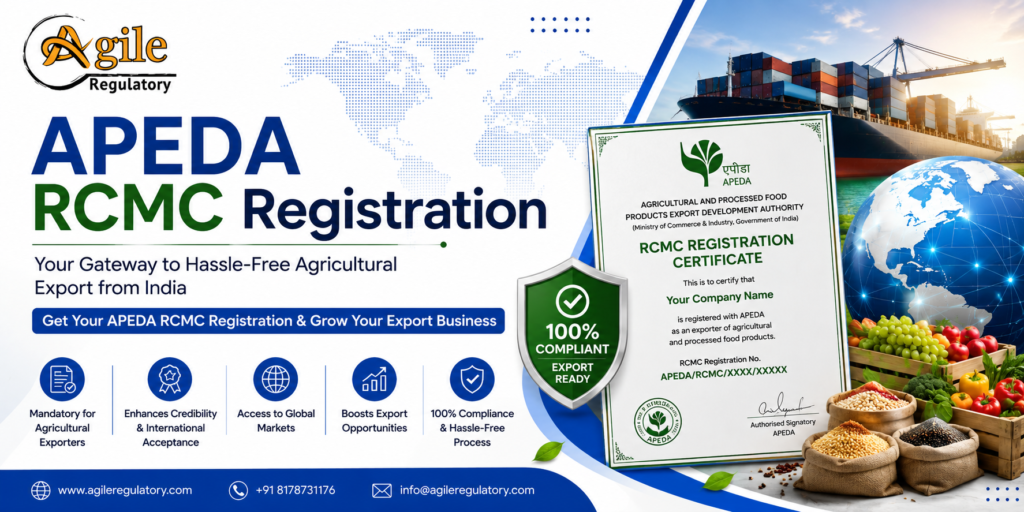

India is one of the world’s leading exporters of agricultural and processed food products. Businesses engaged in exporting scheduled products such as fruits, vegetables, cereals, meat, dairy products, and processed foods are generally required to obtain registration from the Agricultural and Processed Food Products Export Development Authority (APEDA). After successful registration, exporters receive a Registration-Cum-Membership Certificate (RCMC), which serves as proof of registration. Understanding APEDA Certificate Registration helps businesses comply with export regulations, improve international credibility, and access various export promotion schemes. This guide explains eligibility, required documents, registration procedure, fees, benefits, and compliance requirements for APEDA registration. APEDA is a statutory authority established under the APEDA Act, 1985, to promote the export of scheduled agricultural and processed food products.
APEDA Certificate Registration
What is APEDA Certificate Registration?
APEDA Certificate Registration is the process through which eligible exporters obtain a Registration-Cum-Membership Certificate (RCMC) from APEDA. The certificate authorizes businesses dealing with scheduled agricultural and processed food products to carry out export activities in accordance with the applicable regulations.
Obtaining APEDA Certificate Registration helps exporters establish legal recognition while complying with India’s export framework for scheduled products.
The registration also enhances business credibility among overseas buyers and facilitates participation in various export promotion initiatives.
Why is APEDA Registration Important?
Obtaining APEDA registration offers several important advantages.
Legal Export Compliance
The registration helps exporters comply with the requirements applicable to scheduled agricultural products.
Better International Market Access
Registered exporters gain greater confidence among foreign buyers and importers.
Government Recognition
The Registration-Cum-Membership Certificate serves as official proof of registration.
Export Promotion Benefits
Registered businesses may become eligible for financial assistance, export development initiatives, and other promotional schemes offered by APEDA.
Businesses often seek assistance from an experienced APEDA Consultant to ensure accurate documentation and smooth completion of the registration process.
Who Should Apply?
APEDA registration is generally required for:
- Merchant Exporters
- Manufacturer Exporters
- Food Processing Units
- Agricultural Product Exporters
- Fresh Fruit Exporters
- Vegetable Exporters
- Meat Exporters
- Dairy Product Exporters
- Proprietorship Firms
- Partnership Firms
- LLPs
- Private Limited Companies
Any business exporting products covered under the APEDA Schedule should verify whether registration is mandatory before commencing exports.
Documents Required
Applicants generally require the following documents.
Business Documents
- Import Export Code (IEC)
- PAN Card
- GST Registration Certificate
- Business Registration Certificate
Banking Documents
- Bank Certificate
- Cancelled Cheque
Supporting Documents
- Identity Proof
- Address Proof
- Email ID
- Mobile Number
Applicants should carefully complete the APEDA Application Form with accurate business information before submission.
Providing complete documentation helps reduce processing delays.
Step by Step Registration Process
Step 1 Prepare Documents
Collect all required business, banking, and supporting documents.
Step 2 Complete the Application
Fill out the prescribed registration form using accurate business details.
Step 3 Upload Documents
Upload all prescribed supporting documents through the designated online registration system.
Applicants should carefully review the APEDA Application before final submission to ensure that all uploaded information is correct.
Step 4 Verification
The submitted documents are verified by the competent authority.
Step 5 Certificate Issuance
After successful verification, the Registration-Cum-Membership Certificate (RCMC) is issued through the prescribed online system. Since July 2023, APEDA RCMC applications are processed through the DGFT e-RCMC system for eligible exporters.
APEDA Licence
The Registration-Cum-Membership Certificate issued after approval is commonly referred to by businesses as an APEDA License because it authorizes exporters to deal in scheduled APEDA products for export purposes.
Exporters should keep the certificate safely for future regulatory and export-related requirements.
Registration Cost
Applicants should understand the applicable government charges before beginning the registration process.
Businesses should verify the latest APEDA Certificate Charges prescribed by the competent authority, as the applicable fees may be revised periodically through official notifications.
Reviewing the latest fee structure before applying helps applicants plan their registration budget.
Registration Expenses
Apart from government charges, businesses may also incur expenses relating to document preparation and professional assistance.
Applicants often compare the APEDA Certificate Cost while planning their export registration to estimate the total compliance expenditure.
Professional guidance may help reduce documentation errors and processing delays.
APEDA and FSSAI
Food exporters must ensure compliance with multiple regulatory authorities.
Businesses dealing with food products should verify whether an APEDA FSSAI compliance requirement applies to their products, as many food export businesses require both APEDA registration and the applicable FSSAI licence depending on the nature of operations.
Understanding all applicable registrations helps ensure uninterrupted export activities.
Benefits of APEDA Registration
Obtaining APEDA registration provides several long-term advantages.
Legal Recognition
The certificate confirms compliance with APEDA requirements.
Better Export Opportunities
Registered exporters can participate more confidently in international markets.
Enhanced Business Reputation
Registration strengthens confidence among overseas buyers.
Access to Government Schemes
Eligible exporters may benefit from export promotion initiatives administered by APEDA.
Common Mistakes to Avoid
Incorrect Business Information
Business details should exactly match official registration records.
Incomplete Documentation
Missing documents frequently delay approval.
Incorrect Banking Information
Applicants should verify banking documents before submission.
Delayed Registration
Businesses should complete registration before exporting scheduled products.
Why Choose Agile Regulatory?
Agile Regulatory provides professional consultancy for APEDA registrations across India. Our experienced professionals assist exporters with documentation, online application filing, RCMC registration, regulatory coordination, and end-to-end compliance support.
Apart from APEDA Registration, Agile Regulatory also offers consultancy for:
- DGFT IEC Registration
- Spice Board Registration
- FSSAI Central License
Our experts ensure accurate documentation and hassle-free regulatory approvals, allowing exporters to focus on expanding their international business.
Conclusion
Obtaining APEDA Certificate Registration is an essential requirement for businesses exporting scheduled agricultural and processed food products from India. The registration strengthens business credibility, ensures compliance with export regulations, and supports access to various export promotion initiatives. By preparing complete documentation and following the prescribed registration procedure, exporters can avoid unnecessary delays and conduct international trade confidently. With professional assistance from Agile Regulatory, businesses can complete the registration process efficiently and focus on growing their export operations.
FAQs
1. What is APEDA Certificate Registration?
It is the process of obtaining a Registration-Cum-Membership Certificate (RCMC) from APEDA for exporting scheduled agricultural and processed food products.
2. Who should apply for APEDA registration?
Merchant exporters, manufacturer exporters, food processors, and businesses exporting scheduled APEDA products generally require this registration.
3. Is an Import Export Code required for APEDA registration?
Yes. A valid IEC issued by DGFT is generally required before applying for APEDA registration.
4. What documents are generally required?
Applicants usually require an IEC, PAN, GST registration, business registration certificate, bank certificate, cancelled cheque, identity proof, address proof, and supporting documents.
5. How can Agile Regulatory help?
Agile Regulatory provides complete assistance with APEDA registration, documentation, online filing, RCMC applications, and export compliance support across India.