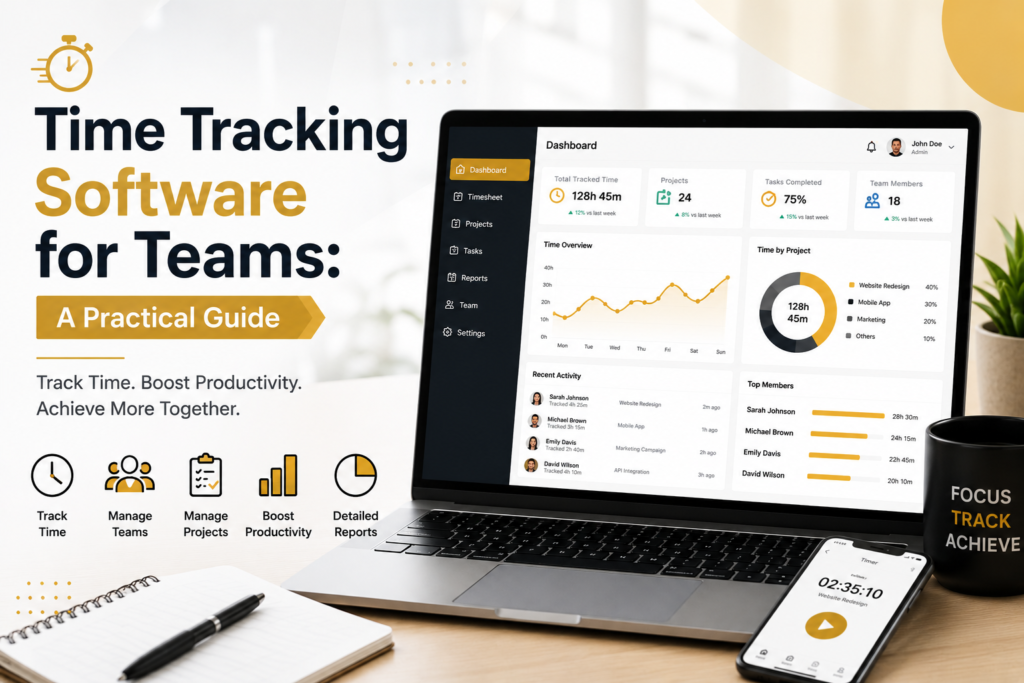

“Modern team” gets thrown around a lot in software marketing, so let’s be specific about what it actually means here: people working across time zones, switching between Slack, email, and three different project tools in a single afternoon, with managers who can’t just glance across the room to see who’s stretched thin. If that’s your team, time tracking software for teams isn’t really about a timer widget — it’s about getting visibility into work that’s genuinely harder to see than it used to be.
This isn’t another top-10 tool ranking. There are plenty of those, and several of them are, frankly, the same article republished with a different tool swapped into the #1 slot. This is about how to actually think through the decision.
What Time Tracking Software for Teams Actually Needs to Do
Strip away the feature marketing, and time-tracking software for teams has one job: turn scattered work — a task here, a meeting there, a Slack thread that ate an hour — into a clear, accurate record of where time actually went.
For a co-located team on a single project, that’s simple. For a modern team, it’s not, because the work itself is fragmented across tools and time zones. A developer might touch Jira, GitHub, and a client call in one morning. A distributed team might have four people finishing their day just as three others are starting theirs. Time tracking for teams structured this way has to capture time without requiring everyone to remember to manually log it after the fact — because they won’t, consistently, and the data will quietly rot.
This is the actual bar modern time-tracking software needs to clear: low enough friction that people actually use it and connected enough to your real workflow that it captures time where the work happens, not in a separate app nobody opens.
The Real Cost of Getting This Wrong
Here’s where most content on this topic stays vague. Let’s not.
Picture a 12-person distributed team — say, split across three time zones for a software consultancy. Without reliable tracking, the team lead reconstructs weekly hours from memory and Slack scroll-back every Friday. That’s roughly 3 hours a week of a senior person’s time spent guessing at what already happened, instead of doing anything useful with it — about 150 hours a year, just on reconstruction.
Now layer in the accuracy problem. Reconstructed time typically undercounts real effort by 15-20%, because short interruptions, quick calls, and context-switching rarely make it into someone’s memory of “what I did this week”. If that team bills a portion of their time to clients at $75/hour, a 15% undercount on even half their billable work adds up to real money left on the table every month — not because anyone’s dishonest, but because memory is a bad time-tracking tool.
That’s the actual business case: not “improve visibility” as a vague good, but a specific, recoverable cost in both admin hours and unbilled or misallocated work.
Choosing How Your Team Actually Tracks Time (Including What “AI-Powered” Really Means)
A lot of current time tracking software leans hard on “AI-driven categorisation” and automatic activity detection as headline features. Worth being straight about what that actually means before you buy based on it.
- Manual timers and logging — Simple and transparent and gives people full control over what gets recorded. The trade-off: it depends entirely on people remembering to start, stop, and categorise consistently, which is exactly the habit modern, fragmented workdays make hard to keep.
- App and website detection (automatic tracking) — Captures time passively across the tools someone uses, reducing the memory problem. But this only works well if it’s mapped correctly to projects and tasks — a tool that logs “spent 2 hours in browser” without knowing which client that was for hasn’t actually solved anything; it’s just automated the same vague record.
- Integration-based tracking — Time gets logged directly from where the work already happens — a task in your PM tool, a card in Trello, or a work item in Azure DevOps — so people don’t switch context to track time at all. This is usually the best fit for distributed, multi-tool teams specifically, because it removes the “remember to log it” step entirely rather than just automating a rough guess.
The honest take: automatic and AI-assisted tracking genuinely helps with the memory problem, but it isn’t a substitute for tracking that’s actually tied to real project structure. A tool that auto-detects hours but can’t tell you which client or task they belong to is solving the wrong half of the problem. Prioritise the connection to your actual workflow over the flashiness of the detection method.
Rolling This Out to a Distributed or Hybrid Team
The tool matters less than how you introduce it — this is true for any team, but it’s a bigger risk with distributed teams specifically, because you can’t read the room the way you could in an office.
- Explain the “why” in writing, not just verbally, in a meeting someone in another time zone missed. Frame it around what it actually protects: accurate billing, realistic workload visibility, and protection against silent burnout among the busiest team members.
- Pilot with one team first, ideally one that’s already vocal about workflow friction — their feedback will surface problems before a company-wide rollout does.
- Pick the tracking method based on how fragmented the work actually is. A team living inside one PM tool all day can get away with lighter manual tracking. A team spread across four tools and three time zones needs the integration-based approach, or the data will be full of holes within a month.
- Set a clear review rhythm — weekly for team leads checking workload balance across time zones and monthly for leadership looking at utilisation and delivery trends. Data nobody looks at doesn’t fix anything, no matter how automatically it was collected.
The mistake we see most often is a company adopts a tool with impressive automatic tracking, skips explaining why to the team, and doesn’t connect it to the actual project structure — so six months later they have a pile of hours with no clear task or client attached to most of them, and the rollout gets quietly abandoned.
How Time Tracking Should Connect to the Rest of Your Stack
For a modern team, time tracking that lives in its own silo is nearly as useless as not tracking at all. If a developer logs hours in one tool and the project budget lives in another, someone’s manually reconciling the two every week — which is the exact problem you were trying to solve in the first place.
Before choosing a tool, check specifically: does it connect directly to the project management tool your team already uses (Jira, Asana, Planner, or Trello), or does time have to be manually copied over? Does it sync with the communication tools where a lot of real work actually happens — meetings, calls, quick decisions in Slack or Microsoft Teams — so that time isn’t lost simply because it happened outside a “task”? And does tracked time flow automatically into billing, payroll, or reporting, or is that another manual step waiting to introduce errors?
The fewer manual handoffs between “time was tracked” and “time shows up somewhere useful”, the more the tool is actually solving your problem instead of just adding a new place to enter data. This is the exact connection Prime Teams’ time tracking software is built around — tracked hours flow straight into project budgets and billing without a manual step in between.
Choosing the Right Setup for Your Kind of Team
- Fully remote, single-tool teams: If your whole team lives inside one PM tool most of the day, a lighter tracker with solid integration into that one tool is usually enough — you don’t need a heavyweight, multi-app detection system.
- Hybrid teams (some in-office, some remote): Consistency matters more than any single feature here — pick a method that works the same way whether someone’s clocking hours from a desk or a laptop at home, so the data stays comparable across the team.
- Distributed, multi-tool teams: This is where integration-based tracking earns its keep — time needs to be captured across whatever tool the work is actually happening in, without relying on anyone to remember to switch over and log it separately.
- Agencies and client-facing teams: Prioritise the connection from tracked time straight through to invoicing and project margin reporting — the value here is less about visibility and more about not leaving billable hours on the table.
Quick gut-check: how many separate tools does your team’s actual work touch in a given day, and does time need to flow into billing or payroll automatically? Those two answers narrow this down faster than any feature comparison.
Frequently Asked Questions
What makes time tracking software different for “modern teams” specifically? It’s less about unique features and more about fit — modern teams are typically distributed, multi-tool, and asynchronous, so the tracking method needs to capture time across fragmented workflows without relying on manual memory or a single shared physical space.
Is automatic or AI-based time tracking accurate? It’s generally better than manual reconstruction at capturing that time was spent, but it’s only as useful as its connection to your actual project structure. Automatic detection without accurate task/project mapping just produces a more automated version of vague data.
Does time tracking software work well for hybrid teams? Yes, as long as the same tracking method applies consistently whether someone’s in the office or remote — inconsistent methods across a hybrid team make the resulting data hard to compare or trust.
How does time tracking connect to project management tools? Most modern platforms offer direct integrations with common PM tools (Jira, Asana, Trello, and Planner), so time logs attach to the task or project automatically. Before buying, confirm whether that connection is automatic or requires manual reconciliation.
What should a distributed team prioritise when choosing a time tracker? Integration with the tools that work already happens with low friction, so tracking doesn’t become its own chore, and there’s a clear connection from tracked hours to billing, payroll, or reporting — not just a longer feature list.
The tool matters less than whether it’s actually wired into how your team really works. Pick a tracking method that matches how fragmented your team’s day genuinely is, connect it to your real project and billing structure instead of letting it sit in its own silo, and make sure someone’s actually looking at what it tells you.
If you’re ready to give your distributed team a single source of truth instead of Friday-afternoon guesswork, Prime Teams’ time tracking software for teams connects tracked hours directly to your projects, budgets, and billing — no manual reconciliation, no lost hours.
See how it works →