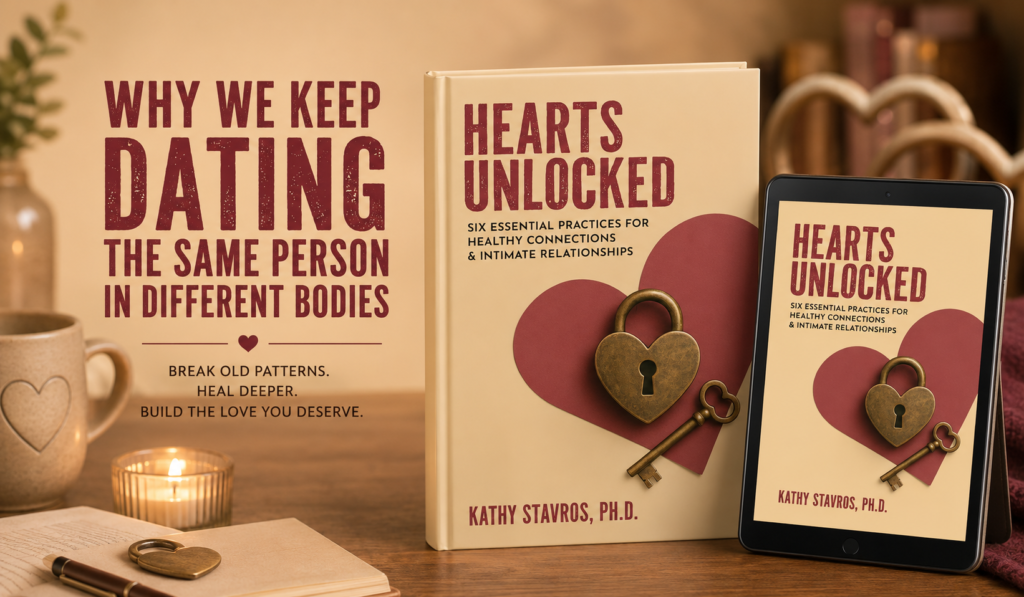

The Strange Familiarity of Repeated Relationships
Most people can recall a moment after a painful breakup when they looked back and thought, how did I end up here again? The faces may have changed, the names may have been different, and the circumstances may have seemed unique, yet the emotional outcome feels strangely familiar. The partner who was emotionally unavailable resembles the last one. The relationship that began with excitement ends with the same disappointment. The conflicts sound different on the surface but evoke identical feelings of rejection, anxiety, abandonment, or frustration.
Amazon: Hearts Unlocked: Six Essential Practices for Healthy Connections and Intimate Relationships
This phenomenon is so common that psychologists often describe it as dating the same person in different bodies. It is not that people consciously seek out identical partners. Rather, many of us unknowingly follow deeply ingrained emotional patterns that shape whom we are attracted to, how we behave in relationships, and what dynamics feel familiar.
The recurring relationship pattern phenomenon is not simply bad luck. It is often the result of emotional blueprints established long before adulthood. These invisible templates influence our choices, expectations, and reactions, creating cycles that can repeat for years unless they are consciously examined.
Understanding why different partners often produce the same emotional outcomes is the first step toward creating healthier and more fulfilling relationships.
The Hidden Blueprint
The Relationship Scripts We Never Knew We Had
Every person enters adulthood carrying a set of unconscious beliefs about love, intimacy, conflict, and connection. These beliefs function like a hidden blueprint, guiding relationship behavior without our awareness.
Most people assume they choose partners based on personality traits, shared interests, or physical attraction. While those factors matter, attraction often operates on a deeper psychological level. We are frequently drawn toward what feels emotionally familiar rather than what is emotionally healthy.
This familiarity can be misleading. A relationship may feel exciting, intense, or even destined, when in reality it resembles old emotional patterns learned during childhood.
The hidden blueprint acts like an internal navigation system. It influences how much closeness feels comfortable, how conflict is handled, what kind of affection feels normal, and how we interpret our partner’s behavior.
Unless this blueprint is examined, it can repeatedly steer us toward the same relational dynamics.
Family-of-Origin Influences
The first relationships we experience are usually within our family of origin. Parents, caregivers, and close family members become our earliest teachers about love and connection.
Children learn not only from what adults say but also from what adults do. They observe how emotions are expressed, how disagreements are managed, and whether affection is given freely or conditionally.
For example:
- A child raised in a household where love is inconsistent may learn to equate affection with uncertainty.
- A child who must earn approval may grow into an adult who constantly seeks validation from romantic partners.
- Someone raised around emotional distance may later feel uncomfortable with genuine intimacy.
- A child exposed to conflict may unconsciously associate love with drama and tension.
These lessons are rarely deliberate. They become embedded through repeated experiences and eventually feel normal.
As adults, people often seek relationships that mirror these familiar dynamics, even when those patterns create pain. Familiarity provides a sense of predictability, and the human brain tends to prefer what it knows.
Early Emotional Conditioning
Beyond family influences, early emotional experiences shape how people interpret relationships.
If a child’s emotional needs are consistently met, they often develop a secure sense of attachment. They learn that relationships can be reliable, supportive, and safe.
However, when emotional needs are inconsistently met, children may develop alternative strategies for coping.
Some become highly vigilant, constantly scanning for signs of rejection. Others learn to suppress their needs altogether. Some alternate between seeking closeness and pushing it away.
These coping strategies may help children navigate difficult environments, but they often create challenges in adult relationships.
A person who fears abandonment may become overly dependent on reassurance. Someone who learned emotional self-sufficiency may struggle to trust others. These responses are not character flaws; they are adaptations formed during early development.
The problem arises when old survival strategies continue operating long after the original circumstances have disappeared.
Recognizing Repeated Patterns
Why the Same Story Keeps Reappearing?
Repeated relationship patterns rarely announce themselves clearly. Instead, they tend to disguise themselves through different people and situations.
One relationship may involve an emotionally distant partner. Another may involve someone who is physically present but emotionally inconsistent. Although the details differ, the emotional experience remains the same.
The common denominator is not necessarily the partner. It is often the underlying pattern.
Recognizing recurring themes requires honest self-reflection. Questions such as these can be revealing:
- What emotions appear repeatedly in my relationships?
- What complaints do I consistently have about partners?
- How do relationships typically begin and end?
- What behaviors trigger me most strongly?
- What role do I usually play during conflict?
Patterns often emerge when individuals stop focusing exclusively on their partners and begin examining their own responses.
Common Relationship Cycles
Many recurring relationship dynamics follow recognizable cycles.
The Pursuer-Distancer Cycle
One partner seeks closeness while the other withdraws. The more one pursues, the more the other distances themselves. Both become frustrated, reinforcing the cycle.
The Rescue Cycle
One person repeatedly chooses partners who need saving, fixing, or helping. Their sense of value becomes tied to being needed. Over time, resentment and exhaustion develop.
The Validation Cycle
A person seeks constant approval from romantic partners to feel worthy. Temporary reassurance provides relief, but self-doubt eventually returns, creating an endless search for validation.
The Conflict Cycle
Some individuals unconsciously associate intensity with intimacy. Calm relationships may feel boring, while emotionally volatile relationships feel exciting and meaningful.
These cycles can repeat for years because they operate largely outside conscious awareness.
Emotional Triggers That Repeat
Emotional triggers serve as powerful clues to underlying relationship patterns.
A trigger occurs when a present situation activates an old emotional wound. The reaction often feels disproportionately intense because it is connected to past experiences rather than only the current event.
For example:
- A delayed text message may trigger fears of abandonment.
- Mild criticism may evoke feelings of inadequacy.
- A partner needing space may feel like rejection.
- Disagreement may trigger fears of losing connection.
Triggers are not signs of weakness. They are indicators that unresolved emotional experiences are influencing present behavior.
When the same triggers repeatedly appear across multiple relationships, it is worth asking whether the issue originates solely from partners or from deeper emotional patterns carried within.
Breaking the Cycle
Awareness Before Change
One of the most difficult truths about recurring relationship patterns is that they cannot be changed through willpower alone.
Many people enter new relationships promising themselves that things will be different this time. Yet without understanding the underlying pattern, they often recreate familiar dynamics.
Awareness is the foundation of change.
Before a cycle can be broken, it must first be recognized. This requires moving beyond blame and becoming curious about personal emotional habits.
Awareness involves noticing:
- Attraction patterns
- Emotional reactions
- Conflict responses
- Relationship expectations
- Repeated fears
The goal is not self-criticism. It is self-understanding.
When people begin observing their patterns without judgment, they create space for new choices.
Using the RAIN Method
One effective approach for increasing emotional awareness is the RAIN method, a mindfulness-based framework developed to help individuals respond to difficult emotions with greater clarity.
RAIN stands for:
Recognize
Notice what is happening.
Identify the emotion, trigger, or reaction occurring in the moment.
For example:
“I notice I am feeling anxious because my partner has not responded.”
Allow
Permit the experience to exist without immediately trying to suppress, fix, or escape it.
Rather than fighting the emotion, acknowledge its presence.
“This anxiety is here right now, and I can allow it to be present.”
Investigate
Explore the experience with curiosity.
Ask questions such as:
- What am I feeling?
- What story am I telling myself?
- Does this feeling remind me of something from the past?
Investigation helps reveal the deeper roots of emotional reactions.
Nurture
Respond with compassion and support.
Instead of criticizing yourself, offer understanding.
“It makes sense that I feel this way. This is an old fear showing up, and I can care for myself through it.”
The RAIN method creates a pause between trigger and reaction. That pause often becomes the doorway to healthier relationship choices.
Choosing Different Responses
Breaking a relationship pattern does not necessarily mean finding a completely different type of partner.
Sometimes the real change involves responding differently to familiar situations.
A person who typically chases reassurance may learn to tolerate uncertainty. Someone who withdraws during conflict may practice staying present. An individual drawn to emotionally unavailable partners may begin valuing consistency over intensity.
These shifts often feel uncomfortable at first because healthy relationships can seem unfamiliar.
Many people mistake emotional familiarity for compatibility. Yet genuine growth requires learning that healthy love may feel different from what has always felt normal.
Creating Conscious Rather Than Automatic Relationships
Relationships are not shaped solely by chance encounters or romantic chemistry. They are deeply influenced by emotional blueprints formed through early experiences, family dynamics, and learned coping strategies.
When these unconscious patterns remain unexamined, people often find themselves repeating the same story with different characters. The names change, but the emotional outcomes remain remarkably similar.
The good news is that patterns are not permanent. Awareness creates the possibility of choice. By recognizing recurring cycles, understanding emotional triggers, and practicing tools such as the RAIN method, individuals can interrupt automatic reactions and build healthier ways of relating.
The journey toward better relationships is not about finding a perfect partner. It is about becoming conscious of the invisible forces that shape attraction, behavior, and emotional responses.
When people learn to understand their patterns rather than simply repeat them, relationships become less about reenacting the past and more about intentionally creating the future.
That is when love stops being an unconscious repetition of old wounds and becomes a conscious expression of growth, connection, and emotional freedom.