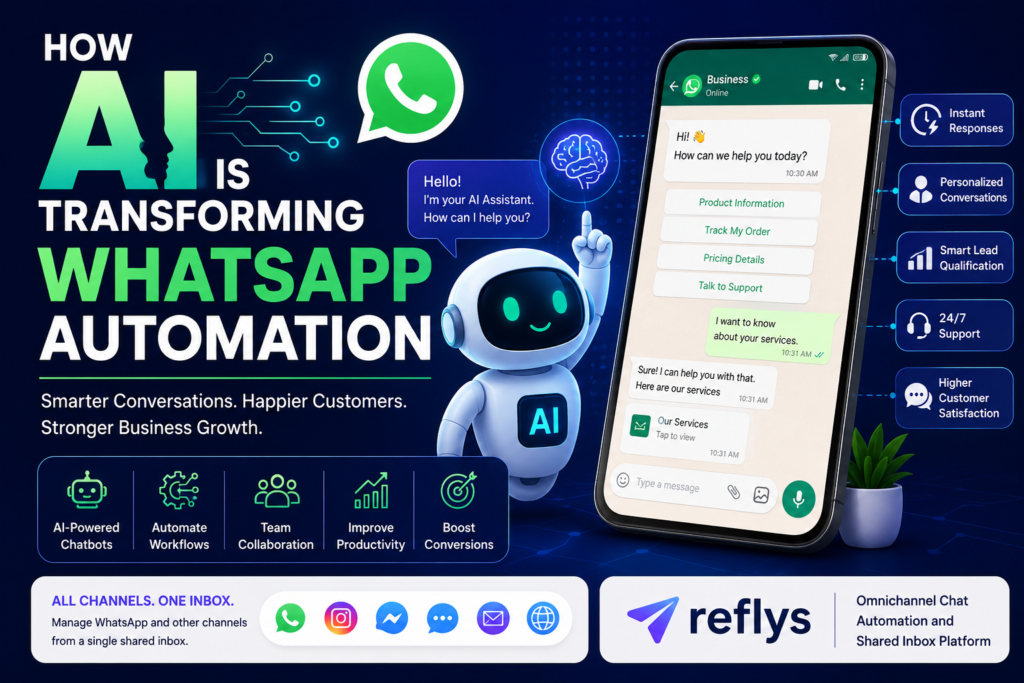

Artificial Intelligence (AI) is reshaping the way businesses communicate with customers. From answering routine questions to providing personalized recommendations, AI-powered tools are making customer interactions faster, smarter, and more efficient. One area where AI has had a significant impact is WhatsApp Automation.
As one of the world’s most popular messaging platforms, WhatsApp has become an essential communication channel for businesses of all sizes. Customers now expect instant responses, personalized conversations, and support that is available whenever they need it. Meeting these expectations manually can be challenging, especially as businesses grow.
AI-powered WhatsApp Automation helps organizations automate repetitive tasks, qualify leads, schedule appointments, answer frequently asked questions, and provide real-time assistance without compromising customer experience. When integrated with an Omnichannel Chat Automation and Shared Inbox Platform, businesses can also manage conversations from WhatsApp, Instagram, Facebook Messenger, website live chat, and other communication channels within one centralized workspace.
This article explores how AI is transforming WhatsApp Automation, the benefits it offers businesses, and why combining AI with omnichannel communication creates a more efficient customer engagement strategy.
Understanding WhatsApp Automation
WhatsApp Automation uses software to automate customer interactions through WhatsApp. Instead of requiring employees to respond manually to every inquiry, businesses can create intelligent workflows that handle common tasks automatically.
Typical automation features include:
- Welcome messages
- Frequently asked questions
- Appointment scheduling
- Order updates
- Lead qualification
- Follow-up reminders
- Customer support routing
Traditional automation relies on predefined rules, while AI enhances these capabilities by making conversations more adaptive and context-aware.
The Role of AI in Modern Customer Communication
Artificial Intelligence adds intelligence to automation rather than simply speeding up repetitive processes.
AI technologies can:
- Understand customer intent
- Analyze conversation context
- Recommend relevant responses
- Personalize interactions
- Learn from previous conversations
- Assist support agents with suggested replies
Instead of providing the same response to every customer, AI helps businesses deliver more relevant and helpful conversations.
1. Faster Customer Responses
Customers expect immediate answers.
AI-powered WhatsApp Automation enables businesses to respond within seconds, even during peak hours or outside business hours.
Instant responses improve customer satisfaction while increasing the likelihood of converting inquiries into sales opportunities.
2. Smarter Lead Qualification
Not every inquiry represents a qualified lead.
AI can automatically ask relevant questions, collect customer information, and determine whether a prospect is ready to speak with the sales team.
For example, AI can identify:
- Customer interests
- Budget range
- Purchase timeline
- Business requirements
This allows sales teams to focus on high-quality opportunities instead of manually filtering every conversation.
3. Personalized Customer Experiences
One of AI’s greatest strengths is personalization.
Instead of sending generic automated replies, AI can tailor conversations using customer information such as:
- Previous purchases
- Browsing behavior
- Conversation history
- Product interests
- Customer preferences
Personalized communication helps businesses build trust and strengthen customer relationships.
4. 24/7 Customer Support
Customers contact businesses at all hours.
Hiring support agents to provide round-the-clock assistance can be expensive.
AI-powered WhatsApp Automation enables businesses to provide immediate assistance twenty-four hours a day while escalating more complex issues to human representatives when necessary.
5. Improved Team Productivity
Customer support teams often spend valuable time answering repetitive questions.
AI automates routine tasks such as:
- Pricing inquiries
- Business hours
- Order status
- Shipping updates
- Appointment confirmations
By reducing repetitive work, employees can focus on higher-value activities like resolving complex issues and building customer relationships.
6. Better Conversation Management
As businesses grow, customer conversations increase across multiple communication channels.
Managing WhatsApp separately from Instagram, Facebook Messenger, website chat, and email often creates inefficiencies.
An Omnichannel Chat Automation and Shared Inbox Platform centralizes these conversations into one dashboard, allowing teams to collaborate more effectively and maintain complete customer histories.
Businesses evaluating solutions such as Reflys or similar platforms should compare features, integrations, security, scalability, and workflow capabilities to determine which option best supports their operational needs.
7. Intelligent Conversation Routing
AI can automatically determine which department should handle a customer inquiry.
For example:
- Sales questions go to the sales team.
- Technical issues go to customer support.
- Billing inquiries go to the finance department.
Automatic routing reduces delays while improving the overall customer experience.
8. Enhanced Customer Insights
AI doesn’t simply respond to customers—it also analyzes conversations.
Businesses can identify:
- Frequently asked questions
- Customer pain points
- Popular products
- Customer sentiment
- Common support issues
These insights help businesses improve products, services, and communication strategies.
9. Increased Sales Opportunities
AI-powered WhatsApp Automation supports sales by engaging prospects throughout the buying journey.
Automation can:
- Recommend products
- Share pricing information
- Schedule product demonstrations
- Send promotional offers
- Follow up with interested prospects
Keeping customers engaged throughout the sales process increases conversion opportunities.
10. Scalability for Growing Businesses
As businesses expand, manually managing thousands of conversations becomes increasingly difficult.
AI allows organizations to handle larger conversation volumes while maintaining fast response times and consistent service quality.
Combined with an Omnichannel Chat Automation and Shared Inbox Platform, businesses can scale customer communication without significantly increasing operational costs.
Best Practices for AI-Powered WhatsApp Automation
To maximize the benefits of AI:
- Keep automated conversations natural and conversational.
- Personalize customer interactions whenever possible.
- Allow customers to connect with a human agent easily.
- Regularly review AI performance.
- Update automated workflows as products and services evolve.
- Monitor customer feedback and satisfaction.
AI should enhance—not replace—meaningful human communication.
Challenges Businesses Should Consider
While AI offers many advantages, businesses should also understand its limitations.
Potential challenges include:
- Over-automation creating impersonal experiences
- Poorly designed conversation flows
- Inaccurate responses to complex questions
- Insufficient human oversight
- Privacy and data security considerations
A balanced combination of AI and human expertise delivers the best customer experience.
The Future of WhatsApp Automation
AI technology continues to evolve rapidly.
Future WhatsApp Automation solutions are expected to include:
- More natural conversations
- Better multilingual support
- Advanced sentiment analysis
- Predictive customer service
- Smarter workflow automation
- Deeper CRM integration
Businesses adopting AI responsibly today will be better prepared for the next generation of customer communication.
Conclusion
Artificial Intelligence is transforming WhatsApp Automation from simple rule-based messaging into an intelligent customer engagement solution. Businesses can now automate repetitive tasks, personalize conversations, qualify leads, and provide faster customer support while improving operational efficiency.
When combined with an Omnichannel Chat Automation and Shared Inbox Platform, AI-powered automation becomes even more effective by centralizing customer conversations across multiple communication channels. Platforms such as Reflys demonstrate how businesses can organize customer interactions, improve team collaboration, and deliver more consistent support from a single workspace.
As customer expectations continue to evolve, organizations that combine AI with thoughtful human interaction will be well positioned to improve customer satisfaction, strengthen relationships, and achieve sustainable business growth.
Frequently Asked Questions
1. What is AI-powered WhatsApp Automation?
AI-powered WhatsApp Automation uses artificial intelligence to automate customer conversations, answer questions, qualify leads, and personalize interactions on WhatsApp.
2. How does AI improve WhatsApp Automation?
AI enables faster responses, better personalization, intelligent lead qualification, conversation routing, and continuous learning from customer interactions.
3. What is an Omnichannel Chat Automation and Shared Inbox Platform?
It is a platform that brings customer conversations from multiple communication channels into one shared workspace, making collaboration and communication management easier.
4. Can small businesses benefit from AI-powered WhatsApp Automation?
Yes. Small businesses can improve response times, automate repetitive tasks, enhance customer engagement, and manage growing conversation volumes more efficiently.
5. Is AI a replacement for human customer support?
No. AI works best when combined with human support. It handles repetitive tasks efficiently while allowing customer service representatives to focus on complex issues that require empathy, judgment, and personalized assistance.