
A pay stub is one of those documents people usually ignore until they actually need it.
You get paid, the money lands in your bank account, and that feels like the main thing. But later, when a landlord asks for income proof, or a lender wants recent earnings, or you notice your paycheck looks smaller than expected, the pay stub suddenly becomes important.
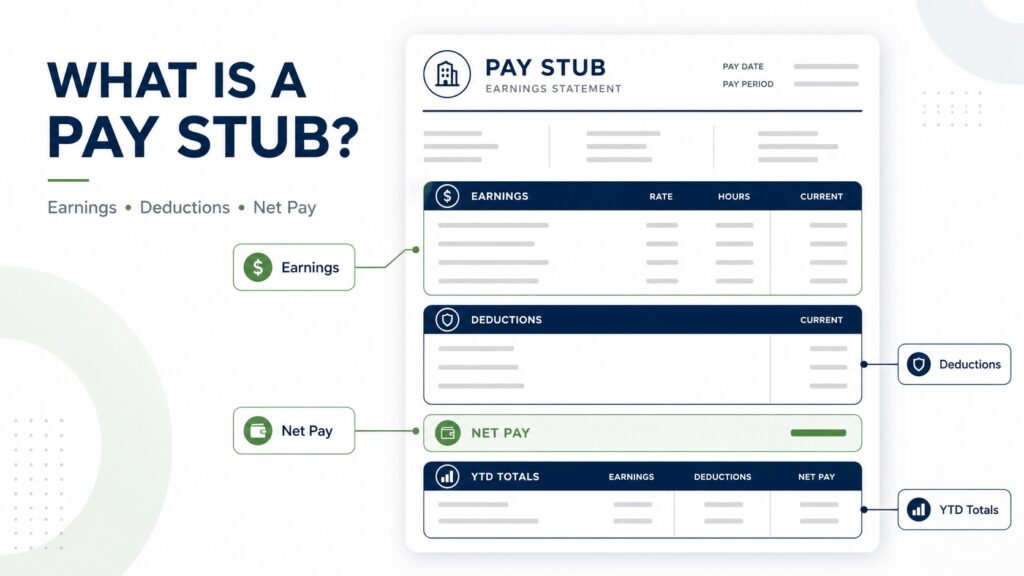
So let’s keep it simple.What a pay stub is: it is a record that explains your pay for one pay period. It shows what you earned before deductions, what was taken out, and what you finally received.
That’s it at the basic level.
A bank deposit only shows the amount that came in. A pay stub shows the story behind that amount.
What you normally see on a pay stub
Most pay stubs have the same type of details, even if the layout looks different. You may see:
-
Employee name
-
Employer name
-
Pay date
-
Pay period
-
Hourly rate or salary amount
-
Hours worked
-
Gross pay
-
Taxes
-
Deductions
-
Net pay
-
Year-to-date totals
The words may look formal, but the idea is not hard.
Gross pay means the money you earned before anything was removed. Net pay means the money you actually take home. Taxes and deductions sit in the middle.
That is why What a pay stub is should not be confused with only a paycheck. A paycheck is the payment. A pay stub is the breakdown.
Why it matters in real life
Imagine your job pays you $1,200 for two weeks. But your bank account only receives $930.
Without a pay stub, you may only guess where the $270 went. With a pay stub, you can see the details. Maybe federal tax was taken out. Maybe Social Security and Medicare were withheld. Maybe health insurance or retirement deductions were included.
This is where What a pay stub is becomes useful. It helps you understand your own money.
Many workers never check their pay stubs. That is a mistake. Small payroll errors happen. Hours can be entered wrong. Overtime can be missed. A deduction can continue after it should have stopped. If you never read your pay stub, you may not catch the problem quickly.
Pay stubs are also used outside work
A pay stub is not only for checking wages. It is often used as proof of income.
You may need it for:
-
Renting an apartment
-
Applying for a car loan
-
Getting a personal loan
-
Applying for a mortgage
-
Verifying employment income
-
Keeping personal tax records
A landlord does not just want to know that money came into your account. They usually want to see regular income, employer details, and recent pay history. A pay stub helps show that.
This is another reason people search for What a pay stub is. They may not care about payroll terms at first. They just need to know what document proves income.
What about direct deposit?
A lot of people think pay stubs disappeared because checks are less common now. That is not true.
Even if you are paid by direct deposit, your employer may still provide a digital pay stub. It might be inside a payroll portal. It might be emailed. It might be downloadable as a PDF.
The payment method changed, but the pay record still matters.
What makes a pay stub useful
A useful pay stub is clear. It should not leave you guessing.
For example, if you worked 80 hours in a two-week period, the pay stub should show those hours. If you earned overtime, that should be separate or easy to understand. If deductions were taken, they should be listed.
A good pay stub helps answer basic questions:
-
How much did I earn?
-
What dates does this payment cover?
-
What taxes came out?
-
What deductions came out?
-
What did I actually receive?
-
How much have I earned so far this year?
When someone asks What a pay stub is, this is probably the best practical answer: it is a clear payroll record that helps explain income.
Pay stub vs W-2
A pay stub and a W-2 are not the same.
A pay stub is given each pay period. A W-2 is given once a year to employees for tax filing. The W-2 summarizes annual wages and taxes. The pay stub shows the smaller details during the year.
Both are important, but they are used differently.
If you want to check one paycheck, use a pay stub. If you want yearly employee tax information, use a W-2.
One thing people overlook
The year-to-date section is easy to skip, but it can be very useful.
Year-to-date, often written as YTD, shows totals from the start of the year up to the current pay date. It can show total wages, taxes, deductions, and net pay so far.
This helps when you want to estimate annual income or compare your pay records with tax forms later.
Final note
What a pay stub is can be explained in one sentence: it is a document that shows how your pay was calculated.
But in real life, it does more than that. It helps you check your wages, prove income, understand deductions, and keep financial records clean.
So the next time you get paid, don’t only look at the deposit. Open the pay stub too. It may save you from confusion later.