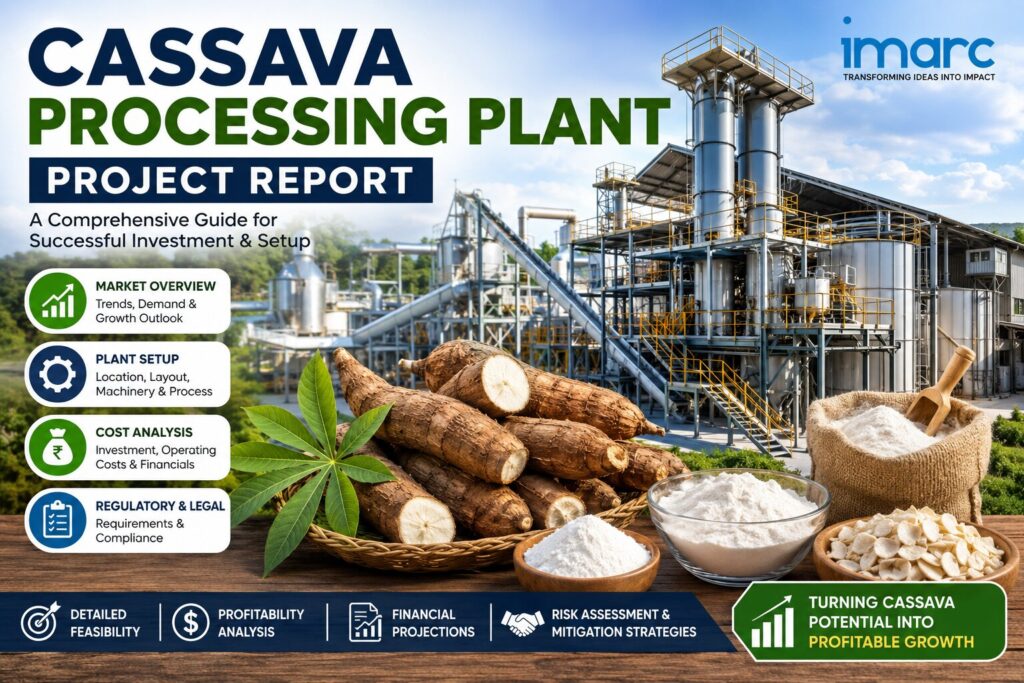

IMARC Group’s report, “Cassava Processing Plant Project Report 2026: Industry Trends, Plant Setup, Machinery, Raw Materials, Investment Opportunities, Cost and Revenue,” offers a comprehensive guide for establishing a cassava processing plant setup. The report offers insights into the processing technology, financials, capital investment, expenses, ROI, and more for informed business decisions.
In addition to covering operational aspects, the report offers detailed insights into the cassava processing plant process and project economics.
- Detailed insights into the cassava processing plant process.
- In-depth project economics and financial metrics.
- Covers capital investments and project funding.
- Analysis of operating expenses and income projections.
- Breakdown of fixed and variable costs, direct and indirect expenses.
- Evaluation of ROI (Return on Investment) and NPV (Net Present Value).
- Profit and Loss account analysis.
- Comprehensive financial analysis for decision-making.
- Provides a roadmap for successfully establishing a cassava processing unit.
What is Cassava Processing?
Cassava (Manihot esculenta), commonly known as manioc or tapioca, is one of the world’s most important tropical root crops, serving as both a staple food and a versatile industrial raw material across regions such as Africa, Asia, and Latin America. Modern cassava processing facilities convert fresh roots into a wide range of value-added products through processes including washing, peeling, grating, extraction, drying, milling, and fermentation. These plants produce cassava starch for industries such as food, textiles, paper, and pharmaceuticals, along with cassava flour, tapioca products, animal feed, and other derivatives such as glucose syrup and bioethanol.
Market Trends and Drivers:
The type of processing technology used largely determines the end products and the scale of investment required. While starch production focuses on extracting and separating starch from fibers, flour manufacturing involves pressing, drying, and milling the roots. Cassava can also be processed into chips for animal feed and fuel applications or upgraded into higher-value products such as modified starch, sweeteners, and bioethanol. Growing demand for gluten-free ingredients, bio-based materials, and renewable fuels is driving market expansion, particularly in countries such as Nigeria, Thailand, and Brazil. At the same time, advances in crop varieties and processing technologies are improving production efficiency and strengthening profitability across the industry.
Request for a Sample Report: https://www.imarcgroup.com/cassava-processing-plant-project-report/requestsample
Key Insights Covered in the Cassava Processing Plant Report
Market Coverage:
- Market Trends: Analysis of current and emerging trends in global cassava starch, cassava flour, tapioca, cassava chips, and bioethanol markets.
- Market Segmentation: Breakdown of the market by product type (native starch, modified starch, HQCF, tapioca, chips, bioethanol), end-use application (food, industrial, animal feed, bioenergy), and region.
- Regional Analysis: Distribution and performance of the cassava processing market across Sub-Saharan Africa, Southeast Asia, South Asia, Latin America, and export destination markets in Europe and East Asia.
- Price Analysis: Evaluation of pricing trends for cassava starch, HQCF, tapioca products, cassava chips, and bioethanol, alongside fresh root farmgate price dynamics.
- Impact of COVID-19: Examination of the effects of the COVID-19 pandemic on cassava root supply chains, processing plant operations, and downstream demand from food, industrial starch, and biofuel sectors.
- Market Forecast: Outlook and projections for the global cassava processing industry through 2030, covering volume growth by product category, emerging application areas, and regional capacity expansion.
Key Aspects Required for Setting Up a Cassava Processing Plant
Detailed Process Flow:
- Product Overview: Comprehensive description of each cassava-derived output product — native cassava starch (food grade and industrial grade), modified starches (oxidised, cross-linked, acetylated, hydroxypropylated), high-quality cassava flour (HQCF), tapioca pearls and flakes, cassava chips and pellets, glucose syrup, and bioethanol — including quality specifications, moisture content standards, viscosity profiles, and key markets.
- Unit Operations Involved: Step-by-step description of all processing operations: fresh root reception, inspection and weighing; root washing in paddle washers or drum washers; mechanical peeling (abrasive drum peelers or knife peelers); rasping/grating into fine pulp; starch juice extraction using rotary extractors or centrifugal screens; fibrous bagasse dewatering and by-product handling; starch milk purification through multi-stage hydrocyclone washing; dewatering by peeler centrifuges or vacuum drum filters; flash drying of wet starch cake to achieve 12–14% moisture finished starch; milling, sieving and packaging of dried starch. For cassava flour: pressing, optional fermentation, crumbling, flash drying and milling. For tapioca: starch gelatinisation, pearl forming, drying. For chips: root slicing and mechanical drying.
- Technical Tests: Essential quality control tests including moisture determination (105°C oven or NIR), whiteness measurement, starch purity (polarimetric method), pH, Brabender or Rapid Visco Analyser (RVA) viscosity profiling, granule size distribution by laser diffraction, sulphur dioxide (SO₂) residue testing, HCN content determination (picric acid paper or argentometric method), and microbial testing (total plate count, yeast and mould, E. coli).
Project Economics
- Capital Investments: Comprehensive estimation of initial capital costs including land acquisition, civil and structural works for processing building, root reception yard, finished goods warehouse, and utilities infrastructure; procurement and installation of all processing machinery (washers, peelers, raspers, extraction systems, hydrocyclones, dryers, milling equipment); boiler and steam system; wastewater treatment plant; laboratory equipment; and working capital provision for initial root procurement and operating costs during ramp-up.
- Operating Costs: Detailed breakdown of ongoing operating expenses including fresh cassava root procurement (typically the largest cost item at 60–70% of total operating cost), energy (steam and electricity), process water, process chemicals (sodium metabisulphite, chlorine), packaging materials, labour, maintenance, quality control, wastewater treatment, and administration.
- Expenditure Projections: Year-by-year capital and operational expenditure forecasts across the project life, incorporating production capacity ramp-up schedules, seasonal root price variability, planned product mix evolution (e.g., addition of modified starch or glucose syrup lines), and machinery replacement provisions.
- Revenue Projections: Income projections from the sale of native cassava starch (food grade and industrial grade), modified starches, HQCF, tapioca pearls and flakes, cassava chips and pellets, glucose syrup, and bioethanol, segmented by domestic and export market pricing, along with by-product income from cassava bagasse (animal feed or boiler fuel) and cassava peel (composting or biogas).
- Taxation and Depreciation: Analysis of applicable corporate income tax rates, VAT/GST on raw materials and finished products, customs duties on imported machinery, agricultural processing incentives and tax holidays, export promotion benefits, and depreciation schedules for processing plant and equipment.
- Profit Projections: Estimated profitability based on the starch conversion margin (selling price per tonne of starch versus fresh root cost and processing costs), product mix optimisation toward higher-value modified starches and downstream derivatives, seasonal root price management through contract farming and inventory strategies, and energy cost reduction through bagasse-fired steam generation.
- Financial Analysis: Comprehensive financial viability evaluation including detailed cash flow modelling, return on investment (ROI), net present value (NPV) at defined discount rates, internal rate of return (IRR), payback period, and sensitivity analysis against fresh root price, starch selling price, plant utilisation rate, and energy cost assumptions.
Ask Analyst for Customization: https://www.imarcgroup.com/request?type=report&id=7277&flag=C
Customization Options Available:
- Plant Location: Selection of optimal plant location considering proximity to cassava farming clusters, availability of process water, road or rail access for finished product distribution, and export port logistics.
- Plant Capacity: Customization based on desired daily or annual fresh root processing capacity, from small-scale community plants (5–20 tonnes fresh root/day) to medium integrated facilities (50–200 tonnes/day) and large industrial complexes (500+ tonnes fresh root/day) producing multiple product lines.
- Machinery: Choice between fully automated continuous processing lines with SCADA control, semi-automated batch configurations, or manually supervised small-scale equipment depending on capital budget, production scale, and target product quality standards.
- List of Machinery Providers: Identification of suitable global and domestic suppliers for root washers and peelers, high-speed raspers, centrifugal extractors, hydrocyclone systems, peeler centrifuges, flash dryers, milling and sieving equipment, and automated bagging lines.
Key Questions Addressed in This Report:
- How has the cassava processing market performed so far and how will it perform in the coming years?
- What is the market segmentation of the global cassava starch and derivatives market by product, application, and region?
- What is the competitive structure of the cassava processing industry and who are the key players?
- What is the total land area and facility footprint required for setting up a cassava processing plant?
- What is the recommended plant layout for efficient, hygienic, and food-safe cassava processing operations?
- What machinery and equipment are required for cassava starch extraction, hydrocyclone purification, flash drying, and packaging?
- What are the fresh cassava root sourcing strategies, out-grower scheme models, and post-harvest handling requirements?
- What is the estimated capital investment and operating cost for a cassava processing plant of different capacities?
- What is the multi-product revenue model for a cassava processing plant and how is profitability optimised?
- And more…
Technical and Process Questions
Q: How much fresh cassava root is needed to produce one tonne of cassava starch?
A: The fresh root-to-starch conversion ratio depends primarily on the starch content of the cassava variety being processed and the extraction efficiency of the plant. As a general benchmark, 4 to 6 tonnes of fresh cassava root are required to produce one tonne of dried native cassava starch. Plants processing high-starch varieties (28–30% starch content) with modern multi-stage hydrocyclone extraction systems can achieve the lower end of this range, while plants processing lower-starch varieties or using less efficient extraction equipment will require more root per tonne of starch produced.
Q: How water-intensive is cassava starch processing?
A: Cassava starch processing is significantly water-intensive. A typical wet extraction plant consumes between 8 and 15 cubic metres of process water per tonne of fresh cassava root processed, depending on the number of hydrocyclone washing stages and the extent of water recirculation practised. Water use minimisation through closed-loop recirculation systems, countercurrent washing, and efficient wastewater treatment and reuse is both an operational cost imperative and a key environmental compliance requirement. Plants should be sited with access to reliable, clean water supply, and effluent treatment must be designed to meet applicable discharge standards.
Q: How is cyanide (HCN) removed during cassava processing?
A: The toxic cyanogenic glycoside linamarin, which releases hydrogen cyanide (HCN) when cassava tissue is disrupted, is effectively removed during the wet starch extraction process. Rasping the roots and washing the starch milk through multiple hydrocyclone stages dissolves and dilutes the water-soluble cyanogens, removing over 99% from the finished starch. The process water and wastewater carry away the residual cyanogens, which are further detoxified during wastewater treatment. For cassava flour production, sun-drying and mechanical flash-drying facilitate HCN volatilisation. Finished product HCN levels must be verified to comply with Codex Alimentarius limits (typically below 10 mg/kg for food products).
Q: What is the typical starch yield extraction efficiency of a modern cassava processing plant?
A: A well-designed modern cassava starch plant with a multi-stage hydrocyclone washing system and efficient raspers typically achieves a starch extraction efficiency of 90–95% of the total starch present in the fresh root. Older or less efficient plants with single-stage extraction may achieve only 75–85% extraction efficiency, leaving significant starch value in the fibrous bagasse by-product stream. Improving extraction efficiency is one of the highest-return process improvements available to plant operators, as it directly increases finished starch output from the same root input tonnage.
Q: Can cassava bagasse be used productively within the plant?
A: Yes. Cassava bagasse, the fibrous residue remaining after starch extraction, contains residual starch (5–10%), fibre (cellulose and hemicellulose), and moisture. It can be used as animal feed supplement after drying (mixed with cassava peel to improve nutritional value), as a boiler fuel (after pressing and drying) to generate process steam and reduce external fuel costs, as a raw material for biogas generation through anaerobic digestion, or as a composting input to produce organic fertiliser for sale to cassava farmers. Bagasse-fired steam generation is particularly attractive as it can reduce or eliminate the plant’s dependence on external fuel sources.
Investment and Financial Questions
Q: What is the typical capital investment required to set up a cassava processing plant?
A: The capital investment varies significantly with plant capacity, technology level, product mix, and location. As a broad indicative range: a small-scale HQCF or chip plant processing 5–10 tonnes of fresh root per day may require a capital investment of USD 50,000–200,000; a medium-scale wet starch extraction plant processing 50–100 tonnes per day typically requires USD 500,000–2,000,000; and a large integrated starch and derivative plant processing 200–500 tonnes of fresh root per day may require USD 3,000,000–10,000,000 or more. IMARC Group’s project report provides detailed, location-specific capital cost estimates calibrated to the investor’s specific capacity, product mix, and machinery configuration requirements.
Q: What is the typical payback period for a cassava processing plant investment?
A: The payback period for a cassava processing plant investment typically ranges from 3 to 7 years, depending on plant capacity, product mix, raw material cost efficiency, market pricing for outputs, and operational utilisation rate. Plants producing higher-value products such as modified starches, glucose syrup, or food-grade tapioca generally achieve shorter payback periods due to superior conversion margins. Plants with well-managed out-grower supply chains that stabilise root input costs and ensure year-round feedstock availability also tend to achieve more predictable and faster returns on investment.
Q: What are the main operating cost components for a cassava processing plant?
A: The main operating cost components are: (1) fresh cassava root procurement, typically the largest single cost item representing 55–70% of total processing cost depending on local farmgate prices; (2) energy costs including steam generation fuel and electricity, representing 10–20% of operating costs (significantly reduced if bagasse-fired boilers are used); (3) labour costs for processing operators, quality staff, and agricultural field teams; (4) process chemicals (sodium metabisulphite, chlorine for water treatment); (5) packaging materials; (6) maintenance and spare parts; and (7) quality control and regulatory compliance costs.
Q: Are there government incentives available for cassava processing plant investments?
A: Many cassava-producing countries offer specific incentives to attract investment in agro-industrial processing. These may include corporate income tax holidays for defined periods, import duty exemptions on processing machinery and equipment, value-added tax (VAT) exemptions or zero-rating for agricultural inputs and processed food products, export promotion grants and subsidies, access to development finance institution (DFI) loans at concessional interest rates, and land allocation at subsidised rates in designated agro-industrial processing zones. IMARC Group’s country-specific project reports detail the applicable incentive frameworks and financing options available in each target investment location.
Regulatory and Environmental Questions
Q: What environmental permits are required to operate a cassava processing plant?
A: A cassava processing plant typically requires an environmental impact assessment (EIA) approval or environmental permit from the national or state environmental protection agency, an effluent discharge consent specifying allowable pollutant loads and discharge volumes into receiving water bodies or sewerage systems, a water abstraction licence for process water offtake from rivers, boreholes, or municipal supply, and an air emission permit covering dust, steam, and combustion gas emissions from drying and boiler operations. The wastewater from cassava processing is high in biological oxygen demand (BOD) due to dissolved starch and cyanogens, and requires effective biological treatment before discharge.
Q: What food safety certifications are important for cassava starch and flour export markets?
A: For export to major international markets, cassava starch and flour processors should obtain HACCP (Hazard Analysis and Critical Control Points) certification as a foundation food safety system, followed by ISO 22000 or FSSC 22000 (Food Safety System Certification) for comprehensive food safety management system recognition. BRC Global Standard for Food Safety certification is widely required by European retail and food service buyers. For the United States market, compliance with FDA 21 CFR food regulations and Foreign Supplier Verification Programme (FSVP) requirements is essential. Country-specific national food safety authority registration (e.g., NAFDAC in Nigeria, KEBS in Kenya, BFAD in the Philippines) is required for domestic market sales.
Services:
- Plant Setup
- Factory Auditing
- Regulatory Approvals, and Licensing
- Company Incorporation
- Incubation Services
- Recruitment Services
- Marketing and Sales
How IMARC Can Help?
IMARC Group is a global management consulting firm that helps the world’s most ambitious changemakers to create a lasting impact. The company provides a comprehensive suite of market entry and expansion services. IMARC offerings include thorough market assessment, feasibility studies, company incorporation assistance, factory setup support, regulatory approvals and licensing navigation, branding, marketing and sales strategies, competitive landscape and benchmarking analyses, pricing and cost research, and procurement research.
Contact Us:
IMARC Group
134 N 4th St. Brooklyn, NY 11249, USA
Email: sales@imarcgroup.com
Tel No:(D) +91 120 433 0800
United States: (+1-201971-6302)