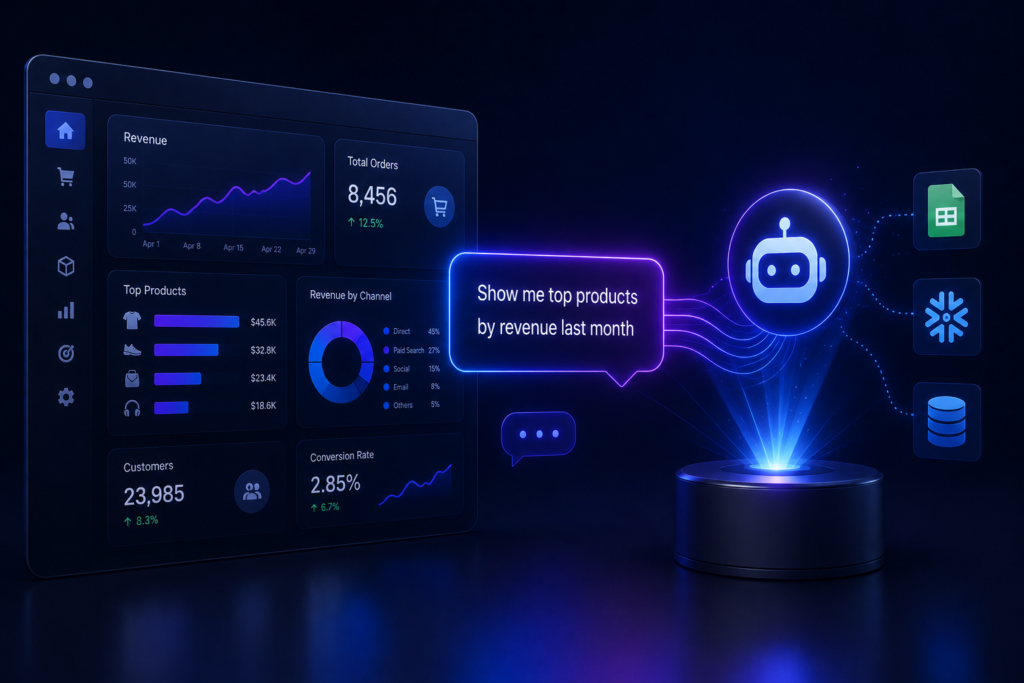

SQL was never designed to be a business tool. It’s a technical language for database interaction — precise, powerful, and entirely inaccessible to the majority of business users who need insights every day. The persistence of SQL as the primary interface for data access in ecommerce has created a structural bottleneck that costs companies millions in delayed decisions.
Natural language BI is the solution. This article explains what it is, why it matters for ecommerce, and what the practical implementation looks like.
What Is Natural Language BI?
Natural language business intelligence is the ability to query data using plain conversational language rather than structured query syntax. Instead of writing:
SELECT channel, SUM(revenue) FROM orders WHERE order_date >= ‘2024-01-01’ GROUP BY channel ORDER BY SUM(revenue) DESC
A user simply asks: “What are my top revenue channels this year?”
The AI interprets the question, identifies the correct data tables and relationships, constructs the appropriate query, executes it, and returns a human-readable answer — often with a chart.
The Business Case for Natural Language Analytics
The case for natural language BI is straightforward:
- 70% of analyst time is spent on repetitive reporting — NL BI automates this
- Business users wait an average of 2–5 days for ad hoc reports — NL BI reduces this to seconds
- Decisions made without data are more common than organisations admit — NL BI removes the friction that causes this
- Analyst retention improves when repetitive work is automated — NL BI elevates the analyst role
For ecommerce teams specifically, natural language bi platforms like ProactiveAI are designed with ecommerce-specific data models — understanding concepts like AOV, CAC, CLV, and attribution without requiring custom configuration.
How Natural Language BI Works Under the Hood
Modern NL BI systems use a combination of large language models (LLMs) and structured knowledge graphs to translate questions into queries. The key components are:
Intent Recognition
The system identifies what the user is trying to understand: trend analysis, comparison, ranking, aggregation, or drill-down.
Entity Mapping
Business terms (“revenue”, “conversion rate”, “acquisition channel”) are mapped to specific database fields and metric definitions.
Context Management
The system maintains context across follow-up questions within a session, enabling multi-turn analytical conversations.
Query Construction
A SQL or equivalent query is constructed from the interpreted intent, mapped entities, and applied filters.
Response Generation
The raw query result is formatted into a natural language answer, chart, or table — depending on what best serves the original question.
What NL BI Can and Can’t Do Today
It’s worth being honest about the current state of natural language BI. It excels at:
- Standard aggregations, comparisons, and trend analysis
- Multi-dimensional breakdowns (“by channel, by device, by region”)
- Follow-up questions and iterative analysis
- Routine reporting that currently requires analyst involvement
It’s less suited for:
- Complex statistical analysis requiring custom models
- Questions requiring data not yet integrated into the platform
- Analysis requiring subjective business judgment that can’t be codified
Implementation: Getting Started with NL BI
The implementation path for natural language BI has become significantly shorter in recent years. A typical deployment involves:
- Data source connection (Shopify, GA4, Klaviyo, ad platforms) — typically 1–3 days
- Semantic layer configuration (defining your key metrics and business terminology)
- Access control setup (defining who can see what)
- Team onboarding (usually a single session per team)
Forward-deployed engineers at specialist platforms handle most of this configuration, with businesses live and querying within 1–2 weeks.
Dashboards as a Complement, Not a Replacement
Natural language BI doesn’t replace dashboards — it complements them. Pre-built dashboards remain valuable for regular monitoring and executive reporting. NL BI adds value for exploration, ad hoc questions, and dynamic analysis that would otherwise require analyst involvement.
The most effective analytics setups combine structured dashboards with NL query capability, offered by platforms that provide integrated ecommerce dashboard software alongside conversational analytics in a single environment.
Conclusion
Natural language BI is not just a convenience feature — it’s a fundamental shift in who can access and act on data in an organisation. By removing the SQL bottleneck, it democratises insight, accelerates decision-making, and frees analysts for the strategic work that drives real competitive advantage.