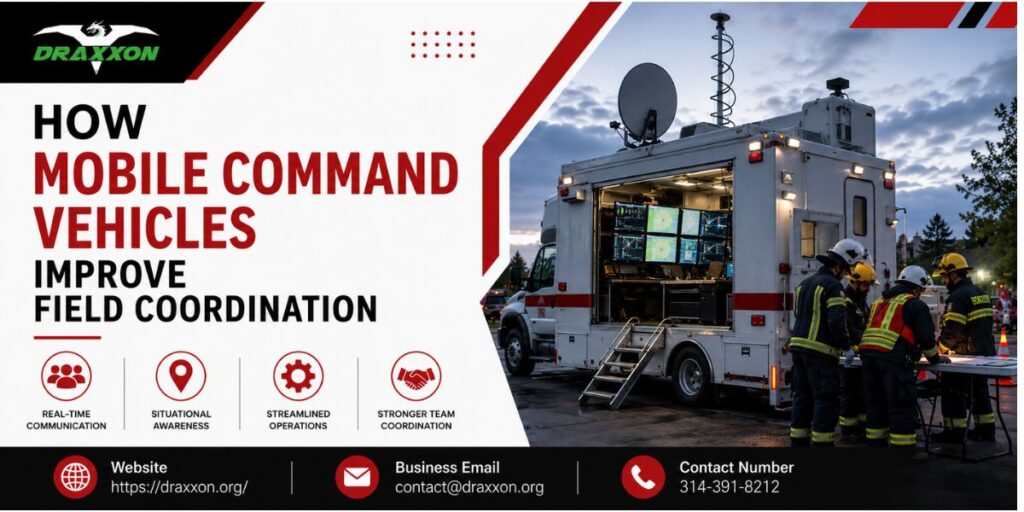

Things do not always go as planned when actions are in the field. The weather changes. Information comes in late. The teams split up faster than planned. At those times, coordinating becomes the hardest thing. This is where mobile command vehicles come in, but not as a sign of power. But also as a useful way to get people, data, and choices back together in one place.
These cars are only there for one reason: to make things clear again when things get complicated.
Why coordination breaks down during field operations
Even well-trained teams struggle when conditions shift quickly.
Information scatters across locations
During emergencies or big events, a lot of information comes at once from a lot of different places. Radio traffic goes up. Visual info comes in a separate package. Different people make decisions at the same time instead of one after the other.
Lack of a single hub makes it hard for teams to share information. Small delays add up to bigger gaps.
Fixed command centers lack flexibility
When processes stay inside the command center, they work well. In the field, actions rarely do. Things happen. The edges get bigger. Every hour, the weather changes.
Mobile command vehicles solve this problem by bringing the power to command right to the place where choices need to be made.
How mobile command vehicles restore operational clarity
These vehicles act as more than transportation. They function as mobile coordination hubs.
Centralized decision-making in real time
People in charge can get real-time information from mobile command cars. Then go over it together and act right away. In one place, you can find maps, live feeds, and tools for talking to people.
This setup cuts down on back-and-forth messaging and speeds up the process of making decisions.
Direct access to the operational environment
Being on-site changes how decisions are made. Command teams can see conditions firsthand instead of relying only on reports. That proximity improves judgment and reduces misinterpretation during critical moments.
The role of technology inside command vehicles
Modern command vehicles rely on integrated systems.
Communications stay unified
Radios, satellite systems, and cellular networks work together inside the vehicle. This integration keeps teams connected even when infrastructure fails.
For a general explanation of how emergency management coordination works, this Wikipedia article offers helpful context: https://en.wikipedia.org/wiki/Emergency_management
Understanding this framework explains why unified communication matters so much.
Data visualization improves situational awareness
Screens display live maps, camera feeds, and status updates. Instead of piecing information together verbally, teams see it instantly.
This shared view reduces confusion and aligns everyone around the same facts.
How UAS command vehicles expand field visibility
Aerial data has changed how teams understand incidents.
Real-time aerial intelligence
A UAS command vehicle supports drone operations directly from the field. Operators can launch, monitor, and analyze aerial footage without leaving the command environment.
This capability improves visibility over large or difficult terrain.
Faster assessment, safer decisions
Drones provide perspectives that ground teams cannot. Flood zones, wildfire edges, and accident scenes become easier to assess without putting people at risk.
That insight supports faster and safer coordination.
Public safety command vehicles in real-world use
Public safety agencies rely heavily on mobile coordination.
Supporting multi-agency operations
Large incidents often involve police, fire, medical, and utility teams. Public safety command vehicles provide a shared space where agencies coordinate without competing systems.
This collaboration improves response efficiency and reduces duplication.
Adapting to different incident types
From natural disasters to planned events, command vehicles adapt quickly. Interior layouts and technology support a wide range of operational needs.
Flexibility becomes a core advantage.
Why emergency command vehicles matter for continuity
Emergencies rarely wait for ideal conditions.
Operations continue despite infrastructure loss
When power, internet, or buildings become unavailable, emergency command vehicles keep operations running. Self-contained power and connectivity remove dependence on damaged infrastructure.
That continuity often defines the success of a response.
Mobility supports evolving situations
As incidents shift, command vehicles move with them. This mobility keeps leadership close to the action without sacrificing coordination.
Field teams benefit from faster feedback and clearer direction.
Designing command vehicles around real operations
Effective design reflects real-world use, not theory.
Layout supports focus under pressure
Interior layouts prioritize visibility, communication, and comfort during long operations. Small design choices reduce fatigue and improve decision quality.
Function outweighs aesthetics in these environments.
Customization matches mission needs
Different agencies require different configurations. Professional companies design mobile command vehicles around specific operational demands, from emergency response to event management.
Customization ensures the vehicle supports the mission instead of dictating it.
Common questions about mobile command vehicles
Are mobile command vehicles only for emergencies?
No. They also support planned events, training exercises, and infrastructure projects.
Do command vehicles replace fixed command centers?
No. They complement them by adding flexibility and on-site capability.
Can smaller agencies use mobile command vehicles?
Yes. Vehicles scale in size and complexity based on need.
Do command vehicles require specialized training?
Yes. Operators need training to use integrated systems effectively.
Conclusions: Coordination that holds up under pressure
Uncertainty still exists even with mobile command vehicles. They set it up.
They make things less confusing when things change quickly by putting people, information, and choices in one mobile space. Teams talk to each other better. Leaders act based on more information. It keeps operations from becoming disorganized. Agents start to notice something important over time. In the background, the car itself fades away.