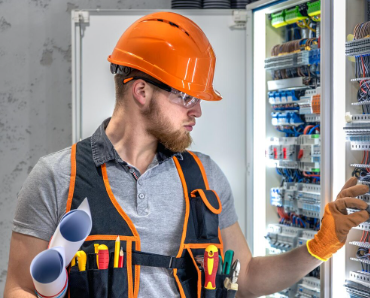

Navigating the complex landscape of Dubai’s utility regulations demands absolute precision. Whether you are launching a flagship commercial development in Business Bay, retrofitting an industrial warehouse in Jebel Ali, or managing a high-end residential build in Emirates Hills, securing an official electrical grid connection requires specialized engineering expertise. This engineering pathway is governed strictly by the Dubai Electricity and Water Authority (DEWA).
We have overseen dozens of complex engineering turnkeys across the Emirates, and we know firsthand that cutting corners on power infrastructure is the fastest way to derail a project. Working with unaccredited personnel leads to severe regulatory fines, structural safety risks, and indefinite delays in obtaining your Certificate of Completion. This master-level guide provides actionable transparency on sourcing, validating, and managing an accredited specialist to ensure seamless compliance and fast energization.
Why You Must Hire a DEWA Approved Electrical Contractor
To find a DEWA approved electrical contractor, verify their licensure via the official DEWA E-Services portal, confirm their engineering grade aligns with your structural power demands, and ensure they employ accredited engineers certified to submit technical mock-ups and drawings for legal grid connection.
Dubai’s regulatory frameworks do not treat power infrastructure as a mere utility layout; it is treated as a critical piece of the municipal infrastructure grid. A Dewa-approved electrical contractor acts as your legal liaison and authorized technical representative to the authority. They understand the strict parameters of the DEWA Regulations for Electrical Installations, ensuring your building’s internal wiring perfectly syncs with the city’s macro-distribution grid.
Without this formal registration, a firm cannot log into the DEWA e-services system, submit technical files, or request physical site inspections. Hiring an uncertified company means your project remains entirely invisible to the regulator, making it legally impossible to get a temporary site meter or a permanent low-voltage/high-voltage supply connection.
Guarding Against Regulatory Penalties and Outages
The risks of bypassing certified engineering talent extend far beyond red tape. Substandard load calculations, incorrect cable sizing, or improper installation of main distribution boards (MDBs) can lead to catastrophic arc flashes, structural fires, or localized grid overloads. By strictly deploying an authorized Dewa approved contractor, you protect your capital investment from:
- Fines and Stop-Work Orders: Dubai Municipality and utility inspectors issue heavy financial penalties and instant site closures for unapproved infrastructure modifications.
- Voided Insurance Policies: Commercial and residential property insurance underwriters in the UAE universally reject claims if fire or asset damage stems from non-compliant electrical works.
- Sunk Procurement Costs: If your contractor installs components lacking the standardized safety certifications required locally, you will be forced to rip out and replace the entire sub-system at your own expense.
Step-by-Step Framework to Source and Validate an Approved Contractor
Source certified firms by extracting the active registered listings directly from DEWA’s online vendor portal, cross-referencing their commercial activity codes with the Dubai Department of Economy and Tourism (DET), and inspecting their active portfolio for successfully energized local projects.
The sourcing phase requires strict diligence. Do not rely on casual word-of-mouth recommendations or unverified online directory listings. Instead, execute this systematic verification sequence to protect your project pipeline from fraudulent operators:
1. Direct Querying of the Official DEWA Portal
Your search must begin at the source. DEWA maintains an actively updated database of certified consultants and contractors. Access the web portal, navigate to the “Partners” or “Builders/Contractors” directory, and filter firms by their active enrollment status. This database confirms that the contractor possesses a live, unexpired account credential within the municipal e-submission platform.
2. Verification of Dubai Trade License Activity Codes
A valid registration is legally tethered to an underlying commercial license issued by the Department of Economy and Tourism (DET) or a free zone authority. Inspect the company’s trade license. It must explicitly list specific activity descriptions, such as “Electrical Fitting Contracting” or “Power Generation & Transmission Contracting”. If these specific structural categories are missing, their registration cannot be utilized for physical installation works.
3. Matching the Contractor’s Capacity Grade to Your Project Scale
Contractors are categorized into strict engineering grades based on the electrical load capacity they are legally permitted to design, install, and test. It is highly inefficient to engage a firm whose technical threshold is capped below your building’s total connected load requirements. The capacity calculation follows the standard power relation:
P_{(kW)} = S_{(kVA)} times PF
Where P represents real power in kilowatts, S represents apparent power in kilovolt-amperes, and PF represents the power factor. Ensure your contractor’s authorization tier covers your peak apparent power (S) requirements, including future expansion provisions. Tiers generally range from basic low-voltage residential connections up to unrestricted high-voltage industrial substations.
Many licensed general contracting companies claim they are “DEWA approved” because they possess a registered trade license. However, the reality is that many subcontract their filings to freelance engineers or external license holders. Always ask the contractor to show you the direct, current employment visas of their registered engineers. If their qualifying engineer is not on their direct corporate payroll, your project files risk being blocked during the technical review stage.
Technical Credentials and Engineering Standards to Inspect
Evaluate a contractor’s technical eligibility by verifying their engineers’ Society of Engineers (SOE) cards, assessing their fluency with the DEWA Regulations for Electrical Installations, and auditing their mastery of complex physical load schedules.
Once you narrow down a shortlist of potential partners, you must pivot from checking basic credentials to conducting a rigorous technical audit. A qualified contractor must show deep engineering literacy regarding the localized safety guidelines that govern Dubai’s built environment.
Mandatory Engineering Cards and Accreditations
In Dubai, individual engineers must hold formal credentials alongside the corporate entity itself. Demand to see the following specific documentation:
- Society of Engineers (SOE) Registration: Every practicing engineer must be a registered member of the UAE Society of Engineers, proving their foundational academic and practical credentials.
- DEWA Examination Certification: Your designated project manager or technical lead must have passed the authority’s rigorous internal examination, awarding them a unique registration number linked directly to the online portal.
Evaluating Mastery of Technical Deliverables
An exceptional contractor does not just run conduits and pull cables; they manage complex engineering data structures. Review their past submittals to ensure they are fully capable of drafting and interpreting the core blueprints required for a successful utility application:
Single Line Diagrams (SLD): These schematics detail the entire electrical distribution topology of your site, mapping everything from the main low-voltage panel (MLVP) down to final distribution boards. The SLD must clearly display accurate circuit breaker ratings, cable cross-sectional areas, and specific earthing arrangements.
Total Connected Load and Maximum Demand Schedules: Contractors must meticulously map out the electrical load distribution across all phases. This prevents phase imbalances, which degrade transformer efficiency and trigger localized voltage drops. The load schedules must calculate demand factors accurately based on the nature of the equipment, balancing HVAC units, lighting rings, and heavy motor loads perfectly.
The Connection Lifecycle: Navigating the Inspection Process
The DEWA connection process flows through four precise phases: technical drawing submission and NOC acquisition, physical installation according to strict local guidelines, rigorous independent field testing, and a final on-site physical inspection before utility energization.
Understanding the operational workflow of an electrical infrastructure project helps you monitor your contractor’s performance and ensure your milestones stay on track. The entire connection lifecycle follows a structured engineering path:
- No Objection Certificate (NOC) and Design Approval: Before a single wire is installed, your contractor submits the comprehensive SLD and architectural layout via the online portal. DEWA reviews these plans against regional grid capacities. Work can only begin once a formal design NOC is issued.
- First-Fix and Second-Fix Installations: The physical installation proceeds in strict phases. First-fix involves embedding heavy-duty containment systems, trunks, and conduits within the structural core. Second-fix involves pulling certified, low-smoke, zero-halogen (LSZH) copper conductors and installing isolating switchgear.
- Continuity and Insulation Testing: Before requesting an inspector’s visit, the contractor must complete independent internal tests. They measure insulation resistance utilizing high-voltage megohmmeters to ensure zero current leakage across the cable jackets, and verify that earth loop impedance values fall well within safe tolerances.
- The Final Field Inspection and Meter Placement: The culmination of the project is the physical utility inspection. An inspector arrives on-site to verify that the physical installation perfectly matches the approved digital SLD drawings. They check earthing pits, verify physical label markers on distribution panels, and ensure all safety shrouds are firmly secured. Once approved, the installation passes inspection, meters are set, and the main breakers are energized.
Strategic Procurement: Interviewing Your Shortlisted Experts
Before executing a commercial contract, hold an in-depth technical interview with the project’s prospective lead engineer. Use these targeted, highly technical questions to separate standard service providers from premier engineering operations:
- “Can you share an active project ID where you recently secured an LV design approval within a master developer community like KIZAD, DDA, or Dubai South?” (This tests their familiarity with localized developer guidelines, which often sit on top of standard utility rules).
- “What specific diversity factors did you apply to the HVAC load calculations on your last multi-story commercial installation?” (This evaluates their practical engineering insight and helps ensure they do not over-design the infrastructure, saving you substantial capital on unneeded cable sizes and transformer fees).
- “How do you handle mitigation if our initial insulation resistance test reveals a localized fault in a cast-in-concrete conduit run?” (This uncovers their real-world problem-solving capabilities and structural contingency planning).
By treating the selection process with this level of structural rigor, you ensure your Dubai development is backed by an engineering partner capable of delivering safe, fully compliant, and highly optimized power infrastructure on time and within budget.