
Introduction
The demand for mental and behavioral healthcare has grown significantly across the United States in recent years. As more patients seek therapy, counseling, and psychiatric support, healthcare providers face increasing pressure to manage complex billing requirements while still focusing on patient care. This is where behavioral and mental health billing services in the USA play a critical role.
Unlike general medical billing, mental health billing involves unique coding structures, session-based reimbursements, insurance authorization rules, and strict documentation standards. Even minor errors can lead to claim denials, delayed payments, or compliance issues.
For clinics, private practices, and behavioral health organizations, having a structured billing system or partnering with a specialized billing team is no longer optional—it is essential for financial stability and operational efficiency.
Understanding Behavioral and Mental Health Billing Services
Behavioral and mental health billing services refer to specialized billing processes designed specifically for psychiatric care, therapy sessions, counseling services, and behavioral interventions. These services ensure accurate claim submission, coding, and reimbursement from insurance providers.
Key components include:
- Accurate documentation of therapy sessions and patient encounters
- Use of correct CPT and ICD-10 codes for mental health conditions
- Insurance verification and eligibility checks
- Prior authorization management for psychiatric treatments
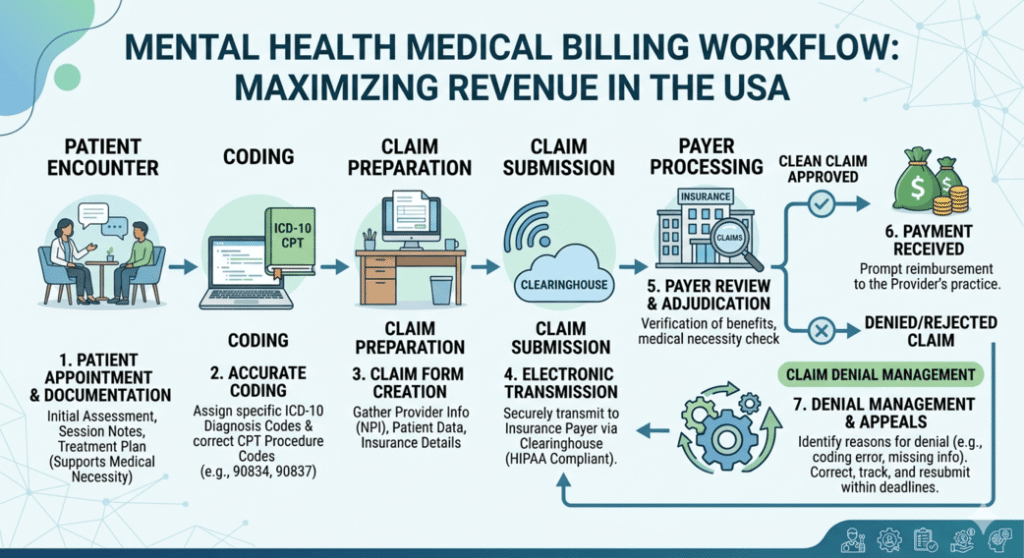
- Timely claim submission and follow-up
Unlike traditional healthcare billing, mental health billing often includes recurring visits such as weekly therapy sessions, partial hospitalization programs (PHP), or intensive outpatient programs (IOP), making precision and consistency essential.
Why Mental Health Billing Is More Complex Than General Medical Billing
Mental health billing comes with several unique challenges that make it more complicated than standard healthcare billing processes.
1. Session-Based Billing Structure
Mental health services are typically billed per session rather than per procedure, requiring precise time tracking and documentation.
2. Insurance Restrictions
Many insurance providers limit the number of covered therapy sessions or require frequent authorization renewals.
3. Complex Coding Requirements
Providers must use specific mental health CPT codes along with ICD-10 diagnosis codes that accurately reflect patient conditions.
4. Documentation Sensitivity
Mental health records require detailed yet confidential documentation, balancing compliance with privacy regulations like HIPAA.
5. High Claim Denial Rates
Due to authorization errors, coding mistakes, or missing documentation, denial rates in mental health billing are often higher than other specialties.
Mental Health Insurance Billing: What Providers Need to Know
Mental health insurance billing involves coordinating directly with insurance companies to ensure reimbursement for therapy and psychiatric services. It requires deep knowledge of payer policies and behavioral health coverage rules.
Common steps include:
- Verifying patient insurance eligibility before treatment
- Checking behavioral health coverage limits
- Obtaining prior authorizations for therapy sessions
- Submitting claims with accurate modifiers and codes
- Handling denials and appeals efficiently
Without proper systems in place, providers often face delayed reimbursements and administrative overload.
The Role of Mental Health Provider Billing Systems
Mental health provider billing systems are designed to support psychiatrists, psychologists, counselors, and therapy clinics in managing their revenue cycle effectively.
A well-structured billing process helps providers:
- Reduce administrative burden
- Improve claim acceptance rates
- Maintain compliance with insurance guidelines
- Increase revenue predictability
- Focus more on patient care rather than paperwork
Many practices are now shifting toward automated billing workflows or outsourcing to specialized agencies for better efficiency.
Outsourced Billing for Mental Health: A Growing Trend
Outsourced billing for mental health has become a popular solution among small and mid-sized practices. Instead of managing billing in-house, providers partner with specialized billing companies that handle the entire revenue cycle.
Benefits include:
- Reduced overhead costs
- Faster claim processing
- Lower denial rates
- Access to expert billing professionals
- Improved cash flow management
Outsourcing also allows mental health professionals to focus entirely on treatment without administrative distractions.
Outsourcing Mental Health Billing in Texas and Other States
The demand for outsourcing mental health billing Texas has increased significantly due to the state’s growing behavioral health network. Clinics in Texas, along with other states like New York, North Carolina, and South Carolina, are increasingly relying on external billing experts.
- In Texas, providers benefit from scalable billing support for large patient volumes
- In New York, strict compliance rules make outsourcing highly valuable
- North Carolina clinics often outsource to reduce administrative workload
- South Carolina practices use outsourcing to improve reimbursement speed
Whether it is a solo practice or a multi-location clinic, outsourcing ensures smoother operations and financial stability.
Choosing the Best Mental Health Billing Company
Selecting the best mental health billing company is a critical decision for healthcare providers. The right partner can significantly improve revenue cycle performance and reduce stress.
Key factors to consider:
- Experience in behavioral and mental health billing
- Strong understanding of insurance policies
- Proven track record of reducing claim denials
- Transparent reporting systems
- Dedicated support teams
Many providers also search for regional expertise, such as:
- Best mental health billing company Ohio
- Best mental health billing company New York
- Best mental health billing company North Carolina
- Best mental health billing company South Carolina
Each region may have different payer requirements, making localized knowledge an added advantage.
Why Specialized Behavioral and Mental Health Billing Services Matter
Behavioral and mental health billing services are not just administrative support systems—they directly impact the financial health of a practice.
A specialized billing setup helps providers:
- Improve reimbursement accuracy
- Maintain compliance with healthcare regulations
- Reduce billing errors and delays
- Strengthen patient satisfaction through smoother operations
- Optimize long-term revenue growth
The best mental health billing services company understands both clinical workflows and payer expectations, ensuring seamless coordination between care delivery and reimbursement.
Role of Revenue Cycle Management Services in Mental Health Practices
Revenue cycle management services (RCM) are essential for maintaining financial stability in behavioral healthcare organizations. RCM covers the entire patient billing journey—from appointment scheduling to final payment collection.
Key RCM functions include:
- Patient registration and insurance verification
- Charge capture and coding accuracy
- Claim submission and tracking
- Denial management and resubmission
- Payment posting and reconciliation
When integrated properly, RCM improves financial performance and reduces administrative inefficiencies.
Importance of Medical Coding Services in Mental Health Billing
Accurate medical coding services are the backbone of mental health billing. Coding errors can lead to claim rejections or compliance issues.
Proper coding ensures:
- Correct identification of mental health diagnoses
- Accurate billing for therapy sessions and psychiatric evaluations
- Compliance with payer guidelines
- Reduced audit risks
Mental health providers rely heavily on ICD-10 and CPT codes, making coding expertise essential for successful reimbursement.
Medical Billing Services and Medical Billing and Coding Services in Behavioral Health
Many organizations combine medical billing services and medical billing and coding services to streamline operations. This integration ensures that claims are both accurately coded and efficiently processed.
Benefits include:
- Faster reimbursement cycles
- Reduced administrative workload
- Improved accuracy in claim submission
- Better coordination between clinical and financial teams
This combined approach is especially useful for growing behavioral health clinics that want scalable solutions.
Credentialing Services in Mental Health Practices
Credentialing services are essential for ensuring that mental health providers are enrolled with insurance networks. Without proper credentialing, claims may be denied or delayed.
Credentialing helps:
- Verify provider qualifications
- Enroll providers with insurance networks
- Maintain compliance with payer requirements
- Enable faster claim approvals
For new clinics or expanding practices, credentialing is a foundational step in revenue cycle management.
Best Practices for Efficient Mental Health Billing
To optimize billing performance, mental health providers should follow these best practices:
- Maintain accurate and detailed patient documentation
- Verify insurance coverage before every session
- Use updated coding standards
- Track claims regularly to avoid delays
- Train staff on billing compliance requirements
- Partner with experienced billing professionals when needed
Consistency and accuracy are key to reducing financial leakage in behavioral health practices.
Future of Behavioral and Mental Health Billing Services in the USA
The future of behavioral and mental health billing services in the USA is evolving rapidly with technology integration. Automation, AI-driven claim processing, and digital health platforms are transforming how billing is managed.
Key trends include:
- Increased use of automated RCM systems
- AI-assisted coding and claim validation
- Telehealth billing expansion
- Real-time insurance verification tools
- Greater focus on compliance and data security
These advancements will continue to improve efficiency and reduce administrative burden for providers.
Conclusion
Managing behavioral healthcare finances requires precision, compliance, and specialized knowledge. As the industry grows, the need for efficient billing systems becomes even more critical for sustainable practice operations.
Modern practices increasingly rely on medical billing services, medical coding services, medical billing and coding services, revenue cycle management services, and credentialing services to maintain financial health and operational efficiency.
Organizations like 247 Medical Billing Services provide comprehensive support tailored to behavioral health providers, helping them streamline workflows, reduce claim denials, and improve revenue performance without compromising patient care.
FAQs
1. What are behavioral and mental health billing services?
They are specialized billing solutions designed to manage claims, coding, and reimbursement for psychiatric and behavioral health services.
2. Why is mental health billing more complex than general medical billing?
It involves session-based billing, strict insurance rules, and detailed documentation requirements, making it more challenging.
3. What is outsourced billing for mental health?
It is when clinics hire external billing companies to handle claim submission, coding, and revenue cycle management.
4. How do revenue cycle management services help mental health practices?
They manage the entire billing process, from patient registration to final payment collection, improving financial efficiency.
5. What role do credentialing services play in mental health billing?
Credentialing ensures providers are enrolled with insurance companies so claims can be processed and reimbursed properly.
6. How do I choose the best mental health billing company?
Look for experience in behavioral health, strong denial management, compliance expertise, and transparent reporting systems.