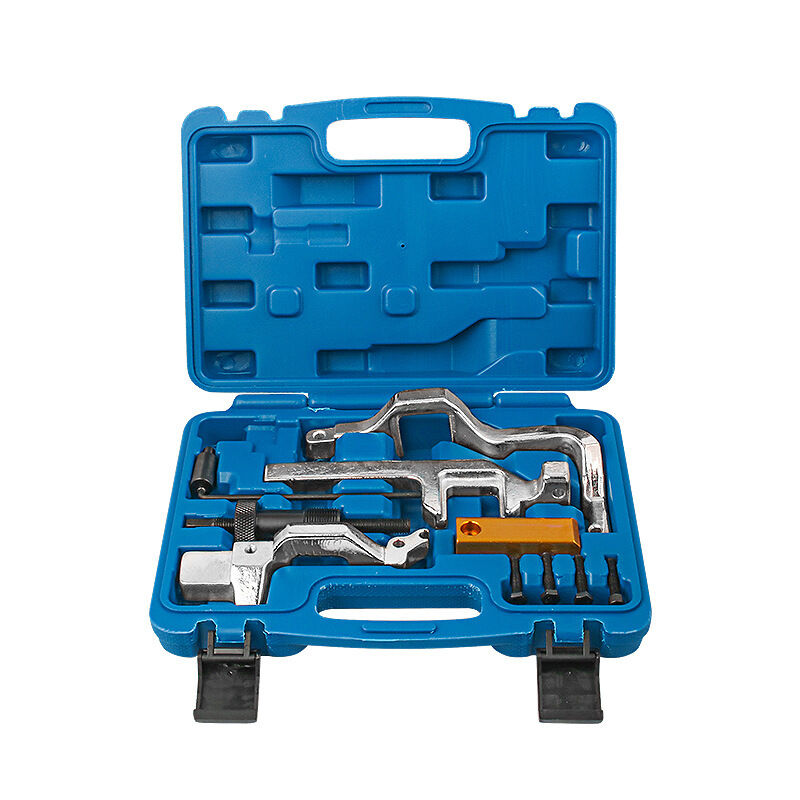

Anyone who has worked on a timing chain job knows the margin for error is essentially zero. The relationship between the crankshaft and camshafts has to be exact – not close, not within a tooth or two, exact. Modern engines are built to tolerances that leave no room for approximation, and the N14 engine in the Mini Cooper S is no exception. Get the timing wrong during reassembly, and you’re looking at rough running at best, bent valves at worst. The right timing tool kit is what stands between a clean repair and an expensive comeback. Here’s what to think about before buying one.
Why a Dedicated Timing Tool Matters
There’s a temptation, especially for enthusiasts doing this work at home, to improvise with generic tools or to rely on careful measurement alone. On older, simpler engines, that approach sometimes works. On the N14, it doesn’t, not reliably. The camshafts and crankshaft need to be physically locked in their correct positions while the chain is removed and refitted. Without the right locking tools holding everything in place, even a small amount of movement during the job can throw the timing off in ways that aren’t always immediately obvious but show up quickly once the engine is running.
A purpose-built mini n14 timing tool eliminates that uncertainty. The locking fixtures are machined to fit the specific geometry of this engine, which means when they’re in place, the critical components aren’t going anywhere. That’s not something you can replicate with a screwdriver through a camshaft sprocket or a socket wedged against the flywheel.
What Separates a Good Kit from a Poor One
Timing tools are one of those product categories where quality differences show up immediately and matter a lot. A poorly machined locking pin that fits loosely in the camshaft bore isn’t giving you accurate positioning – it’s giving you the illusion of it. That distinction matters enormously on a precision engine.
The things to look for are straightforward. The locking fixtures should fit without play. When you insert a camshaft locking tool into its bore, it should seat cleanly and hold without wobbling. The crankshaft locking tool should engage positively with no slop. If the tools feel imprecise before the job starts, they’re going to cause problems during it.
Material quality is the other factor. Timing tools take real mechanical stress during use, particularly when resisting the spring pressure of the valvetrain. A kit made from hardened steel will handle this repeatedly without deforming. Cheaper kits made from softer alloys can wear or bend, compromising their accuracy over time and making them unreliable for subsequent jobs.
A protective case with clearly organised compartments is worth having too. Timing jobs involve a lot of components at once, and fumbling around for a specific tool while something else is held in position is exactly the kind of situation that causes mistakes. A proper timing chain tool setup always prioritizes control and organisation.
N14 vs N12 – Know Which Engine You Have
The Mini Cooper S N14 and the standard Mini’s Mini N12 engine share some family resemblance but have different timing systems. The locking tool requirements are not interchangeable, and using a kit designed for the N12 on an N14 will cause problems. Before purchasing anything, confirm the exact engine code. It’s on a sticker in the engine bay and in the car’s service documentation. This sounds obvious, but it’s a common source of confusion, particularly when buying tools online, where listings aren’t always specific about compatibility.
If the kit description doesn’t explicitly list N14 compatibility, contact the supplier and confirm before buying, rather than assuming it will work and finding out otherwise halfway through the job.
The Case for a BMW-Compatible Kit
Many workshops and serious home mechanics work across both Mini and BMW models, which share a significant amount of engineering. A timing kit that covers multiple engine families across both brands offers better value than buying separate kits for each application. A professional BMW timing chain tool kit that also covers the N14 and related Mini engines means one organised case handles a wide range of jobs rather than needing to source different tools for every engine variant that comes through.
For a workshop, this kind of versatility directly affects productivity. Setting up for a timing job is faster when everything needed is already in one place rather than pieced together from multiple kits. The upfront cost of a broader kit is higher, but it pays back quickly across the range of work it supports.
How the Right Tools Affect the Finished Job
Timing chain replacements done with proper locking tools consistently produce better outcomes than those done without. The engine runs smoother, returns to its correct fuel economy, and the timing system components wear evenly because everything is where it’s supposed to be from the first start after reassembly. There’s also less chance of needing to revisit the job, which, on a timing chain replacement, is a significant amount of rework to avoid.
For professional workshops, repair time matters as much as repair quality. Specialized timing tools simplify genuinely complex procedures, so the job gets done faster without cutting corners on accuracy. That combination – speed and precision – is what good tooling delivers.
For both experienced mechanics and enthusiasts taking on this job for the first time, YK Auto Tools produces professional-grade kits built to the tolerances this kind of work requires. The difference between the right tool and the wrong one shows up immediately on an engine like the N14, where precision isn’t optional.