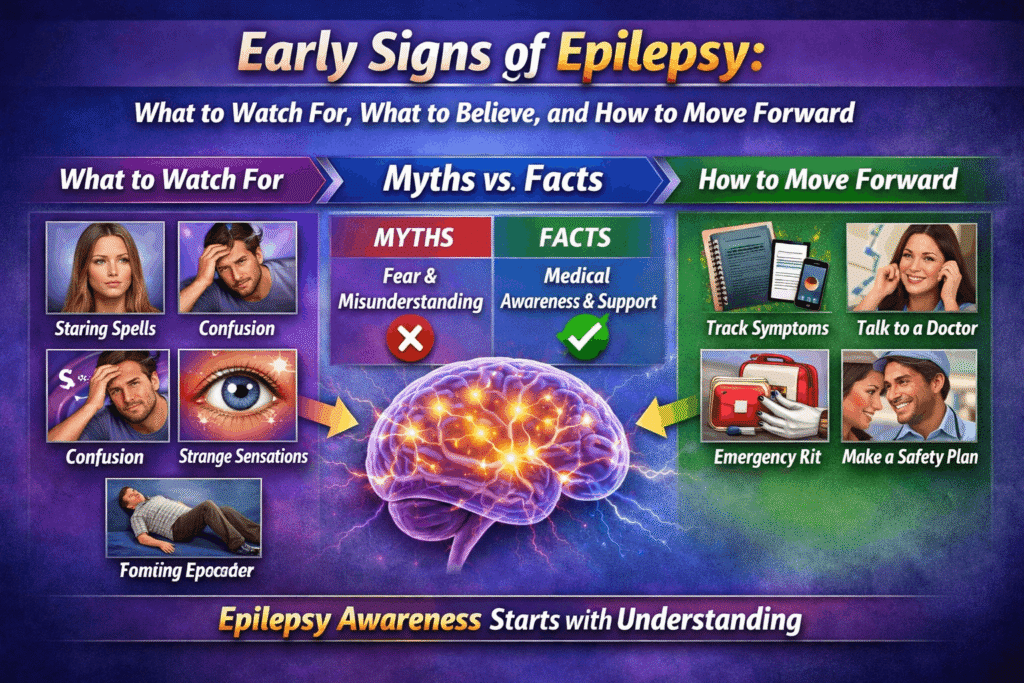

Most people picture a dramatic seizure when they hear the word “epilepsy” — someone falling, convulsing, losing consciousness completely. But the truth is far more nuanced. Epilepsy can begin quietly, with moments so brief and subtle that they are easily dismissed as tiredness, stress, or just “one of those days.” Recognising the early warning signs is not just medically useful; it can be genuinely life-changing. And yet, even after a diagnosis, many patients and families find themselves wading through misinformation, fear, and uncertainty about what life will look like going forward. This article cuts through that noise — covering real early symptoms, the myths that delay care, and what thoughtful, long-term management actually involves.
What Epilepsy Actually Feels Like in the Early Stages
Epilepsy is a neurological condition characterised by recurrent, unprovoked seizures. These seizures result from abnormal electrical activity in the brain — but not every seizure looks the same, and early-stage epilepsy is often mistaken for something else entirely.
Subtle Seizure Types That Often Go Unnoticed
Absence seizures, common in children, may appear as nothing more than a brief staring spell — perhaps five to fifteen seconds where the child seems to “switch off” mid-sentence. Teachers sometimes label these children as inattentive. Focal aware seizures (previously called partial seizures) can cause an unusual smell, a sudden wave of déjà vu, tingling in one limb, or an unexplained feeling of fear or stomach-churning. These episodes are over within seconds to a couple of minutes, and the person remains conscious, which makes them very easy to dismiss.
Physical Warning Signs Worth Taking Seriously
Some early signs have a physical quality that is harder to ignore. Myoclonic jerks — sudden, involuntary muscle twitches, particularly in the arms or shoulders — often occur just after waking up and are a hallmark early symptom in certain epilepsy syndromes like juvenile myoclonic epilepsy. Episodes of unexplained confusion, temporary memory gaps, or the feeling of “losing time” in the middle of a normal activity are also red flags that deserve proper investigation, not guesswork.
When to Seek Medical Attention
A single seizure is not automatically a diagnosis of epilepsy. However, any unexplained episode — whether it looks like a staring spell, an involuntary jerk, a temporary loss of awareness, or a full convulsive event — warrants prompt medical review. This is especially true if episodes are recurring, if they occur in children, or if there is a family history of neurological conditions.
Consulting an Experienced Neurologists in Nagpur early can make a significant difference in how accurately the condition is classified and how quickly appropriate treatment begins. Epilepsy has over forty recognised types, and the treatment path varies considerably depending on which type a patient has — which is why specialist evaluation matters so much.
Myths About Epilepsy That Cause Real Harm
Perhaps no other neurological condition carries as much misinformation as epilepsy. These myths don’t just cause embarrassment — they actively delay diagnoses, discourage treatment, and damage the quality of life for people who deserve proper care.
Myth: You Should Hold Someone Down During a Seizure
This is one of the most persistent and dangerous myths. Restraining someone having a convulsive seizure can cause injury to both the person and the bystander. The right response is to clear the area of hard objects, gently turn the person onto their side to protect the airway, cushion their head, and time the seizure. Only call emergency services if it lasts longer than five minutes or if the person does not regain consciousness.
Myth: Epilepsy Always Means Lifelong Disability
With appropriate treatment, around 70 percent of people with epilepsy can achieve good seizure control and lead full, active lives. Many children outgrow certain epilepsy syndromes altogether. The condition does require management, but it does not automatically preclude education, careers, relationships, or independence.
Myth: Anti-Epileptic Drugs Are Addictive or Harmful Long-Term
This belief leads many patients to discontinue medication without medical supervision — a decision that can trigger severe seizure recurrence or a life-threatening condition called status epilepticus. Anti-epileptic drugs (AEDs) are not addictive. Side effects do exist and vary by medication, but they are monitored and managed by a qualified neurologist. Stopping AEDs abruptly, on the other hand, poses very real risks.
Aftercare and Long-Term Management of Epilepsy
A diagnosis is just the starting point. Living well with epilepsy requires consistent aftercare, honest communication with your medical team, and a few lifestyle adjustments that become second nature over time.
Medication Adherence and Follow-Up
Taking medication at the same time every day is non-negotiable for most patients. Missing doses — even occasionally — can destabilise seizure control. Regular follow-up appointments allow the neurologist to monitor blood levels, check for side effects, assess whether the current medication dose is still appropriate, and adjust the treatment plan if needed. This is not a “set and forget” condition; it requires ongoing attention.
Sleep, Triggers, and Lifestyle Modifications
Sleep deprivation is one of the most well-documented seizure triggers. Maintaining a consistent sleep schedule is among the most straightforward and impactful things a person with epilepsy can do. Other common triggers include excessive alcohol consumption, high stress, illness with fever, and flashing lights in photosensitive individuals. Keeping a seizure diary — noting when episodes occur and what preceded them — helps identify personal triggers and gives the treating doctor valuable information.
For individuals seeking Expert Epilepsy Care, the goal is always a personalised plan that accounts for seizure type, age, lifestyle, comorbidities, and the patient’s own priorities — not a one-size-fits-all protocol.
Epilepsy in Children: Special Considerations for Parents
Children with epilepsy face unique challenges at school and socially, and parents often carry a heavy psychological burden alongside the medical one. Schools should be informed so that teachers can respond appropriately during a seizure and avoid unnecessary alarm. Children benefit enormously from being included in age-appropriate conversations about their condition — understanding what is happening to their body reduces fear and builds self-advocacy skills. Many children with well-controlled epilepsy participate fully in physical education, sports, and social activities with sensible precautions in place rather than blanket restrictions.
Conclusion
Epilepsy begins subtly more often than dramatically, and those early, easy-to-miss signs deserve attention rather than dismissal. Equally important is separating genuine medical guidance from the myths that still circulate in homes, schools, and even workplaces. Long-term management is not about restriction — it is about building a sustainable, informed routine that keeps seizures under control and life moving forward. If you or someone you care for has experienced unexplained episodes, recurring confusion, or any of the symptoms described here, speaking to an Epilepsy Treatment Doctor in Nagpur is a sensible and important next step. Early evaluation, accurate diagnosis, and the right treatment plan make all the difference.
Frequently Asked Questions
Can epilepsy begin in adulthood, or is it only a childhood condition?
Epilepsy can develop at any age. While certain syndromes are more common in childhood, many people are first diagnosed in their twenties, thirties, or even later in life. Stroke, head injury, brain tumours, and neurodegenerative conditions are all known causes of adult-onset epilepsy.
How is epilepsy diagnosed — is it just a brain scan?
Diagnosis involves a detailed clinical history, an electroencephalogram (EEG) to record brain electrical activity, and usually an MRI of the brain to look for structural causes. No single test is sufficient on its own; the clinical picture as a whole guides the diagnosis.
Are there non-medication treatments available for epilepsy?
Yes. For patients whose seizures are not adequately controlled by medication, options include epilepsy surgery, the ketogenic diet (particularly in children), vagus nerve stimulation, and responsive neurostimulation. The suitability of these options depends on the epilepsy type and individual patient factors.
Is it safe for someone with epilepsy to drive?
Driving regulations for people with epilepsy vary by country and state. In India, regulations require that a person be seizure-free for a defined period before obtaining or renewing a driving licence. Your neurologist can advise you specifically based on your seizure history and current control.
What should I do if I witness someone having a seizure for the first time?
Stay calm, note the time, protect the person from injury by clearing hard objects nearby, and gently roll them onto their side. Do not put anything in their mouth. Call emergency services if the seizure lasts longer than five minutes, if the person does not regain awareness, or if they are injured. Most seizures stop on their own within one to three minutes.
Source: Signs and Symptoms of Epilepsy