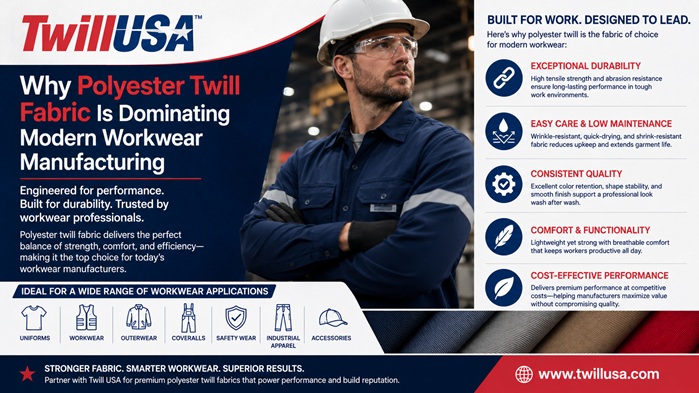

The modern workplace has changed dramatically over the last decade. Construction crews rely on high-performance uniforms under intense weather conditions. Warehouse teams need breathable yet durable apparel that can survive long shifts. Hospitality staff require polished workwear that looks professional hour after hour. Behind this transformation lies a fabric quietly redefining the standards of industrial apparel: polyester twill fabric.
Manufacturers are no longer choosing textiles based solely on appearance. Today’s workwear must balance durability, comfort, branding compatibility, and long-term cost efficiency. This is where polyester twill fabric has emerged as a dominant force across industries.
But what exactly makes this material so valuable in modern manufacturing? The answer goes far beyond simple durability.
The Engineered Strength Behind Modern Workwear
Workwear faces constant abuse. Repeated washing, exposure to dirt, friction from machinery, and outdoor conditions can quickly destroy low-quality materials. Traditional fabrics often fade, wrinkle, or lose structure over time.
Polyester twill fabric offers a different performance profile entirely.
The twill weave creates a diagonal rib pattern that strengthens the fabric while maintaining flexibility. This structure allows garments to resist tearing and abrasions without becoming stiff or uncomfortable. Workers in logistics, automotive, healthcare, and industrial sectors benefit from apparel that maintains its integrity after continuous use.
Manufacturers appreciate this reliability because it reduces product returns and extends garment lifespan. For businesses purchasing uniforms in bulk, durability directly affects operational costs.
Comfort Without Sacrificing Professional Appearance
One reason workwear has evolved is the growing focus on employee comfort. Modern professionals spend long hours in uniforms, making fabric feel just as important as functionality.
Unlike heavier traditional materials, polyester twill fabric provides a smoother surface and lighter feel while still retaining shape. It drapes cleanly, creating a sharp professional appearance suitable for both industrial and customer-facing environments.
Another major advantage is wrinkle resistance. Employees can move through demanding shifts while maintaining a polished look, reducing the need for constant ironing or garment replacement.
This balance between comfort and presentation has helped manufacturers expand workwear beyond utility into brand identity.
The Rise of Custom Branding in Workwear
Modern workwear is no longer just protective clothing—it is a marketing tool. Businesses increasingly use uniforms to strengthen brand recognition through embroidered logos, printed graphics, and customized designs.
This trend has accelerated demand for fabrics compatible with advanced decoration techniques.
Polyester twill fabric performs exceptionally well with modern printing and transfer methods, especially when paired with high-quality accessories for heat press applications. The fabric’s stable surface supports clean transfers, vibrant colors, and long-lasting graphics without excessive distortion.
For manufacturers, this compatibility streamlines production workflows. Heat press customization allows faster turnaround times while maintaining consistent branding quality across large orders.
As industries continue investing in branded uniforms, fabrics that support efficient customization naturally gain market dominance.
Moisture Resistance Improves Workplace Performance
Many work environments expose employees to heat, humidity, or physically demanding tasks. Fabrics that absorb excessive moisture can become heavy, uncomfortable, and unhygienic.
This is another area where polyester twill fabric outperforms traditional alternatives.
Its synthetic fibers help wick moisture away from the body while drying faster than many natural materials. Workers remain more comfortable throughout long shifts, particularly in active industries such as transportation, manufacturing, and food service.
From an operational perspective, faster drying times also simplify industrial laundering processes, allowing businesses to maintain uniform inventories more efficiently.
Sustainability Is Reshaping Textile Choices
Sustainability has become a major conversation in apparel manufacturing. Companies are under pressure to reduce waste while investing in longer-lasting products.
Because polyester twill fabric offers extended durability, garments require less frequent replacement. Many manufacturers are also incorporating recycled polyester fibers into twill production, helping reduce environmental impact without compromising performance.
This combination of longevity and recyclability aligns with modern sustainability goals while still meeting industrial demands.
The result is a fabric solution that satisfies both operational efficiency and environmental responsibility.
Why Manufacturers Continue Choosing Twill-Based Solutions
The dominance of polyester twill fabric is not driven by a single feature. It is the result of multiple advantages working together:
- High durability under demanding conditions.
- Wrinkle resistance for professional appearance.
- Comfort during extended wear.
- Moisture management capabilities.
- Excellent compatibility with accessories for heat press customization.
- Cost-effective long-term performance.
- Adaptability across industries.
Manufacturers value materials that simplify production while delivering dependable results for clients. Twill-based polyester continues to meet those expectations consistently.
The Future of Workwear Manufacturing
As technology and workforce expectations evolve, workwear will continue moving toward smarter, stronger, and more adaptable textiles. Businesses now expect uniforms to function as protective gear, branding tools, and comfort-focused apparel simultaneously.
In this competitive environment, accessories for heat press has positioned itself as more than just a textile trend. It has become the foundation of modern workwear manufacturing.
From industrial floors to customer-facing service environments, its combination of resilience, appearance, and customization potential makes it one of the most practical fabric choices available today.
The future of workwear is being stitched together with performance-driven materials, and polyester twill fabric is leading the way.