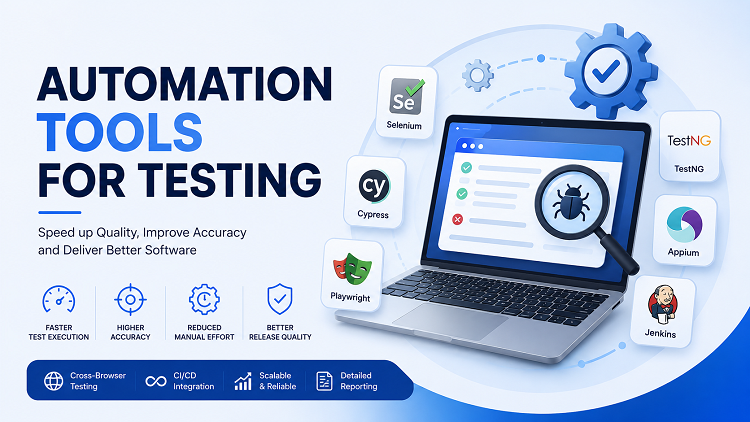

In today’s fast-paced software development environment, delivering high-quality applications quickly has become a top priority for businesses. Manual testing alone is often insufficient to meet the growing demands of modern development cycles. This is where automation tools for testing play a crucial role. By automating repetitive testing tasks, organizations can improve software quality, reduce testing time, and accelerate product releases.
As companies increasingly adopt Agile and DevOps methodologies, test automation has become an essential component of the software development lifecycle. Automation testing tools help teams identify defects early, ensure application stability, and deliver a better user experience.
What Are Automation Tools for Testing?
Automation tools for testing are software solutions designed to execute test cases automatically, compare actual outcomes with expected results, and generate detailed reports. These tools reduce the need for manual intervention, making the testing process faster, more accurate, and more reliable.
Test automation can be applied to various types of testing, including:
- Functional Testing
- Regression Testing
- Performance Testing
- Load Testing
- API Testing
- Mobile Application Testing
- Cross-Browser Testing
By automating repetitive tasks, testing teams can focus on more complex scenarios that require human judgment and creativity.
Why Businesses Need Automation Testing
Modern applications undergo frequent updates and feature enhancements. Testing every change manually can be time-consuming and prone to human error. Automation testing addresses these challenges by providing consistent and repeatable testing processes.
Faster Testing Cycles
Automated tests can run significantly faster than manual tests. This allows development teams to receive feedback quickly and resolve issues before deployment.
Improved Accuracy
Manual testing may result in mistakes due to repetitive execution. Automated testing ensures consistent execution of test cases, reducing the risk of errors.
Cost Savings
Although initial setup requires investment, automation significantly reduces long-term testing costs by minimizing manual effort and increasing productivity.
Better Test Coverage
Automation tools can execute thousands of test cases across multiple environments, devices, and browsers, ensuring comprehensive coverage.
Continuous Integration Support
Automation testing integrates seamlessly with Continuous Integration and Continuous Deployment (CI/CD) pipelines, enabling faster and more reliable software releases.
Popular Automation Tools for Testing
Several automation tools are widely used by software development teams worldwide. Each offers unique features and benefits depending on project requirements.
Selenium
Selenium is one of the most popular open-source automation testing frameworks. It supports multiple programming languages and browsers, making it a preferred choice for web application testing.
Cypress
Cypress is a modern testing framework designed specifically for web applications. It offers fast execution, real-time reloading, and detailed debugging capabilities.
Playwright
Playwright enables end-to-end testing across multiple browsers, including Chromium, Firefox, and WebKit. It is known for its reliability and advanced automation features.
Appium
Appium is widely used for mobile application testing. It supports both Android and iOS platforms, allowing testers to automate mobile app functionality efficiently.
JMeter
Apache JMeter is a popular performance testing tool used to evaluate application speed, scalability, and reliability under varying workloads.
Key Benefits of Test Automation Tools
Increased Productivity
Automation reduces repetitive manual work, allowing testing teams to focus on strategic quality assurance activities.
Early Bug Detection
Automated tests can be executed frequently throughout development, helping identify and resolve defects before they impact users.
Reusable Test Scripts
Automation frameworks allow teams to reuse test scripts across multiple projects, improving efficiency and reducing maintenance efforts.
Enhanced Reliability
Automated tests execute the same steps consistently every time, ensuring reliable and predictable testing results.
Faster Time-to-Market
By accelerating testing processes, organizations can release products more quickly and respond faster to market demands.
Best Practices for Implementing Test Automation
To maximize the benefits of automation tools for testing, organizations should follow industry best practices:
Define Clear Objectives
Identify which testing activities should be automated and establish measurable goals for automation initiatives.
Select the Right Tool
Choose automation tools based on project requirements, technology stack, team expertise, and budget considerations.
Prioritize Regression Testing
Regression testing often provides the highest return on investment because it involves repetitive test execution.
Maintain Test Scripts
Regular updates and maintenance ensure automated test scripts remain effective as applications evolve.
Integrate with CI/CD Pipelines
Connecting automation testing with CI/CD workflows enables continuous testing and faster feedback loops.
Future Trends in Test Automation
The future of software testing is being shaped by emerging technologies and intelligent automation solutions.
Artificial Intelligence and Machine Learning
AI-powered testing tools can automatically generate test cases, predict defects, and improve test maintenance efficiency.
Shift-Left Testing
Organizations are increasingly adopting shift-left testing approaches, integrating testing earlier in the development process.
Cloud-Based Testing
Cloud testing platforms provide scalable environments for automated testing across different devices and browsers.
Low-Code and No-Code Automation
Modern automation platforms enable testers with limited programming knowledge to create automated test workflows efficiently.
Conclusion
Automation testing has become a critical component of modern software development. By leveraging advanced automation tools for testing, organizations can improve software quality, accelerate release cycles, reduce costs, and enhance customer satisfaction.
As technology continues to evolve, businesses that invest in effective test automation strategies will be better positioned to deliver reliable applications and maintain a competitive advantage. Choosing the right automation tools and implementing best practices can significantly improve testing efficiency and contribute to long-term software success.
Read more: What’s the Difference Between Ratings and Reviews?