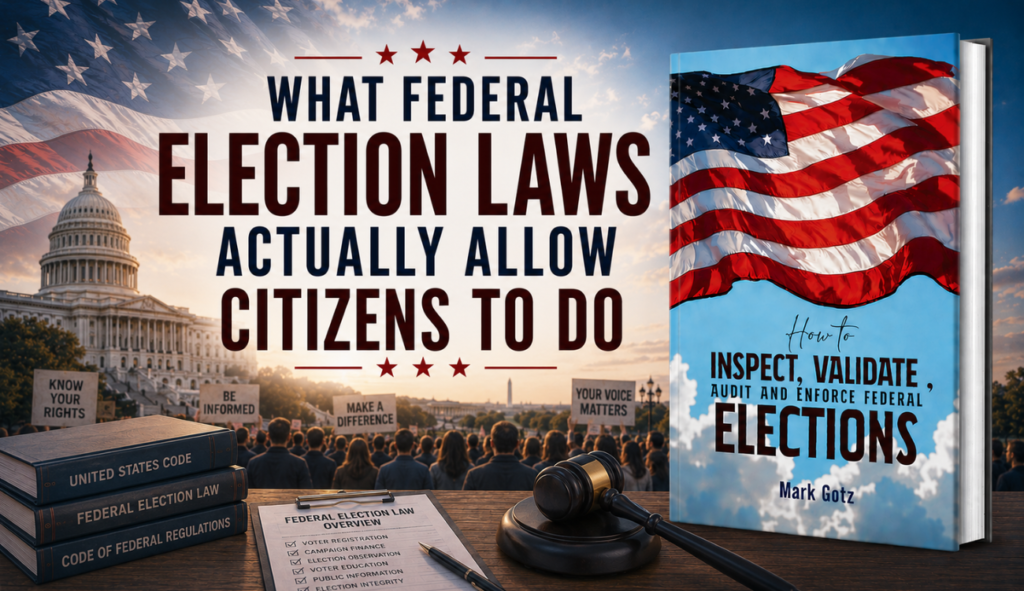

Most Americans assume election oversight belongs exclusively to government officials, attorneys, or political organizations.
But according to author Mark Gotz, federal law tells a more complicated story.
In How to Inspect, Validate, Audit, and Enforce Federal Elections, Gotz explores a little-discussed aspect of election law that many citizens may not fully understand: the legal authority ordinary Americans already possess to observe, inspect, question, and challenge certain election procedures.
The book argues that citizen involvement in election oversight is not simply tolerated under federal law.
In many ways, it is anticipated by it.
This perspective forms one of the book’s central themes.
Throughout the work, Gotz examines federal statutes such as the National Voter Registration Act of 1993 (NVRA) and the Help America Vote Act of 2002 (HAVA), highlighting provisions that establish public inspection rights, complaint procedures, and opportunities for citizen participation in election oversight processes.
Rather than presenting election law as something distant or inaccessible, the book attempts to make these legal frameworks understandable for ordinary readers.
The tone remains educational throughout.
Complex statutes are translated into practical explanations.
Procedures are broken down step by step.
And legal concepts are presented in language designed for citizens rather than specialists.
This accessibility gives the work much of its appeal.
Many Americans hear references to election laws during political debates, but few have the opportunity to explore how those laws function operationally. Gotz focuses specifically on that operational side—what records can be reviewed, how voter registration systems are maintained, how complaints may be filed, and what oversight mechanisms exist within federal election law itself.
Again and again, the author returns to one important point:
Citizens are not merely observers of democracy.
They are participants in maintaining it.
That idea shapes much of the discussion surrounding transparency and accountability.
The book explains that federal election laws require states to preserve certain records, maintain accurate voter registration systems, and make portions of election-related information available for public inspection. These requirements, according to Gotz, are designed to strengthen public confidence by ensuring elections remain open to lawful review.
For many readers, this may be unfamiliar territory.
Election systems often appear highly technical and institutionally controlled, leading citizens to assume they have little direct involvement beyond casting a ballot. The book challenges that assumption by outlining the rights and responsibilities citizens already possess under existing law.
That educational focus becomes especially significant in the context of growing public debate surrounding election integrity and transparency.
Across the country, citizens increasingly want to understand not only election outcomes, but also the systems producing those outcomes. Questions about voter registration accuracy, ballot verification procedures, chain-of-custody protocols, and audit mechanisms have become part of mainstream civic conversation.
The book addresses those questions through a legal and procedural lens rather than a partisan one.
This measured approach gives the material a notably civic tone.
The emphasis is not on confrontation.
It is on understanding.
Readers are encouraged to familiarize themselves with election procedures, public documentation requirements, and lawful oversight opportunities in ways that strengthen transparency rather than deepen division.
The discussion surrounding complaint procedures is particularly notable.
Gotz explains that both the NVRA and HAVA include provisions allowing citizens to file complaints or pursue legal remedies when election laws are believed to have been violated. While the book is careful not to position itself as legal advice, it highlights the fact that federal law recognizes the public’s role in ensuring accountability within election systems.
That recognition, according to the author, is foundational to representative government.
Democratic systems function best when citizens remain informed and engaged with the institutions operating in their name. Oversight is presented not as interference, but as part of the balance between public authority and public accountability.
There is also a broader philosophical dimension beneath the procedural discussions.
The book repeatedly emphasizes that rights within a democracy carry corresponding responsibilities. If citizens want trustworthy systems, the author suggests, they must be willing to understand how those systems operate and participate constructively in maintaining transparency.
That participation may take many forms:
Reviewing public records.
Observing procedures.
Learning election laws.
Asking informed questions.
Remaining civically engaged beyond Election Day itself.
The writing consistently frames these actions as part of democratic stewardship rather than political conflict.
Ultimately, How to Inspect, Validate, Audit, and Enforce Federal Elections seeks to shift how readers think about election oversight entirely.
Not as something reserved exclusively for institutions.
But as something in which citizens already possess both legal standing and civic responsibility.
And in an era where public confidence in institutions continues to face increasing scrutiny, that message may resonate far beyond election law alone.
For more information about How to Inspect, Validate, Audit, and Enforce Federal Elections or to schedule an interview with Mark Gotz, please contact:
Media Contact:
Author: Mark Gotz
Amazon: How to Inspect, Validate, Audit, and Enforce Federal Elections: An Educational Pamphlet for Citizens
Email: theelectionexpert@gmail.com
About Mark Gotz:
Mark Gotz has spent more than two decades involved in election observation, public oversight efforts, and civic education related to federal election systems and procedures. His work focuses on transparency, accountability, and helping citizens better understand their role within democratic governance.